Abdul Samad Tariq ISLAMABAD, Sep 14 (APP):Islamabad is to get its first integrated water, sewerage and stormwater management plan with a 2050 horizon, in a move that could determine how the capital meets its growing water needs, tackles recurring urban flooding and manages wastewater over the next quarter of a century. The plan will assess everything from potential new water sources and leaking supply lines to sewage treatment, stormwater drainage …
Abdul Samad Tariq
ISLAMABAD, Sep 14 (APP):Islamabad is to get its first integrated water, sewerage and stormwater management plan with a 2050 horizon, in a move that could determine how the capital meets its growing water needs, tackles recurring urban flooding and manages wastewater over the next quarter of a century.
The plan will assess everything from potential new water sources and leaking supply lines to sewage treatment, stormwater drainage and digital metering, according to details shared with APP by CDA Director General Water Management Sardar Khan Zimri in an exclusive interview.

The initiative assumes added significance for residents as Islamabad’s population and built-up areas continue to expand while existing water infrastructure ages and rainfall patterns become increasingly erratic. Its stated objective is to replace individual, short-term schemes with a single framework for planning and investment in the capital’s water cycle.
The Capital Development Authority (CDA) and Japan International Cooperation Agency (JICA) have agreed on a 36-month technical cooperation project to prepare the plan. The project is tentatively scheduled to start in March 2027.
A major part of the exercise will be a fresh assessment of Islamabad’s potential water sources. Proposed schemes involving Tarbela, Chinot, Shahdara, Dotara and Chirah dams will be examined for water availability, quality, reliability, climate vulnerability, environmental and social impacts and indicative costs.
This assessment could have a direct bearing on the future availability and cost of water for the capital, particularly as demand increases and existing sources come under greater pressure.
The study will also examine the complete supply chain — abstraction, treatment, transmission, storage and distribution — along with leakage, non-revenue water, water quality and the management and financial sustainability of Islamabad Water.
The emphasis on leakage and non-revenue water is particularly significant because improving the efficiency of the existing network can potentially increase available supply without relying entirely on expensive new sources.
For residents facing flooded roads and disrupted movement after intense rainfall, stormwater management will be another critical component.
The plan will map natural streams, existing drains and stormwater infrastructure and identify areas vulnerable to flash floods and localised urban flooding. Priority interventions will then be proposed.
The approach is intended to shift the city towards planned flood-risk management rather than relying primarily on emergency measures after heavy rainfall.
The master plan will also assess the capital’s sewered and non-sewered areas, wastewater collection and treatment, decentralised systems, on-site sanitation and faecal-sludge management.
Treated wastewater reuse and aquifer recharge will be examined as possible measures to conserve freshwater resources, while better wastewater management could help reduce pollution and public-health risks.
The plan is also expected to lay out a digital transformation roadmap for Islamabad Water, potentially covering smart meters, automated meter reading, digital billing, customer and asset management, leakage detection, water-quality monitoring and a more effective complaints system.
Pilot interventions could include monitoring water pressure, flow and supply hours, improving customer records and identifying leaks across the network.
The possibility of gradually introducing a metered tariff will also be studied, with affordability and protection of vulnerable consumers to be considered.
Climate resilience will be built into the 2050 strategy through possible diversification of water sources, demand management, treated wastewater reuse, watershed management, aquifer recharge and nature-based solutions.
Energy-efficient pumping, gravity-based water systems and renewable-energy options will also be examined where feasible.
The plan will cover all five zones of Islamabad Capital Territory. Detailed facility planning will be undertaken for Zone 1, while strategic assessments will be conducted for Zones 2 to 5.
Zimri told APP that the exercise was being designed as a joint process involving CDA, Islamabad Water and the Japanese technical team, rather than simply producing a report for the authority.
The intention is also to strengthen the capacity of local institutions to implement the recommendations after the JICA project ends.
A Joint Coordination Committee headed by CDA Chairman and Islamabad Chief Commissioner Sohail Ashraf will oversee the project. Wapda, the Ministry of Water Resources, PCRWR, WASA Rawalpindi, the Small Dams Organisation, Punjab irrigation authorities, the Rawalpindi Cantonment Board, Defence Housing Authority, private developers and other relevant departments are expected to participate.
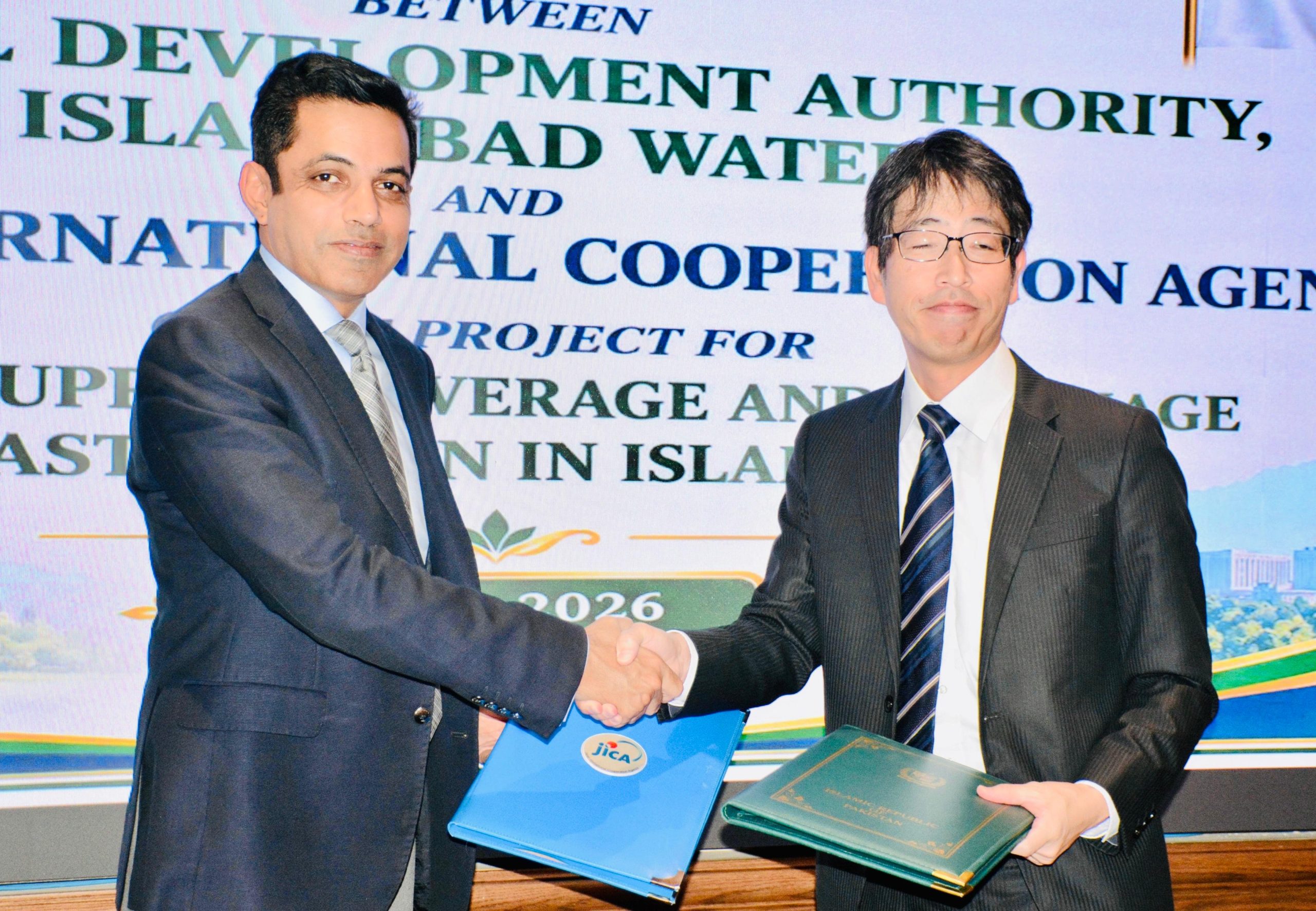
The agreement was signed by CDA Chief Sohail Ashraf and JICA Detailed Planning Survey Team leader Miyagawa Masahito at CDA headquarters. It followed a JICA planning survey conducted from Aug 24 to Sept 14, during which the Japanese team consulted the CDA, Islamabad Water and other relevant organisations.
The project also envisages about three training programmes in Japan, each lasting around 14 days, for approximately five Pakistani participants, subject to final arrangements.
The draft Record of Discussions is expected to be finalised and signed in late November after completion of the required procedures.
Ultimately, the master plan is expected to identify priority projects, estimated costs, responsible agencies, financing options and implementation schedules, potentially opening the way for government investment as well as bilateral and multilateral development assistance and private-sector participation.
For Islamabad’s residents, however, the significance of the 2050 plan will be measured less by the document itself than by what follows it: whether new water sources are secured before shortages intensify, whether leakage and wastage are reduced, whether sewage is safely treated and reused, and whether the capital’s drainage network is upgraded before increasingly intense rainfall turns recurring flooding into a permanent urban problem.