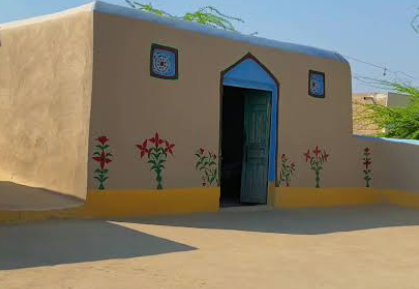
For generations, the humble mud house was more than a shelter in the villages of South Punjab. Built with clay, timber and the skilled hands of local craftsmen, it was part of a way of life closely connected with the land, seasons and traditional rural culture across the region.
Mud houses era fades into history in South Punjab
Muhammad Atif Ismail
MULTAN, Sept 13 (APP)::For generations, the humble mud house was more than a shelter in the villages of South Punjab. Built with clay, timber and the skilled hands of local craftsmen, it was part of a way of life closely connected with the land, seasons and traditional rural culture across the region.
Today, however, the mud house is becoming increasingly rare.
Over the past nearly three decades, South Punjab has witnessed a visible change in its rural settlements. Brick and concrete houses have steadily replaced the traditional mud structures, while the skills, materials and customs associated with their construction are also disappearing.
Elderly residents recall a time when building a mud house was a familiar part of village life. Good-quality clay was collected, prepared and carefully worked before being applied to walls. Women played an important role in maintaining and finishing the houses, particularly through the traditional practice of plastering and smoothing the clay walls.
But both the material and the people who knew the craft are now becoming difficult to find even the rural areas.
According to Muhammad Shafiq, a village elder and resident of Syed Wali Khoi, mud houses required considerable effort to maintain, particularly before the rainy season every year.
“The walls were polished with specially prepared clay. The clay was cleaned and filtered to make a smooth mixture, which was then applied to the walls,” he said, adding that the clay-colored finish gave the houses a distinctive natural beauty.
The roofs also reflected the traditional knowledge of rural communities. Wooden beams and other timber supports were commonly used, while roofs were repaired and strengthened before the monsoon. Drainage arrangements, including traditional outlets and channels, helped manage rainwater.
In many old houses, wooden roof beams can still be seen, silently carrying memories of a construction tradition that has largely disappeared.
Another traditional style, locally associated with roofs made from wooden “ballas”, has also become uncommon. The availability of suitable timber has declined as many trees have been cut over the years, while modern construction materials have become easier and more practical for most families.
The mud house also offered a natural response to the region’s harsh climate. Its thick clay walls helped moderate indoor temperatures, keeping rooms relatively cooler during the intense summer heat and warmer during colder periods.
The traditional house was, in many ways, built around the environment rather than separated from it.
Yet the changing lifestyles, aspirations and construction practices have made brick, cement and concrete the preferred choices for most families. New generations increasingly associate a modern house with permanent brick walls, concrete roofs and improved facilities.
Muhammad Liaqat, another elderly resident, said the change had become so complete that many young people had never experienced life inside a traditional mud house.
“Our children now live in brick houses. They hardly know what a mud house was like,” he said. “If a mud room is found somewhere today, it is usually a structure built many years ago.”
The decline of mud houses has also affected a small but important community of craftsmen who once specialized in building and repairing these traditional mud-based houses.
As modern construction replaces mud walls, their traditional skills are gradually losing demand, along with a craft that was once an essential part of village life.
Mason Khalid told APP that the people no longer approached him to construct traditional mud
houses.
“We do not take this work anymore because our experience is mainly in brick and concrete construction. If we were asked to build a mud house today, it would be difficult for us because the traditional techniques are no longer part of our regular work,” he said.
The disappearance of these houses therefore represents more than a change in building material. It marks the gradual loss of a body of traditional knowledge how to select and prepare clay, how to build walls, how to support roofs with timber, how to protect structures before the rains and how to maintain them with locally available
materials.
For South Punjab, where summers can be extremely hot, the traditional mud house also offers an interesting lesson in climate-sensitive architecture. Long before modern discussions about energy efficiency and sustainable construction, rural communities were using locally available materials to create homes that responded naturally to the weather.
This does not mean that modern construction should be rejected. Brick and concrete houses provide durability, security, sanitation and facilities that many rural families understandably seek. The change is also part of broader social and economic development.
But preserving the memory and knowledge of mud-house construction remains important.
Old mud houses, wooden beams, traditional roofs and the skills of the craftsmen who once built them are part of South Punjab’s cultural landscape. Even where the houses themselves cannot be preserved, their construction techniques, stories and terminology can be documented for future generations.
The mud house can no longer dominate the villages of South Punjab, but its walls once carried more than a roof. They carried the relationship between people, clay, trees, seasons and community, a quiet architectural expression of a rural culture that is changing with every passing generation.
Behind those walls lived memories of childhood, family gatherings, summer nights and winters spent close to the warmth of loved ones. Today, as these houses slowly disappear, their walls may fall silent, but the stories they carried remain etched in the changing landscape of South Punjab.