ISLAMABAD, Sep 10 (APP):Chinese leader Mao Zedong was on Thursday remembered for his role in building modern China and laying the foundations of enduring Pakistan-China friendship, as speakers at a ceremony marking his 50th death anniversary praised his political legacy and Pakistan-China Institute Chairman Senator Mushahid Hussain Sayed reaffirmed that China remains the “pivot” of Pakistan’s foreign policy. The ceremony, organised by the Pakistan-China Institute, was attended by parliamentarians, policymakers, …
Mao hailed as architect of Pak-China friendship on 50th death anniversary
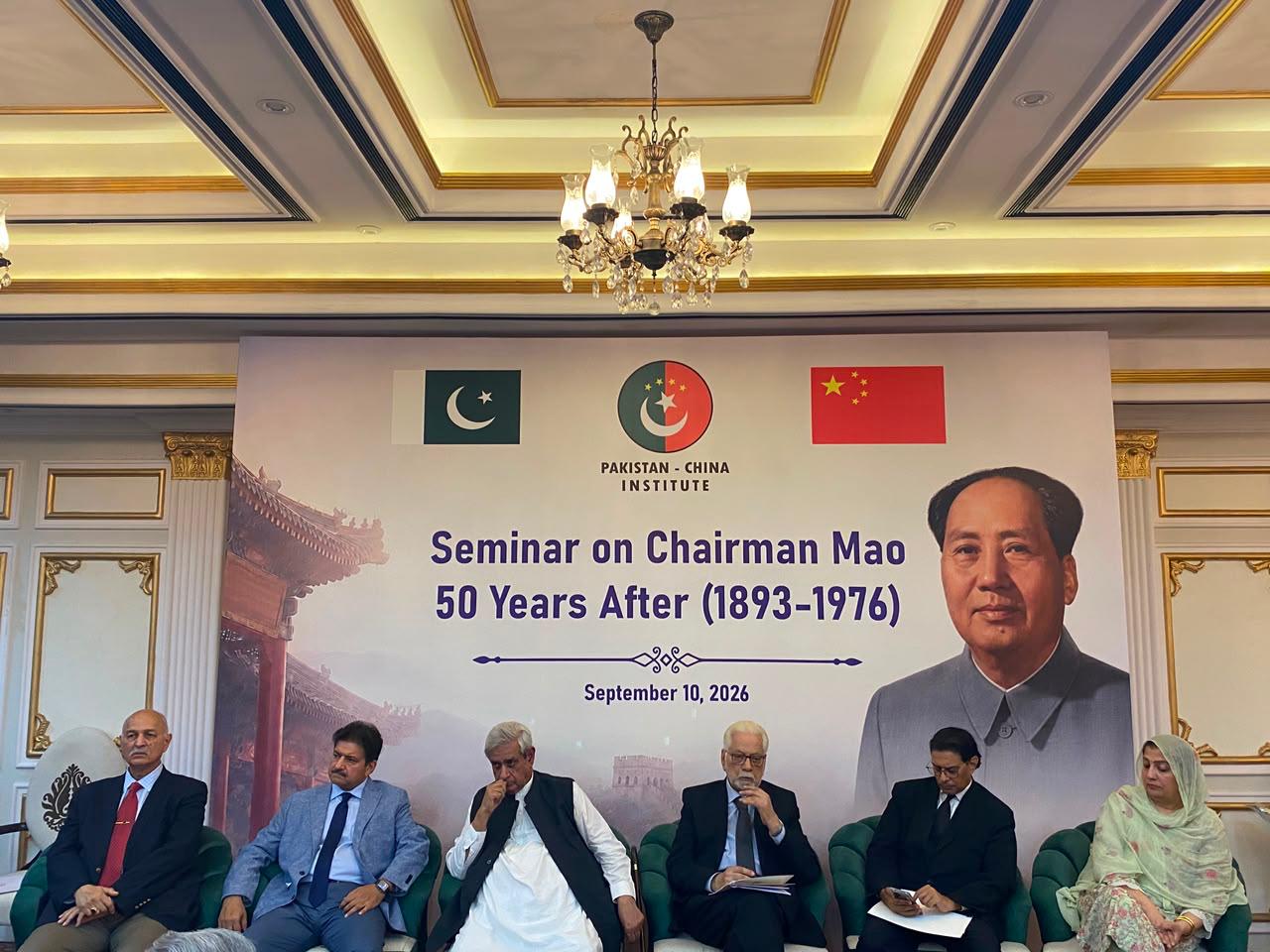
ISLAMABAD, Sep 10 (APP):Chinese leader Mao Zedong was on Thursday remembered for his role in building modern China and laying the foundations of enduring Pakistan-China friendship, as speakers at a ceremony marking his 50th death anniversary praised his political legacy and Pakistan-China Institute Chairman Senator Mushahid Hussain Sayed reaffirmed that China remains the “pivot” of Pakistan’s foreign policy.
The ceremony, organised by the Pakistan-China Institute, was attended by parliamentarians, policymakers, diplomats, business leaders, students and scholars.
Former National Assembly speaker Syed Fakhar Imam was the chief guest, while former foreign minister and ambassador to China Inamul Haq presided over the event.
Prominent journalist Hamid Mir and lawyer Salman Akram Raja also spoke at the gathering, while Senator Sitara Ayaz delivered the vote of thanks.
In his keynote address, Senator Mushahid Hussain described Mao as one of the three “historical giants” of the 20th century who, through their leadership and vision, shaped the course of history.
The other two, he said, were Russian revolutionary Vladimir Lenin and Pakistan’s founder, Quaid-i-Azam Mohammad Ali Jinnah.
Terming Mao the “builder of new China”, Senator Mushahid said that during nearly a quarter-century of his leadership, Mao transformed Chinese society by ending feudal structures, expanding education, improving life expectancy, advancing women’s rights and developing the country’s scientific and technological capabilities.
He said Mao had laid the foundations of the China that subsequently emerged as a peaceful, prosperous and powerful country.
Senator Mushahid also described Mao as an “architect” of Pakistan-China friendship, saying the Chinese leader had extended full support to Pakistan during the 1965 war with India.
He said Mao had also supported causes including Kashmir and Palestine, besides backing liberation movements in Africa.
Highlighting three decisive moments in Mao’s leadership, Senator Mushahid said the first came in 1935 when Mao led the Long March, helping preserve the Communist Party and the People’s Liberation Army.
The second, he said, was the Cultural Revolution launched in 1966, which Mao initiated amid concerns that China’s political system was becoming corrupted and could eventually face a fate similar to that of the Soviet Union.
The third, he said, was Mao’s diplomatic opening to the United States in 1971, which altered the global strategic balance by separating Washington from Moscow and preventing the two powers from joining forces against China.
Other speakers paid tribute to Mao as a revolutionary, thinker and philosopher, describing him as a selfless patriot whose political focus remained centred on the welfare of the Chinese people.
Mr Fakhar Imam praised China’s governance model and said peace and political stability had been important factors behind the country’s rapid economic development.
Ambassador Inamul Haq highlighted Chinese diplomacy under Mao, describing it as a beacon of hope for developing countries and saying China had played a pivotal role in the emergence of the Third World and the Global South.
Senator Sitara Ayaz highlighted Mao’s contribution to advancing the rights of Chinese women, saying their empowerment had enabled them to become equal partners in China’s subsequent economic and social development.
The speakers reaffirmed the importance of Pakistan-China relations and agreed that China remains central to Pakistan’s foreign policy.
The event was attended by people from various walks of life, including parliamentarians, diplomats, policymakers, business representatives, students and members of academia.