The FO spox said that there was no blanket decision from the government to deport all Afghan students and those enrolled in a valid degree program and holding a valid visa were permitted to stay and complete their education.
Makkah Agreement a defensive alliance; expansion not yet on cards: FO spox
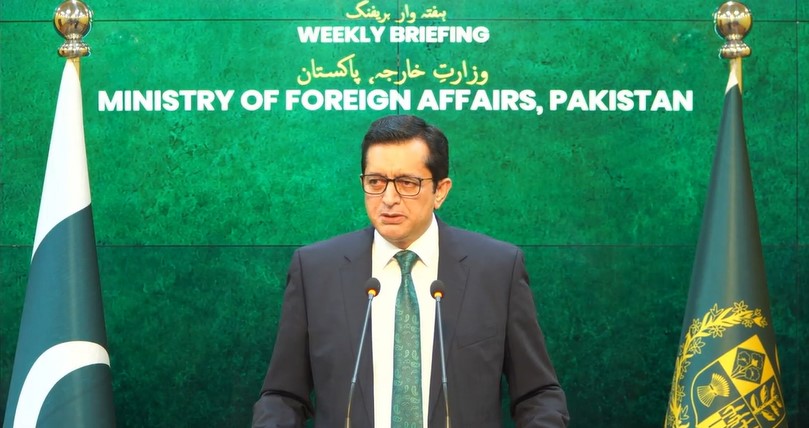
ISLAMABAD, Sep 10 (APP): Pakistan on Thursday calling the Makkah Joint Defence Agreement a “defensive alliance” said that the expansion of the pact was not yet on the cards, as the member states have to first consolidate their own framework.
“This is a defensive alliance of the countries which feel that the security of the region has to be protected through deterrence basically… As of now, expansion of the Makkah Agreement is not on the cards because first they have to solidify their own organisation. And then, of course, it will be open for all countries who hold similar views and perceptions and requirements,” Foreign Office spokesperson Sajjad Haider Khan said at his maiden weekly press briefing after he assumed the office of the spokesperson, replacing Ambassador Tahir Andrabi.
He said the signatory countries of the Makkah pact, including Pakistan, Turkey and Saudi Arabia, were holding frequent meetings and consulting at different levels and that any expansion would be decided by the three countries subsequently.
“So at this stage, it is not being discussed,” he remarked, saying that the pact’s primary objective was to strengthen regional peace and stability besides strengthening many aspects of existing long-term relationships and defence cooperation.
To a question about the repatriation of Afghan students from Pakistan, he said that there was no blanket decision from the government to deport all students and that students enrolled in a valid degree program and holding a valid visa were permitted to stay and complete their education.
Regarding CASA-1000 and other major connectivity projects, spokeperson Khan said that the primary challenge remained that the current Afghan regime must address Pakistan’s security sensitivities concerning cross-border terrorism. Once terrorist threats subside, normal bilateral and economic relations can flourish, enabling these major regional energy and transit projects to move forward.
About the demolition of mosques in India, he said Pakistan expressed deep concern and strongly condemned the systematic and state-sanctioned demolition of Islamic holy places in India, which directly breached the 1950 Liaquat-Nehru Pact as well as India’s own laws, particularly the Places of Worship Act, 1991, mandating that the religious character of a place of worship should be maintained.
He said that the Hindutva-driven Islamophobic campaign has posed an imminent threat resulting in the destruction of centuries-old heritage sites and places of worship, adding that the demolition of the historic Babri Mosque in 1992 remained a dreadful memory of this ideology of religious intolerance, prejudice, and hatred.
The spokesperson called upon the international community to take immediate notice of the systematic persecution taking place against Muslims in India, as well as the continued desecration and destruction of their places of worship.
About the affidavit submitted by the Hurriyat leader Yasin Malik, in connection with the trumped-up charges dating back to 1990, he said that the stance taken by him was beyond an act of heroism, which was a damning indictment of the Indian judicial system, striking a stinging blow to the judicial sham that the Indian government wanted to stage in its sinister campaign to malign the Kashmiri leadership.
He reiterated that Pakistan would continue to raise his case and the human rights situation in the Indian Illegally Occupied Jammu and Kashmir at all international fora as the right of the Kashmiri people to self-determination, as enshrined in the UN Security Council resolutions, cannot be diminished by Indian state oppression.
To a query about the 25th anniversary of 9/11, he said that the incident had changed the whole paradigm of international cooperation, following which Pakistan played a monumental counter-terrorism role, sacrificing over 80,000 lives and suffering around $150 billion in economic losses and till continued to face the threat of terrorism.
“These are largely instigated by India… While India continues to raise the bogey of terrorism against Pakistan and claims that terrorism originates from here, the factual situation on the ground is that India is heavily involved in terrorist activities across nearly all parts of Pakistan, particularly in Khyber Pakhtunkhwa and Balochistan through its state networks. A living example is Kulbhushan Jadhav, who has been in our custody since 2016,” he remarked.
The spokesperson said that the state-sponsored terrorism needed to be addressed —not only in our region, but globally, including in Europe, Canada, and the USA, where India’s footprint of sponsoring targeted actions has been documented on record.
Calling Kashmir an internationally recognised dispute, he said that the United Nations’ maps presented on its website testified to the fact.
He said that India was trying to portray it falsely and illegally as part of India, which was unacceptable not only to Pakistan but also to the international community, as there were more than a dozen UN Security Council resolutions still pending clearly stating that the final disposition has to be decided by the people through a plebiscite under the auspices of the UN.
Asked about the added deployment of troops in IIOJK, he said that every seven persons were monitored by a policeman or military soldier, and that the primary objective has been to suppress the Kashmiri people so that they stop asking for their right to self-determination.
Discussing the Houthi attacks on Saudi Arabia, Spokesperson Khan said that Pakistan strongly condemned the reprehensible attacks targeting civilian and economic sites in Abha, Khamis Mushait, Jazan and Najran, and was also desirous of peace and stability in Yemen and continued to support all international efforts in this regard.
He reiterated Pakistan’s unwavering support for the sovereignty, territorial integrity, security, and prosperity of the Kingdom of Saudi Arabia as the country continued to pursue dialogue and diplomacy for peace and stability in the broader region.
About the repatriation of illegal foreign nationals, he said that since the implementation of the policy, a large number have returned; however, over a million individuals remained in various parts of Pakistan.
He reiterated that Pakistan desired a peaceful and stable Afghanistan but Afghanistan must address its serious security concerns by curbing terrorist elements operating from Afghan territory who carried out attacks in Pakistan.
He told the media that recently, 25 Pakistani prisoners were released by India, and Pakistan also released Indian prisoners—over 400 in the last two years alone upon completion of their sentences.
Clarifying rumours regarding UAE visa policy, he said that the number of visas issued by the UAE to Pakistani citizens annually far exceeds the number of repatriations.
He said that approximately 7,000 to 8,000 Pakistanis are repatriated annually due to visa overstays, employment issues, or petty violations while around 40,000 to 50,000 Pakistanis receive work visas for the UAE every year. The issuance rate is seven to eight times higher than the repatriation rate.
Highlighting the diplomatic engagements during the previous week, the spokesperson mentioned Prime Minister Shehbaz Sharif’s official visit to Kyrgyzstan, where the two nations signed 17 agreements and MoUs to boost cooperation in defense, trade, energy—including CASA-1000—and regional connectivity. Concurrently, Deputy Prime Minister and Foreign Minister Senator Ishaq Dar held talks with counterparts including those from Saudi Arabia, Turkiye, Egypt, Kuwait, and Norway, as well as OIC Secretary-General and UN Secretary-General candidate Olara Otunnu.
He rejected the false and politically motivated assertions made by the Indian Ministry of External Affairs regarding the Hindu temple at Adda Siraj, Narowal, which was damaged on 21 July 2026 due to torrential rains, following which local authorities surveyed the damage and initiated measures for restoration.
The spokesperson announced that Pakistan would host the 14th South Asian Games from April 4 to 11, 2027, with competitions being held across Islamabad, Punjab and Khyber Pakhtunkhwa. The eight-day event will feature 28 sports and is expected to attract over 6,000 athletes and officials from across South Asia, he added.