ISLAMABAD, Sep 10 (APP):Federal Minister for Planning, Development and Special Initiatives Professor Ahsan Iqbal on Thursday said comprehensive tax reforms, resource mobilization and digitalization were essential to provide the financial engine for achieving the targets of Uraan Pakistan and transforming the national economy. Chairing a meeting on the National Economic Mission of Uraan Pakistan concerning tax reforms and digitalization, he said Mission-2, tax reforms and resource mobilization, was one of …
Ahsan stresses tax reforms, digitalization to fuel Uraan Pakistan’s economic transformation
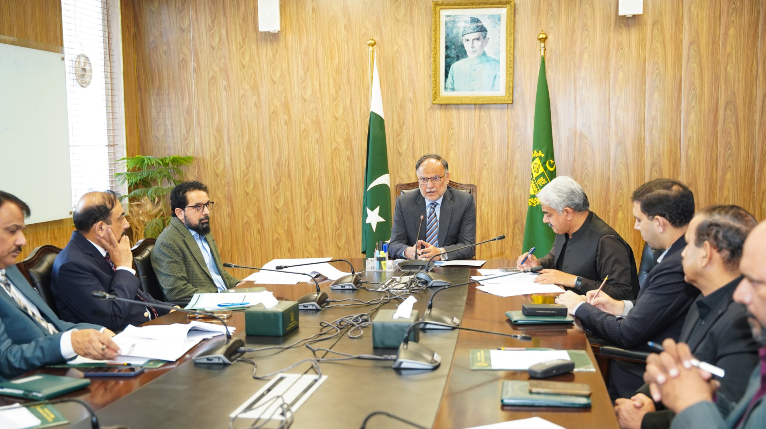
ISLAMABAD, Sep 10 (APP):Federal Minister for Planning, Development and Special Initiatives Professor Ahsan Iqbal on Thursday said comprehensive tax reforms, resource mobilization and digitalization were essential to provide the financial engine for achieving the targets of Uraan Pakistan and transforming the national economy.
Chairing a meeting on the National Economic Mission of Uraan Pakistan concerning tax reforms and digitalization, he said Mission-2, tax reforms and resource mobilization, was one of the 11 National Economic Missions approved by the National Economic Council (NEC) and served as the financial engine for the entire Uraan Pakistan programme.
He said the required resources for the other 10 National Economic Missions could not be generated without increasing revenues through reliable and effective sources. The 11 missions, approved by the NEC, were aimed at transforming Pakistan into a $1 trillion economy by 2035, he added.
Ahsan said the NEC was the country’s highest constitutional economic decision-making body and stressed that the targets of Uraan Pakistan were achievable, but required transformation in every sector.
“Achieving the target of a $1 trillion economy while maintaining the status quo will be extremely difficult,” he said, adding that the desired level of economic transformation could not be achieved if the country continued to operate on a business-as-usual basis.
“We have to move forward at digital speed, not at the speed of a tortoise,” he said, stressing that Pakistan would have to move away from conventional approaches and rapidly transition towards a technology-driven digital economy for sustainable economic growth.
The minister said Pakistan had undoubtedly achieved economic stability, but the current level of stability was not sufficient to ensure sustainable growth.
He pointed out that in 2018, the size of the development budget in relation to the Gross Domestic Product (GDP) was considerably higher, whereas today the development budget had shrunk significantly in proportion to the GDP.
“If we are achieving stability with a development budget of Rs2,000 billion, it cannot be termed complete economic stability,” he said, stressing the need to increase the size of the national economy for sustainable development.
Ahsan said Pakistan needed to rapidly shift towards a technology-based economy, while the shrinking development budget posed a major challenge. “If we cannot complete ongoing development projects, how can we initiate new projects?” he asked.
He said the existing structure of the national budget left little room for further expansion in development expenditure. Therefore, generating new resources and effectively mobilizing existing ones was imperative for economic growth.
The minister said fundamental reforms in the tax system were required to mobilize domestic resources. He said, with the efforts of the Prime Minister, the government’s tax collection performance had improved significantly over the past two years.
“Our major challenge is to increase the tax base and tax collection while reducing tax rates,” he said, adding that reducing the tax burden and increasing the number of taxpayers should be a key priority of the country’s economic policy.
Ahsan also stressed the need for a substantial increase in exports, saying that Pakistan would have to significantly enhance its exports if it wanted to achieve rapid economic growth.
He said increasing exports was currently among Pakistan’s most important national priorities and called for setting clear, achievable export targets based on comprehensive analysis and research.
The minister said the Ministry of Planning had the responsibility to prepare a comprehensive national development plan under the guidance of the Prime Minister and provide it to the relevant ministries to ensure effective implementation.
He directed that the analytical and research capabilities of the Ministry of Planning be utilized to set clear export targets and determine the potential contribution of different sectors.
“We have to determine which sectors can generate how much in exports and what measures will be required to achieve these targets,” he said.
Ahsan said tax reforms and digitalization of the economy were essential not only for increasing domestic resources but also for documenting the economy and improving transparency and efficiency.
He reiterated that Pakistan’s economic transformation required a departure from traditional methods, stronger resource mobilization, technology-driven growth and a sustained focus on exports to achieve the objectives of Uraan Pakistan.