ISLAMABAD, Sep 9 (APP):Prime Minister’s Coordinator for the National Paigham-e-Aman Committee, Hafiz Muhammad Tahir Mehmood Ashrafi, has highlighted the committee’s achievements during its first year, describing its work as a significant step towards strengthening interfaith harmony, national unity and Pakistan’s collective response to extremism and terrorism. Addressing a media briefing on the completion of one year of the National Paigham-e-Aman Committee, Ashrafi said the committee was established on September 9, …
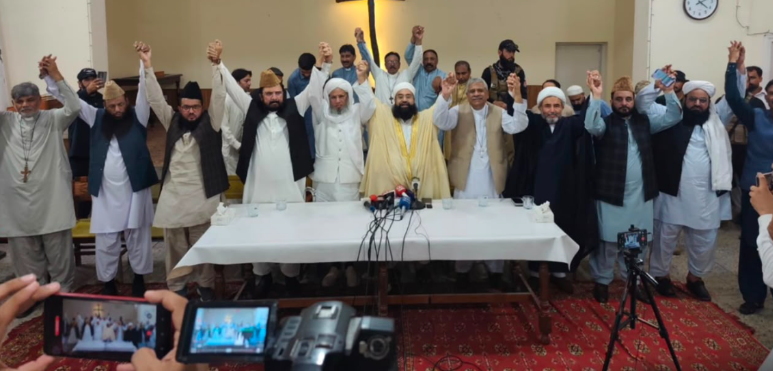
ISLAMABAD, Sep 9 (APP):Prime Minister’s Coordinator for the National Paigham-e-Aman Committee, Hafiz Muhammad Tahir Mehmood Ashrafi, has highlighted the committee’s achievements during its first year, describing its work as a significant step towards strengthening interfaith harmony, national unity and Pakistan’s collective response to extremism and terrorism.
Addressing a media briefing on the completion of one year of the National Paigham-e-Aman Committee, Ashrafi said the committee was established on September 9, 2025, on the directions of Prime Minister Muhammad Shehbaz Sharif, reflecting a broader vision of using Pakistan’s religious leadership as a force for peace, tolerance, national cohesion and stability.
He said the formation of the committee represented an important development in Pakistan’s history because, for the first time in such a national-level initiative, leaders of different Muslim schools of thought were brought together alongside representatives of non-Muslim faith communities.
According to Ashrafi, the committee was established with the objective of giving practical expression to the principles of Paigham-e-Pakistan and creating a unified national response to extremism, terrorism, sectarian violence, hate speech and religious intolerance.
Ashrafi said one of the most visible achievements of the committee during its first year had been the creation of greater unity among religious scholars and leaders representing different schools of thought.
He recalled that critics had often argued that religious scholars belonging to different schools of thought could not even offer prayers together. The National Paigham-e-Aman Committee, he said, had helped disprove that perception through repeated joint appearances and collective prayers.
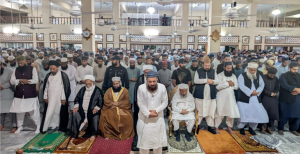
Religious leaders from different schools of thought have participated together in gatherings at major religious institutions, including Jamia-tul-Rasheed, Jamia Ashrafia, Minhaj-ul-Quran and other leading seminaries, demonstrating publicly that religious differences need not become a source of social division. A recent multi-faith and multi-sect delegation comprising Christian, Hindu, Shia and Sunni representatives also jointly visited Jamia Ashrafia, where participants reaffirmed their commitment to tolerance, mutual respect and social cohesion.
Ashrafi said these initiatives had sent a powerful message that Pakistan’s religious leadership could stand together on matters of national interest while respecting legitimate differences of faith and jurisprudence.
A major feature of the committee’s first year, he said, had been the active participation of Christian, Hindu, Sikh and other non-Muslim representatives in national peace and harmony initiatives.
Religious leaders and members of minority communities have jointly visited places of worship and participated in interfaith conferences, conveying the message that Pakistan belongs equally to all its citizens.
The committee’s work has included advocacy for the protection of the lives, property, honour and places of worship of non-Muslim citizens, while emphasizing peaceful coexistence and respect for religious freedom. In August, religious scholars associated with the committee and its allied organisations also delivered nationwide Friday sermons highlighting the rights of non-Muslims in Islam and the principles of peaceful coexistence.
Ashrafi said the purpose of such initiatives was not merely to issue statements but to build confidence among communities and create practical channels of dialogue at the grassroots level.
Ashrafi also highlighted the peaceful observance of Muharram-ul-Haram and Ashura as an important example of cooperation among religious scholars, the government and security institutions.
The National Paigham-e-Aman Committee had worked with religious leaders and authorities to promote restraint, prevent sectarian provocation and encourage adherence to the Paigham-e-Pakistan Code of Conduct.
The committee later commended scholars, spiritual leaders, organisers of Majalis and processions, police, security institutions and federal and provincial governments for their collective efforts in ensuring a peaceful Ashura across the country.
Ashrafi said the experience demonstrated that religious leadership, when united around peace, could become an effective partner of the state in preventing conflict and maintaining social stability.
The committee, he said, had consistently maintained that terrorism, extremism, sectarian violence and attacks on innocent people had no justification in Islam.
It has also worked to reinforce the message that the use of religion to promote violence, hatred or disorder cannot be accepted.
At various national and provincial forums, religious scholars have publicly rejected terrorism and pledged cooperation with the country’s armed forces, police and other security institutions in confronting violent extremism.
In January, members of the committee joined a national effort to promote Paigham-e-Pakistan through Friday sermons, with religious scholars across the country asked to deliver a unified message of peace, national unity and rejection of terrorism.
Ashrafi said the country’s madrassas, mosques, religious scholars and minbars had demonstrated during the past year that they could play a constructive role in countering extremist narratives and strengthening Pakistan’s national resilience.
Ashrafi said the unity demonstrated by Pakistan’s religious leadership had been particularly significant during difficult national and regional circumstances, including the Iran-Israel-US crisis, the security situation in the region, Muharram and other sensitive periods.
He said religious leaders belonging to different schools of thought had demonstrated an unprecedented level of unity and responsibility, ensuring that differences were not allowed to undermine national cohesion.
The committee’s approach, he added, had been to promote peace, patience, dialogue and national unity while firmly rejecting terrorism and violence.
He said large gatherings of Ulema and religious leaders had reaffirmed that the Mihrab-o- Mimbar stood with Pakistan in the struggle against terrorism, extremism and attempts to destabilise the country.
The National Paigham-e-Aman Committee has continued to urge religious leaders to honour the sacrifices of Pakistan’s martyrs and to ensure that mosques, seminaries and other religious institutions become centres of peace, national unity and responsible citizenship.
Ashrafi also referred to the devastating suicide attack at the Khadija-tul-Kubra Mosque in Tarlai, Islamabad, which struck worshippers during Friday prayers on February 6, 2026.
The attack killed more than 30 worshippers and injured more than 170 people, becoming one of the deadliest attacks in the capital in more than a decade.
He said the tragedy further underscored the importance of the National Paigham-e-Aman Committee’s mission of preventing sectarian hatred and protecting places of worship and innocent citizens.
The attack, he stressed, was completely contrary to the teachings of Islam and the values of humanity, reinforcing the need for all religious communities and scholars to stand together against terrorism and sectarian violence.
The committee and religious leadership also stressed solidarity with the victims and their families and the importance of providing assistance to those affected by such tragedies.
Ashrafi said the National Paigham-e-Aman Committee had also moved towards strengthening its institutional presence beyond Islamabad, with provincial and district-level structures being developed to ensure that its message of peace reaches communities across Pakistan.
He also called for the activation of National Paigham-e-Aman Committees at the district level throughout the country, while appreciating their role in promoting interfaith harmony and combating sectarianism.
Meetings with provincial governments, religious scholars, police and security institutions have created a wider network for addressing potential sources of sectarian tension before they escalate.
In Sindh, for example, provincial and national committee representatives held discussions with the provincial government on peace, religious harmony, interfaith dialogue and countering extremist and hate-based narratives.
Ashrafi said the committee’s first year had demonstrated that Pakistan’s religious leadership could make a meaningful contribution not only to religious affairs but also to national security, social stability, community relations and Pakistan’s international image.
He said the committee had sought to ensure that Pakistan’s message to the world was one of Islam’s true teachings of peace, tolerance, compassion, human dignity and coexistence.
“Friends and even those who disagree with us have acknowledged that Pakistan’s religious leadership has genuinely represented the peaceful message of Islam,” Ashrafi said in his briefing.
Ashrafi said the committee would continue to translate the principles agreed under Paigham-e-Pakistan into practical initiatives across Pakistani society.
The committee’s agenda includes strengthening inter-sect and interfaith dialogue, countering hate speech and extremist propaganda, promoting responsible use of social media, protecting minorities and places of worship, and encouraging young people to reject violence and sectarian hatred.
Recent initiatives have included nationwide religious messaging on the rights of non-Muslims, interfaith harmony conferences, peace seminars and coordinated preparations for sensitive religious occasions.
Ashrafi expressed gratitude to Prime Minister Muhammad Shehbaz Sharif, the federal government, provincial governments, security institutions and religious leadership for supporting the committee’s work during its first year.
He also acknowledged the guidance and cooperation of the country’s senior military leadership particularly Chief of Army Staff and Chief of Defence Forces, Field Marshal Syed Asim Munir, and security institutions in advancing the shared objective of peace and stability.
He said the achievements of the past year should be viewed as the beginning of a longer-term national effort rather than an endpoint.
Looking ahead, Ashrafi said the National Paigham-e-Aman Committee would intensify its efforts to help build a Pakistan where peace, tolerance, religious harmony, mutual respect and social cohesion become defining characteristics of society.
He said no individual or group should be allowed to frighten or exploit citizens in the name of religion for personal, sectarian or political interests.
“The Mihrab-o-Mimbar have demonstrated their responsibility during the past year,” Ashrafi said, expressing confidence that religious scholars and leaders would play an even stronger role in the years ahead.
He concluded by reaffirming that the National Paigham-e-Aman Committee would continue working from the national level down to the provincial and grassroots levels to promote a peaceful and tolerant Pakistan.
“Pakistan will always remain united and strong, and Insha’Allah the message of peace, tolerance and religious harmony will continue to strengthen throughout the country.”
The first year of the National Paigham-e-Aman Committee, therefore, marks an important transition from declarations of religious harmony to collective action by religious leaders, minority representatives, governments and security institutions with the stated objective of making peace, tolerance and national unity a permanent feature of Pakistan’s social fabric.