
Muhammad Atif Ismail MULTAN, Sep 6 (APP)::In the narrow streets of interior Multan, where centuries-old houses still preserve the city’s architectural character, hundreds of carved wooden doors continue to stand as silent witnesses to a bygone era of craftsmanship. Many of these doors are believed to be a century old or even older. Made by local craftsmen from durable indigenous trees, they were designed not merely as entrances to homes …
Handcrafted wooden doors preserve Multan’ s heritage
Muhammad Atif Ismail
MULTAN, Sep 6 (APP)::In the narrow streets of interior Multan, where centuries-old houses still preserve the city’s architectural character, hundreds of carved wooden doors continue to stand as silent witnesses to a bygone era of craftsmanship.
Many of these doors are believed to be a century old or even older. Made by local craftsmen from durable indigenous trees, they were designed not merely as entrances to homes but as strong, decorative structures reflecting the skill, taste and economic standing of their owners.
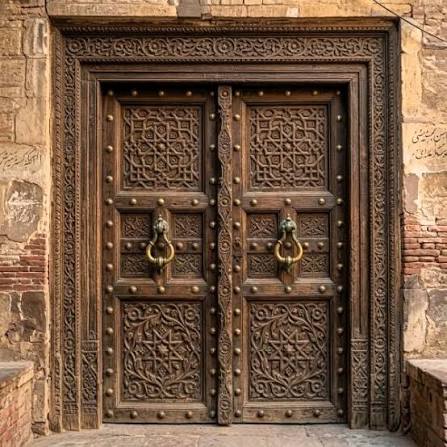
Even today, some of these remarkable doors remain intact despite decades of exposure to weather and daily use. Their intricate carvings, heavy wooden panels, traditional ironwork and distinctive locks demonstrate a level of craftsmanship that has become increasingly rare.
According to Amir Bashir, an official guide of the Walled City Authority, interior Multan contains hundreds of houses where such traditional wooden doors have survived for generations.
He said the doors were generally made from locally available woods such as kikar and sheesham, selected for their strength and durability.
“These doors were built to last for generations,” Amir Bashir said, adding that their beauty was considered as important as their strength. Elaborate patterns were carved into the wood by hand, while iron fittings were incorporated to reinforce the doors and provide additional security.
Geometric panels, floral motifs, intertwined designs and traditional decorative patterns cover many of the doors’ surfaces. Some doors also feature heavily carved frames, adding to their visual appeal and giving each entrance a distinctive character.
The use of iron was another important feature of traditional Multani doors. Heavy iron bands, studs, hinges, chains and traditional latches were used to strengthen the wooden structures. Instead of modern locks, these houses often relied on large and distinctive “kundas” and other traditional fastening mechanisms.
Some doors also feature a smaller opening within or beside the main entrance. Such arrangements allowed residents to enter or communicate without opening the large main door, combining security with everyday practicality.
Amir Bashir said the design and quality of a house’s main entrance could often provide clues about the financial status of the family living inside. Wealthier families could afford larger doors with more elaborate carvings and expensive ironwork, turning the entrance itself into a statement of social standing, he shared.
The doors also carried elements of the cultural and religious identity of their occupants. According to Amir Bashir, some families had religious symbols, inscriptions or other identifying motifs carved into their doors. These details became part of the architectural identity of individual homes and neighborhoods.
One of the most distinctive examples can be found in Bagh Veera, a unique neighborhood in the old city. Amir said the locality has around 130 houses, many of which still retain their traditional wooden doors.
For residents, however, these doors are more than architectural objects. They are familiar parts of homes that have witnessed generations grow up, families change and neighborhoods evolve.
Local resident Riyaz Khan said he and other residents had lived with these doors for decades and had developed an emotional attachment to their homes. He described the old doors as exceptionally strong and said their continued survival was a source of pride for residents.
But the tradition is now facing serious pressure.
As old houses are demolished and replaced by modern structures, many traditional architectural features are disappearing. Interestingly, some residents who have constructed new houses have preserved their old doors and reused them in the new buildings, giving the centuries-old craftsmanship a new lease of life.
The growing cost of traditional craftsmanship is another reason behind its decline, Riyaz maintained.
Another resident, Zafar Ansari, said he had once inquired about having a similar door made and was told that the cost would now exceed Rs300,000. He said skilled craftsmen capable of producing doors with the same level of detail had become extremely difficult to find.
Changing preferences among homeowners have also contributed to the decline. Modern doors are generally lighter, easier to manufacture and available in a wide range of inexpensive materials. For many families, commissioning a heavily carved wooden door has become financially difficult.
A traditional door that once formed an ordinary part of a Multani home has therefore become something increasingly precious.
Beyond their practical purpose, these doors represent a disappearing craft tradition. Every carved panel, iron fastening and hand-worked design reflects the labour of craftsmen who worked without modern machinery and passed their skills from one generation to another.
Today, these doors continue to guard the entrances of old houses across interior Multan. Their worn surfaces and weathered edges tell stories of generations that have come and gone, while their remarkable strength demonstrates why their makers chose quality over convenience.
As modern construction rapidly transforms the old city, preserving these doors could help retain an important part of Multan’ s architectural heritage.
For now, they remain standing in the narrow streets of the ancient city quiet, weathered and dignified reminders of a time when a house door was not simply an entrance, but a work of art, a security system and a reflection of a family’s identity.