
ISLAMABAD, Sep 2 (APP):Pakistan on Wednesday welcomed the “clear and authoritative pronouncements” by the Permanent Court of Arbitration (PCA) in its ruling, affirming that it retained all diplomatic and non-diplomatic options to protect its water rights under the Indus Waters Treaty (IWT), and urging New Delhi to return to full compliance. Addressing his weekly press briefing, Foreign Office spokesperson Tahir Andrabi said that the court’s unanimous award constituted an important …
On IWT, Pakistan retains all diplomatic, non-diplomatic options; urges India’s full compliance: FO spox
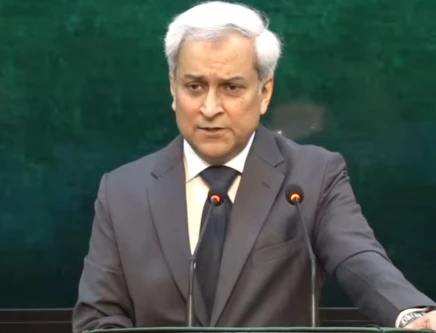
ISLAMABAD, Sep 2 (APP):Pakistan on Wednesday welcomed the “clear and authoritative pronouncements” by the Permanent Court of Arbitration (PCA) in its ruling, affirming that it retained all diplomatic and non-diplomatic options to protect its water rights under the Indus Waters Treaty (IWT), and urging New Delhi to return to full compliance.
Addressing his weekly press briefing, Foreign Office spokesperson Tahir Andrabi said that the court’s unanimous award constituted an important reaffirmation of the sanctity of the Indus Waters Treaty and the rule of international law.
He said that PCA’s ruling vindicated Pakistan’s consistent position that differences concerning the Indus waters must be addressed strictly within the framework of the Treaty and in accordance with international law.
He said that the proceedings at the Permanent Court of Arbitration were conducted strictly under the dispute settlement framework of the Indus Waters Treaty.
“India’s rejection of the award by the Permanent Court of Arbitration raises concerns that extend well beyond the present dispute. India cannot treat international law as a matter of convenience—invoking it when useful and discarding it when inconvenient,” he said.
The spokesperson said that India could not disregard binding treaty obligations and the legal processes and that such an approach by India undermined the sanctity of treaties, eroded confidence in established international dispute settlement mechanisms, and created adverse precedents for other regions.
“India should, therefore, return to full compliance with the treaty, respect the institutional and dispute settlement mechanisms of the treaty, and engage Pakistan constructively within the framework that both countries solemnly accepted.”
He said that the statement by the Indian Ministry of External Affairs could not extinguish or alter India’s obligations under the Indus Waters Treaty or its obligations to fulfil the award of the Court of Arbitration.
“Pakistan is committed to implementing it in earnest, in letter and in spirit, in accordance with the language and provisions of the treaty. We will continue to urge India to reciprocate with the same approach whereby the treaty is upheld in letter, in spirit, and in full legal and documented provisions.”
To a question about the visit of Chinese Special Envoy for Afghanistan to Pakistan, he said that Pakistan appreciated China’s constructive and sustained engagement on issues concerning Afghanistan.
Andrabi said that Pakistan has always remained positively engaged for constructive dialogue on the subject of Afghanistan. However, progress would depend on the interim Taliban regime taking concrete and verifiable action against TTP, BLA, and other terrorist organizations operating from their soil against Pakistan.
Asked about the ongoing conflict between the United States and Iran and the status of the Islamabad MoU, he said that Pakistan was closely monitoring the situation.
“We are closely monitoring the situation… International armed conflicts have their cycles, whereby a period of escalation is followed by relative calm, eventual cessation of hostilities, and an ultimate return to the negotiation table. This is the standard pattern of international armed conflicts. While we remain concerned and these escalations are certainly not desirable, we are not discouraged and we remain engaged.”
Spokesperson Andrabi said that the escalation should not be termed as a failure of the mediatory process, as Pakistan has remained engaged in complete earnest with the peace process.
He said that after his meeting with the Iranian President, Prime Minister Shehbaz said that Islamabad MoU provided a framework for the parties to return to the negotiation table and hold dialogue, including technical-level talks, for a long-lasting and sustainable settlement of this standoff.
Asked about the criminal case against Kashmir leader Yasin Malik, he said that there was obviously no question of any change in Pakistan’s position with respect to Jammu and Kashmir.
“Pakistan’s position on Jammu and Kashmir is firmly anchored in UN Security Council resolutions, international law, and the wishes of the Kashmiri people…We remain fully engaged with this issue at relevant international platforms.”
During the leadership’s interactions in Bishkek, Prime Minister Shehbaz Sharif and Deputy Prime Minister and Foreign Minister Ishaq Dar also held interactions with the UN Secretary-General and added that Jammu and Kashmir remained a top priority for Pakistan at the United Nations.
Commenting on the European Commission’s recently launched bi-annual GSP Monitoring Report, he said Pakistan appreciated the report and the Commission’s recognition of Pakistan’s continued compliance under these international conventions. However, its overall narrative does not present a sufficiently balanced picture of Pakistan’s performance.
To a question, Andrabi said that counter-terrorism in Pakistan involved internal and external dimensions. On the internal side, major operations continue to be conducted by our security forces. The external dimension involves the support provided by elements in Afghanistan, including the interim Taliban regime, to terrorists operating inside Pakistan, as well as the support and abetment by extra-regional actors—specifically India, for which the country had concrete evidence.
Highlighting the diplomatic engagements during the previous week, he said Pakistan remained actively engaged on the diplomatic front, with a series of high-level bilateral, regional, and multilateral engagements aimed at advancing Pakistan’s foreign policy priorities and further strengthening relations with key partners.
He referred to the ongoing official visit of Prime Minister Shehbaz to Kyrgyzstan for the SCO summit, where he delivered important statements, besides several meetings on the sidelines by him as well as DPM Ishaq Dar with world leaders.
He said Pakistan has also assumed the Chairmanship of the Shanghai Cooperation Organization, during which it will host the next meeting of the SCO Council of Heads of State next year.
Highlighting the inaugural meeting of the Strategic Political and Defence Committee, established under the Makkah Joint Defence Agreement between Pakistan, Saudi Arabia, and Turkiye, held in Istanbul, he said the three sides reaffirmed their resolve to work together for regional peace, stability, and de-escalation, including through restraint and the peaceful resolution of crises.
He said a Secretariat, headed by a Secretary-General, will be established in Saudi Arabia, initially led by a Secretary-General from Pakistan for three years.
Marking his final press briefing before taking up his appointment as Pakistan’s Permanent Representative to Geneva, Andrabi handed over the charge to Ambassador Sajjad Haider Khan, who steps in as the new Foreign Office spokesperson.

