For any dialogue to take place, the Afghan Taliban must ensure that Afghan soil is not used to perpetrate terrorism against Pakistan. Kabul must honour its international commitments, including those under the Doha framework, and ensure that Afghan soil is not used by hostile proxies, particularly the TTP and BLA, against Pakistan, FO spokesperson said.
Afghan dialogue linked with verifiable anti-terror action; Makkah Agreement open to states with common security interests: FO
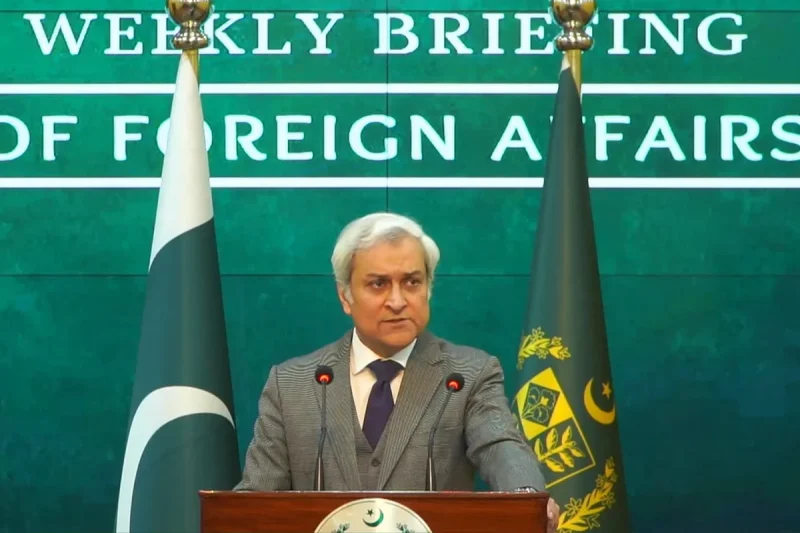
ISLAMABAD, Aug 27 (APP): Pakistan on Thursday said that it was open to initiating state-level dialogue and institutional coordination with Afghanistan, provided the Afghan Taliban regime took tangible and verifiable counterterrorism measures to ensure Afghan soil was not used by terrorist groups against it.
“For any dialogue to take place, the Afghan Taliban must ensure that Afghan soil is not used to perpetrate terrorism against Pakistan. Kabul must honour its international commitments, including those under the Doha framework, and ensure that Afghan soil is not used by hostile proxies, particularly the TTP and BLA, against Pakistan,” Foreign Office spokesperson Tahir Andrabi said at his weekly press briefing here.
He highlighted that if the Afghan regime’s actions occurred at the behest of a neighbouring country, specifically pointing to evidence of Indian involvement in terrorism emanating from Afghan soil, Pakistan was constrained to label them as proxies.
To a question about other countries, including Bangladesh showing interest in joining the Makkah Joint Defence Agreement, the spokesperson described it as an evolving defensive architecture open to countries sharing common security obligations, with formal requests to be reviewed alongside partners in Riyadh and Ankara.
“As an evolving security architecture, the MJDA remains open to countries who share their commitments, collective obligations, and common security interests. Any formal request will be considered in consultation with our partners in Riyadh and Ankara. The operationalisation of MJDA, however, remains at an early stage.”
The spokesperson announced that Pakistan was set to assume the chairmanship of the Shanghai Cooperation Organisation (SCO) for a one-year term following the Council of Heads of State summit in Bishkek from August 31 to September 1, 2026. Prime Minister Shehbaz Sharif will attend the Bishkek summit, leading up to Pakistan hosting the SCO summit in Islamabad in 2027, he added.
Highlighting Pakistan’s active mediation in the US–Iran conflict and efforts to reopen the Strait of Hormuz, he told the media that Chief of Army Staff and Chief of Defence Forces, Field Marshal Syed Asim Munir, visited Tehran on August 24 to facilitate regional de-escalation and explore a negotiated settlement.
He, however, rejected claims that the field marshal visited Tehran as an envoy for the US President, clarifying that the visit was undertaken strictly within Pakistan’s independent capacity as a mediator.
He said Deputy Prime Minister and Foreign Minister Senator Muhammad Ishaq Dar held discussions with counterparts from Egypt, Türkiye, Kuwait, Mauritania, Uzbekistan, and Brazil, alongside UN Secretary-General António Guterres on matters of bilateral and regional interest.
The spokesperson categorically dismissed retrospective claims by a former Indian CDS concerning the Kirana Hills incident, noting that during Marka-e-Haq, Pakistan’s air defense successfully thwarted Indian objectives.
“Pakistan’s layered air defence network effectively thwarted India’s military objectives… No strategic asset or sensitive infrastructure was compromised in Pakistan. Attempts to retrospectively recast these events through selective narrative or dramatised production cannot alter the verifiable operational record. History is established by facts and evidence, not by Bollywood-style retrospective claims. These post-facto punches, 16 or 17 months after the conflict, would be better directed at their own faces.”
He said Pakistan had lodged a strong diplomatic protest against Indian authorities for unilaterally demolishing consular facilities outside the Pakistan High Commission in New Delhi, differentiating it from Islamabad’s pre-notified anti-encroachment drive across diplomatic missions.
Asked about Pakistan’s participation in the upcoming UN General Assembly session, the spokesperson said that the preparations were underway and the country would provide its input to the outcome documents that the General Assembly, or any organ or any agency, would issue on the occasion.
Spokesperson Andrabi said that during his ongoing official visit to the United Kingdom, DPM Dar met with International Maritime Organization (IMO) Secretary-General Arsenio Dominguez, seeking institutional intervention for the safe release of 10 Pakistani seafarers held captive by Somali pirates.
Highlighting the complexity of the situation, he said that the government was making active efforts for their release, but this was a complex problem involving a tribal society and energy-related cargo, which restricted direct action.
He said that the DPM also engaged with Commonwealth Secretary-General Shirley Botchwey and a delegation of British-Pakistani parliamentarians to discuss bilateral ties, Jammu and Kashmir, and regional peace.
Referring to the recent bilateral visit of Syrian Foreign Minister Asaad Hassan Al-Shabani to Islamabad, he reaffirmed Pakistan’s support for Syria’s sovereignty and welcomed the international lifting of sanctions against the country.
He said that the Syrian people should be mainstreamed in global affairs, particularly with respect to the economy, trade, culture-to-culture ties, and tourism.
He said that Pakistan joined joint diplomatic statements condemning Israeli settlement expansion in the West Bank, particularly the E1 plan, as well as Israeli strikes on Syria’s Abu al-Duhur military base.
He told the media that Pakistan assumed the final presidency of the 2026 session of the UN Conference on Disarmament in Geneva and participated in the Pakistan-France dialogue on multilateral affairs in Paris.
Regarding the issue of Israeli settlements, he said that Israel had no right to build settlements in the West Bank as those were deemed illegal not just by the UN General Assembly, but also by the UN Security Council.