ISLAMABAD, Aug 24 (APP):The Pakistan Engineering Council (PEC) marked a landmark achievement with the passing-out ceremony of the first cohort of its Graduate Engineer Trainee (GET) House Job Programme, held at the National Defence University (NDU), Islamabad. The ceremony marked the transition of around 510 young engineering graduates from university education to professional practice after completing a structured six-month training programme. Chairman PEC Engr. Waseem Nazir and Deputy President NDU …
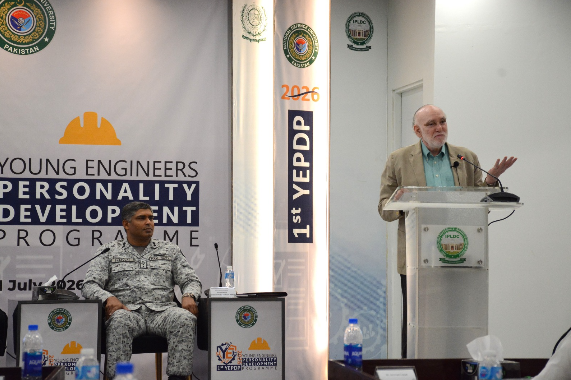
ISLAMABAD, Aug 24 (APP):The Pakistan Engineering Council (PEC) marked a landmark achievement with the passing-out ceremony of the first cohort of its Graduate Engineer Trainee (GET) House Job Programme, held at the National Defence University (NDU), Islamabad.
The ceremony marked the transition of around 510 young engineering graduates from university education to professional practice after completing a structured six-month training programme.
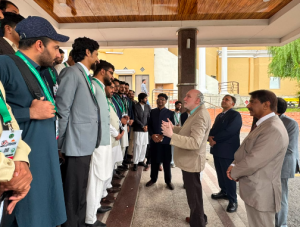
Chairman PEC Engr. Waseem Nazir and Deputy President NDU Rear Admiral Shafaqat Hussain Akhtar, HI(M) were the chief figures at the ceremony.
The GET Programme has introduced, for the first time in Pakistan, a structured “House Job” model for fresh engineering graduates, addressing the critical gap between academic education and professional practice.
Under the six-month programme, trainees undertake five months of field and industrial exposure, followed by one month of professional and soft-skills development.
The first cohort was placed across around 60 leading public and private sector organizations, while PEC provided a monthly stipend of Rs50,000 per trainee.
Around 510 GETs subsequently participated in the first-ever nationwide one-month professional and soft-skills training through eight centers across Pakistan.
The NDU component included the Young Engineers Personality Development Programme, focusing on leadership, communication, teamwork, conflict management, professional ethics, critical thinking and professional development.
A defining feature of the programme has been its commitment to equal opportunity and transparency. Approximately 10% of eligible engineering graduates were selected for the first cohort through a transparent random digital balloting process, ensuring that every eligible graduate had an equal opportunity to participate rather than relying on discretionary selection.
This approach established a transparent and replicable model for scaling the programme nationally.
As a special case and in line with the objective of promoting regional inclusion and equal opportunity, PEC accommodated 100% of eligible engineering graduates from Balochistan in the GET initiative.
The experience demonstrates that the programme can be adapted to address specific regional needs while maintaining a transparent, structured and digitally managed framework.
Speaking at the ceremony, Chairman PEC Engr. Waseem Nazir said the GET Programme was envisioned to fundamentally transform the transition from university to professional practice. He said the first cohort had demonstrated that a structured House Job model for engineers was both necessary and achievable.
He emphasised that the programme represented a major investment in Pakistan’s engineering human capital, providing young engineers with practical exposure, professional discipline, leadership capabilities and the essential skills required to succeed in professional life.
The programme is now gaining momentum, with the regulatory, operational and digital frameworks established by PEC and the implementation model put in place for future cohorts.
At the heart of the initiative is the PEC GET Portal, which has transformed the process into a transparent, digital and largely automated system. Registration, eligibility, balloting, placement, monitoring, performance evaluation and certification are integrated into the digital ecosystem, significantly reducing human dependency and ensuring transparency, efficiency and traceability. With the system now largely automated and operational, the GET Programme has moved beyond a pilot initiative and is ready for sustainable national expansion.
With approximately 1930 engineers already inducted into the GET Programme-around 510 completing the first cohort and 1420 inducted in the second batch- the initiative has demonstrated its demand, feasibility and scalability.
The next logical step is for the Government of Pakistan and Provincial Governments to own and institutionalize the programme. PEC has established the regulatory framework, developed the digital platform and tested the complete implementation mechanism.
The foundation is therefore already in place.
The federal and provincial governments should now consider dedicated budgetary allocations for GET, with the objective of progressively providing 100% of eligible engineering graduates with structured professional exposure.
Provincial Governments, in particular, can take ownership of the programme within their respective jurisdictions, leveraging the regulatory and digital framework already developed by PEC rather than creating parallel systems.
Such an approach would transform GET into a sustainable national human-capital investment, ensuring that every engineering graduate has an opportunity to move from graduation to professional practice, from knowledge to experience, and ultimately from education to productive employment.
Deputy President NDU Rear Admiral Shafaqat Hussain Akhtar, HI(M) congratulated the graduates and appreciated their dedication, urging them to utilise their capabilities for Pakistan’s technological advancement, sustainable infrastructure and national development.
The PEC GET House Job Programme represents a significant step towards building a competent, industry-ready and future-focused engineering workforce-and provides Pakistan with a ready-to-scale model for investing in the country’s most valuable asset: its young engineering human capital.