
Moniba Iftikhar ISLAMABAD, Aug 23 (APP)::A father whose tiredness is vividly visible on his wrinkled-face is running from pillar-to-post in search of money to bear the expenses of his daughter’s marriage to meet the unreasonable dowry demands from the daughter’s in-laws. A room once full of hope and purity is now heavy with doubts and questions. The groom’s family’s talk of dowry struck the father, turning his …
Moniba Iftikhar
ISLAMABAD, Aug 23 (APP)::A father whose tiredness is vividly visible on his wrinkled-face is running from pillar-to-post in search of money to bear the expenses of his daughter’s marriage to meet the unreasonable dowry demands from the daughter’s in-laws. A room once full of hope and purity is now heavy with doubts and questions.
The groom’s family’s talk of dowry struck the father, turning his joyful heart restless and wiping away smiles and plans for the future.
The quiet house is now filled with worries and silent pain. A father who worked hard all his life is left wondering how to buy expensive things just to please the groom’s family. For Shabnam from Sargodha, this story is very real.
Her niece is getting married in two months, but her father has already passed away, leaving the family in deep financial trouble.
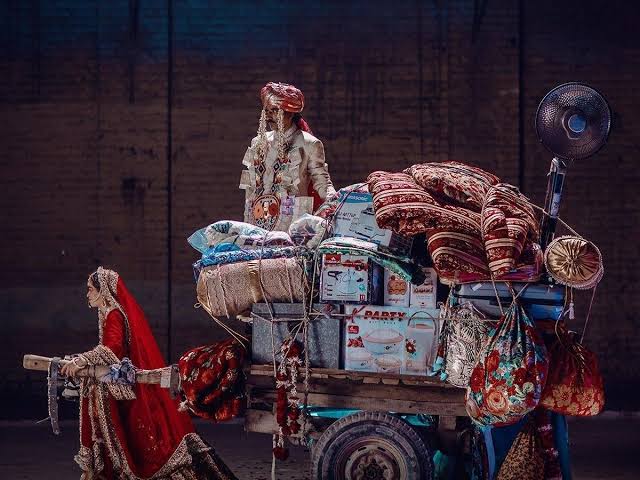
Even though the groom’s family knows this, they still demand woven rope beds, a washing machine, double beds, a refrigerator, a rug, and kitchen utensils. They call these heavy demands a necessary part of custom, showing no mercy to a struggling family.

In the past, giving items to a daughter started as a way to help her financially, but over time, it turned into a bad tradition and a source of pride. Today, low-income and middle families suffer the most from this custom.
In a country where finding steady jobs and good pay is very hard, parents struggle every day just to buy basic food and pay for a home. Studies in rural Faisalabad show that an average dowry costs start around Rs 157,640.
This is a huge amount for families who earn less than Rs 30,000 to 50,000 a month. To meet these demands, parents borrow money from lenders, sell their land or useful belongings and cut back on everyday needs.
Amna shares the sad story of Rukhsana from village Qubo Saeed Khan. Her family was so poor that they could not afford any dowry. In the end, they were forced to marry her to a man with serious mental health problems simply because his family did not ask for dowry.
This shows how financial pressure can force parents into hard choices that ruin a daughter’s whole life.
Psychological expert Zilehuma Suleman told APP that dowry pressure is not just a financial burden. It causes deep mental stress and anxiety for parents.
They feel constant guilt, sadness and fear of being judged or rejected by society. At the same time, many young daughters feel terrible watching their elderly fathers work long hours in heavy labor when their hair has already turned grey. Because of dowry, daughters are often seen as a financial burden instead of a gift.
Zilehuma Suleman also warns that dowry creates an unfair balance of power in marriage. When a bride’s family cannot give enough, it leads to constant taunting, mental cruelty, money demands, and even physical violence after the wedding.
Social activist Farzana Bari and civic experts with APP describe dowry as the main “bone of contention” or the biggest point of fight between families. They point out that this practice hurts women deeply. Young girls are told that going to school or getting an education is useless.
Instead, they are forced to spend all their time learning household work to become “ideal” housewives. This makes women feel like low-value objects rather than human beings with real dignity.
However, hope still exists. A growing number of young people and grooms are taking a strong stand against dowry. They choose to marry without taking a single item from the bride’s family, proving that marriage can be simple, honorable, and free of financial burden if people simply say no.
This greedy custom goes completely against the clear teachings of Islam. Islam is a simple religion that never puts an unfair load on anyone.
In our country, people look to Islam for guidance, yet many ignore its simple rules during weddings. As reported by Uqbah ibn ‘Amir, the Prophet Muhammad (PBUH) said, “The best marriage is one that is easiest.” In Islam, there is no concept of dowry from the bride’s side.
Looking at the law, Pakistan made the Dowry and Bridal Gifts (Restriction) Act in 1976. This law sets a strict limit on dowry and bridal gifts at just Rs 5,000 and requires all items to be written down in the Nikah form. The Supreme Court has also ruled that all gifts belong solely to the bride.
However, High Court Advocate Shah Muhammad Awan says people routinely break this legal limit due to heavy social pressure and media influence.
People watch extravagant weddings on television and social media and falsely believe that dowry is a necessary part of marriage. Awan clearly states that demanding dowry is illegal and wrong and no one can legally force a family to give it. Yet, because of these demands, thousands of dowry disputes end up in court every year.
When the sacred bond shatters, dowry becomes the ultimate battlefield. Rawalpindi High Court Advocate Malik Amir Saleem, a practicing lawyer at the district courts, exposes the bitter aftermath of these marital breakdowns.
He reveals how dowry rapidly mutates into a toxic bone of contention between two families where a bitter feud that casts a dark, unforgiving shadow over a young woman’s entire future.
Though custom dictates that parents send their daughters off with gifts, greedy in-laws routinely seize these belongings the moment separation or divorce strikes.
Under the West Pakistan Family Courts Act of 1964, the law draws an unyielding line, granting family courts exclusive authority to treat every piece of dowry (saman-e-jahez) as the wife’s absolute property, recoverable in court or compensated at monetary value.
Yet, as Advocate Malik Amir Saleem passionately warns, black-letter law alone cannot cure a broken culture. The legal system may offer a shield to restore her stolen items, but to truly protect a daughter’s future, society itself must step out of the courtroom and play its vital role in breaking this crushing weapon once and for all.
Yet, amidst this darkness, a powerful wave of change is rising. A local vlogger recently brought camera lights to the streets, exposing how these greedy demands destroy poor families. Standing tall against this old mindset is Mohsin Iftikhar, a young groom-to-be who refused to let his wedding become a financial trap. “I completely refused to take any dowry,” Mohsin declared.
“A wife is a life partner, not a trade deal. I will never let her father shed tears of helplessness for my comfort.” His bold stand shows that when the youth say no, custom loses its power.
In the end, society must realize that dowry brings only pain, debt, and injustice. Instead of saving money for years to buy furniture and home appliances for in-laws, parents should spend that money on their daughters’ education. Educating daughters makes them confident, skilled, and independent.
A daughter’s wedding day should be a time of genuine happiness and smiles, not a time when an aging father cries and worries about debts.
If young people and families stand together and firmly say no to dowry, this harmful tradition will finally end, allowing daughters to marry with respect and honor.

