On Islamabad’s quiet, tree-lined roads, a new kind of police patrol is quietly taking shape, one that arrives without the roar of an engine, leaves no exhaust behind and moves into action without delay. The city’s new electric police vehicles are bringing a silent but significant change to the way policing is carried out in the capital.
By Roy Zia ur Rehman
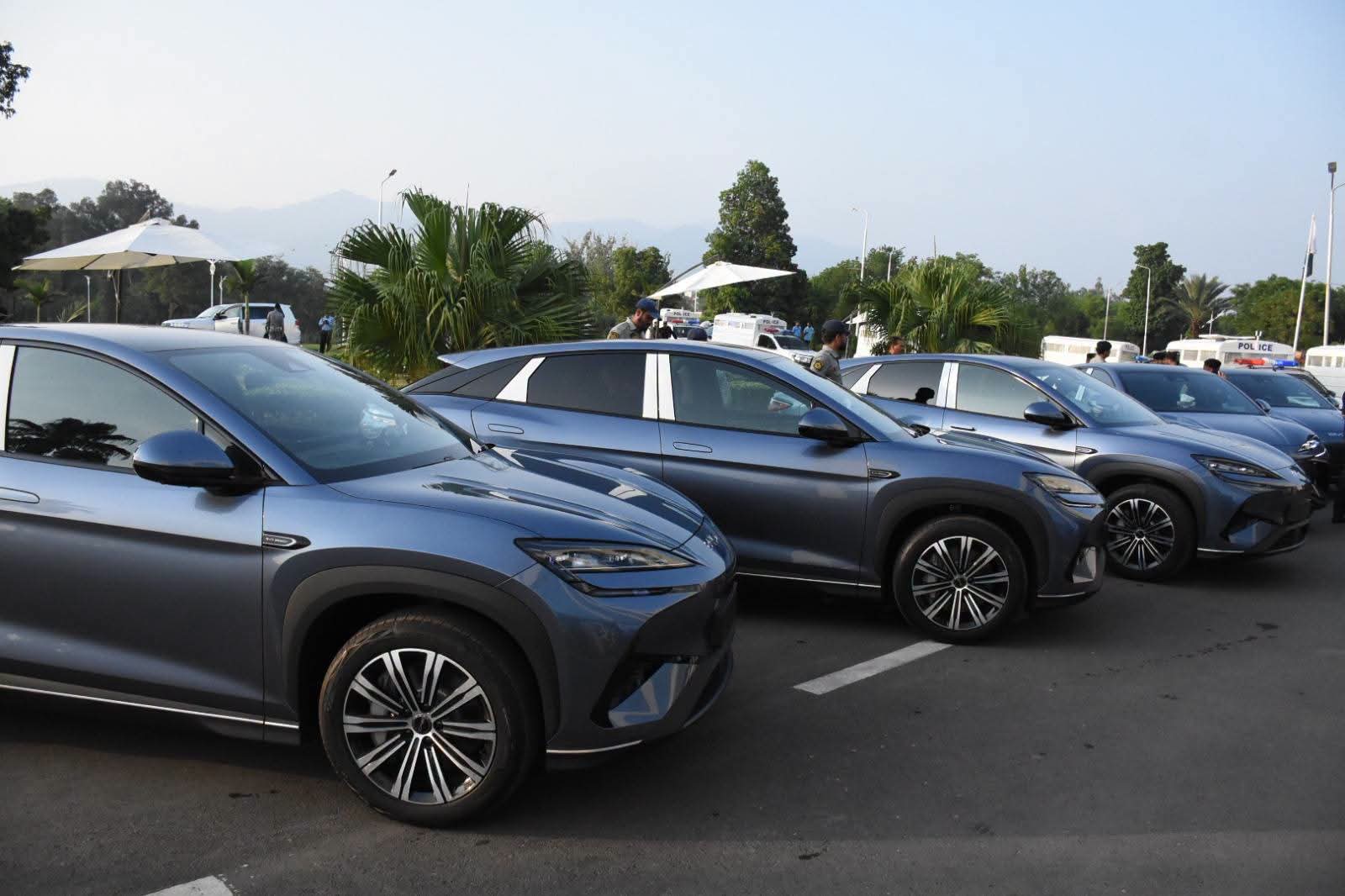
ISLAMABAD, Aug 16 (APP): On Islamabad’s quiet, tree-lined roads, a new kind of police patrol is quietly taking shape, one that arrives without the roar of an engine, leaves no exhaust behind and moves into action without delay. The city’s new electric police vehicles are bringing a silent but significant change to the way policing is carried out in the capital.
With no fuel burning while standing idle and no lengthy starting process, Islamabad Police’s newly inducted electric vehicles are bringing a quieter and potentially faster dimension to policing in the capital. The initiative is aimed at modernizing the force, improving mobility and ensuring that police teams remain ready when citizens need immediate assistance.
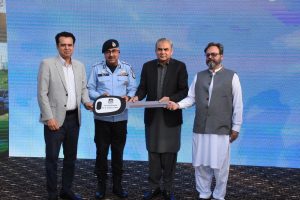
Federal Interior Minister Mohsin Naqvi, accompanied by Minister of State for Interior Talal Chaudhry, handed over the new vehicles to Islamabad Police as part of efforts to strengthen the force’s operational
capacity.
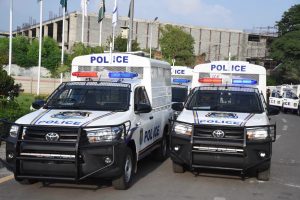
The arrival of 30 vehicles for 27 police stations after a gap of 14 years has attracted attention across the capital. Yet their importance goes beyond their modern appearance. The real question is whether these vehicles can make police response quicker, patrolling more reliable and the city’s streets cleaner.
For Tahir Azad, a local resident and government employee, improved police transport can directly contribute to better policing.
“Giving police reliable and fast vehicles means they can respond quickly and pursue criminals more effectively,” he told APP. “An electric vehicle can remain ready for action without wasting fuel while standing.”
That readiness could prove particularly useful for officers who spend long hours at checkpoints and duty points. Conventional vehicles often require their engines to remain running while officers wait, consuming fuel and producing emissions even when the vehicle is stationary.
The electric vehicles remove that need.
Inspector Tajammul Hussain Shah said the vehicles could remain stationary without burning fuel, while also avoiding unnecessary engine noise and emissions. For Islamabad, where green spaces, parks and tree-lined avenues are central to the city’s identity, the environmental benefit could be significant.
Environmental experts generally view the shift from conventional fuel-powered vehicles to electric transport as a positive step for reducing tailpipe emissions and urban noise.
They also point out that the overall environmental advantage depends partly on how electricity is produced and how batteries are maintained, reused and eventually disposed of. For a public institution operating vehicles for extended periods, however, moving towards electric transport can be an important step in reducing direct
pollution.
Rai Usman, a lawyer, highlighted another concern that improved vehicles could address: reliability.
“There have been instances where shortages of fuel or faulty vehicles affected the ability of police to reach the place of a complaint. With better and more reliable vehicles, this problem should reduce,” he told APP.
SSP Operations Islamabad Qazi Ali Raza oversees field policing, where mobility is essential for patrols, crime prevention and emergency response. The addition of vehicles at police stations is expected to keep more police teams available for field duties and improve their ability to move across assigned areas.
According to Shah, the electric vehicles can travel more than 500 kilometers on a full charge, while their range could reportedly reach around 700 kilometres without using air conditioning.
Charging time is another important factor. Shah said fast charging could take around two hours, while normal charging could require five to six hours. Officers have also been instructed to place the vehicles on charge when the battery level falls to around 30 per cent. A full charge, he said, could support patrolling across two shifts, depending on usage.
But perhaps the most important feature becomes visible when an emergency call arrives.
“There is no lengthy starting process. You press the pedal and move,” Shah said.
In an emergency, those few moments can matter. Unlike a conventional vehicle, an electric vehicle does not require the same starting process before moving. Its comparatively low maintenance requirements could also help reduce the time vehicles spend off the road because of routine mechanical problems.
The patrol system has also been organized into East and West sectors. Shah said areas including Faisal Avenue, G-5, G-6 and F-7 fall within the eastern sector, while the deployment and monitoring system has been computerize.
For citizens, however, technology only matters when it produces visible results.
Near Kachnar Park, resident Farukh said the new vehicles had changed the way he viewed police patrol cars.
“These vehicles are beautiful. Instead of creating a sense of fear, they give a feeling of protection,” he told APP.
Schoolteacher Nazia saw the vehicles as a symbol of a changing capital.
“When you see these vehicles, you feel that we are living in a developed country,” she said.
For Bilal, a supervisor at a battery firm with a warehouse in Islamabad, the expectation was more practical: better vehicles should lead to more patrols.
“If patrolling increases, we can leave our workplace and go home with greater peace of mind,” he told APP.
Inspector Shah described the induction as a welcome step for both Islamabad’s security and environment, while appreciating IGP Islamabad Syed Ali Nasir Rizvi, Interior Minister Mohsin Naqvi and the government for providing modern resources to the force.
After 14 years without such an addition, the 30 vehicles represent more than a fleet upgrade. They are a test of whether modern technology can translate into stronger police presence, faster response and cleaner streets.
The vehicles may be silent, but the expectations are loud.
The new fleet is more than a change in wheels; it is a step towards cleaner streets and quicker action which a quiet drive towards a greener, safer Islamabad.