
By Fakhar-e-Alam PESHAWAR, Aug 16 (APP):In a narrow lane of Mohallah Sethian, away from the bustle of historic Qissa Khawani Bazaar, an old wooden doorway of Sethi House opens into another age. Beyond the modest entrance of Sethi House is a world of carved wood, coloured glass, brick, light and shadow, attracting tourists from worlwide. A fountain occupies the courtyard, wooden screens filter the daylight and intricate ceilings draw the …
Sethi House: Where Peshawar’s trading past lives on in wood, glass and light includes in UNESCO heritage list
By Fakhar-e-Alam
PESHAWAR, Aug 16 (APP):In a narrow lane of Mohallah Sethian, away from the bustle of historic Qissa Khawani Bazaar, an old wooden doorway of Sethi House opens into another age.
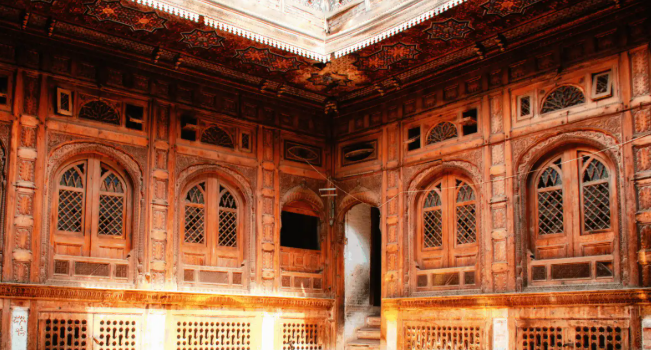
Beyond the modest entrance of Sethi House is a world of carved wood, coloured glass, brick, light and shadow, attracting tourists from worlwide. A fountain occupies the courtyard, wooden screens filter the daylight and intricate ceilings draw the eyes upward, inviting visitors to pause and look again.
For a city shaped by centuries of trade, migration, conquest and cultural exchange, Sethi House is far more than an old mansion. It is a surviving portrait of the cosmopolitan Peshawar that once stood at the crossroads of the Indian subcontinent, Afghanistan and Central Asia.
The house has gained renewed attention following its inclusion among heritage properties being considered in connection with UNESCO’s tentative-list process. For Peshawar, the recognition carries significance beyond international status as it offers an opportunity to present the city’s architectural heritage as a living cultural inheritance rather than a collection of fading remnants.
The story of Sethi House is inseparable from the Sethi merchant family, whose wealth grew through extensive commercial networks.
The Sethis settled in Peshawar after migrating from Punjab and established themselves in the neighbourhood that came to be known as Mohallah Sethian. Their trading connections extended towards Central Asia, and their exposure to the architecture of Bukhara and other trading centres influenced the homes they built in Peshawar.
What emerged was an architectural language that was distinctly their own.
Research on the Sethi haveli complexes describes them as examples of elite domestic architecture in which local building traditions were blended with Central Asian influences. Basements, upper-storey living spaces, large halls, decorated niches, courtyards, fountains, carved wood and colourful glass became defining elements.
The buildings thus preserve more than the memory of a wealthy merchant family. They record the cultural exchange created by Peshawar’s position along historic trade routes.
For visitors, the experience begins before they enter the Sethi house. The journey through Mohallah Sethian takes them into a compact historic landscape where narrow lanes reveal old wooden façades and buildings that seem to belong to another era.
Inside Sethi House, the change fir visitors is immediate. The courtyard forms the heart of the residence, with rooms and passageways opening around panes of glass transform ordinary daylight into patches of red, green and other hues.
Carved doors, arches, balconies and ventilators reveal the extraordinary skill of craftsmen who worked more than a century ago.
Small niches and glass shelves incorporated into the interiors once provided places for lamps and candles. When illuminated, the glass, wood and mirrored surfaces would have created a shimmering interior landscape.
For Engr. Fahim Khan, a civil engineer who recently revisited the house after a decade, the craftsmanship made the visit unforgettable.
“I have not seen such an impressive building with eye-catching wood designs, red and green window glass and ventilator structures anywhere in KP,” he told APP during his visit.
He was particularly fascinated by the decorated mehrabs and small glass shelves designed to hold candles.
“The ceilings are designed with pure Islamic architecture and visitors could look at them for hours,” he said, stressing that the building was part of Peshawar’s identity and deserved digital spotlight.
His reaction explains something that heritage buildings often accomplish better than history books neccessaiting proper projection through social media platforms.
Inside Sethi House, visitors do not merely read about the past. They walk through it.
The building’s wooden screens, openings and ventilators were designed to encourage airflow and bring natural light into the interior. The basement and internal spaces helped moderate the environment, while carefully positioned openings allowed air to circulate.
Senior architect of C&W Development Gaffar Ali describes Sethi House as an example of early green architecture, pointing particularly to its ventilation and airy design.
Long before phrases such as sustainable architecture and climate-responsive design entered everyday vocabulary, craftsmen in Peshawar were designing buildings around shade, airflow, natural illumination and the local climate.
These features were not decorative additions. They were part of the way the house worked.
Research on the Sethi havelis has likewise highlighted the potential of adaptive reuse in conserving historic buildings while reducing the need for new construction and the associated consumption of materials and energy.
For many visitors, however, it is the woodwork that leaves the deepest impression on visitors minds.
Doors, windows, balconies and arches carry floral and geometric patterns carved with extraordinary precision. Depending on where a visitor stands, and how sunlight enters the room, the same surface can appear to change.
The combination of wood, brick and coloured glass also reflects the meeting of different artistic traditions.
Documentation by the Heritage Foundation of Pakistan describes Sethi House as a highly embellished residence associated with one of Peshawar’s most powerful mercantile families, while highlighting the strong influence of Central Asian architecture on the Sethi residences.
Before its conversion to musesum, the building had suffered from neglect, water seepage and inappropriate additions. Conservation records noted damage to historic wooden rafters and other parts of the structure, raising concerns about the survival of its architectural details.
Bakhtzada Khan, Director Archaeology and Museums Khyber Pakhtunkhwa said the government purchased Sethi House in 2006 and started its restoration. Following restoration, the Directorate of Archaeology and Museums converted it into a museum in 2010, opening the once-private residence to the public.
That decision transformed the relationship between the building and the people of Peshawar.
Sethi House was no longer simply a private relic known through photographs and historical accounts. It became a place where schoolchildren, families, researchers, tourists and architecture enthusiasts could encounter the city’s past for themselves.
Its conservation was also linked with the Cultural Heritage Trail in the old city. The project revitalised a roughly 500-metre route between Ghanta Ghar and Gor Gathri and improved the appearance of around 85 heritage buildings representing Mughal, Sikh and British-era architectural traditions.
The wider lesson is increasingly recognised by conservation experts who said that heritage has a better chance of surviving when it remains connected to public life.
The experts have argued that adaptive reuse can help historic buildings survive by giving them cultural, educational and social functions.
The research studies highlighted the Sethi complexes as an important blend of local and Central Asian architectural traditions and points to the potential of public use to support the sustainability and liveability of the walled city.
Engr Fahim said preservation, in this sense, does not have to mean freezing a building in time rather it can mean allowing the building to continue serving society without sacrificing the qualities that make it historically important.
Museums, guided tours, cultural exhibitions, craft demonstrations, architectural research and educational programmes can all give historic structures a continuing purpose.
Dedpite ups and down, the Sethi House stands within a much larger and more fragile heritage landscape.
The Sethi family constructed several havelis in the neighbourhood, creating an architectural enclave that reflected their wealth and their connections with the wider world.
Not all have enjoyed the same level of conservation like Sethi House Peshawar.
Heritage researchers have warned that several Sethi haveli complexes have deteriorated and require continued preservation and appropriate reuse, adding this presents both an opportunity and a challenge.
If one restored haveli can attract visitors, then a carefully managed network of historic homes, bazaars, caravanserais and archaeological sites could tell a far richer story of old Peshawar.
The city would not simply be offering tourists a monument rather it would be offering them an experience.
Perhaps the deepest significance of Sethi House lies beyond its architecture.
Heritage is often described through buildings, dates and architectural styles. But behind the carved doors were people: merchants negotiating trade, families gathering in courtyards, craftsmen shaping wood by hand, travellers arriving from distant lands and children growing up in a city connected to several cultural worlds.
The house therefore preserves social history as much as architectural history.
Its Central Asian influences recall trading networks that once carried goods, ideas, designs and artistic traditions across borders. Its local materials and construction methods show how those influences were adapted to Peshawar’s own environment.
In that sense, Sethi House is a physical record of globalisation long before the modern word existed.
Recognition is only the beginning
International recognition can bring attention, but attention alone cannot protect heritage.
Engr Fahim said historic buildings require continuous maintenance, skilled conservation, detailed documentation, protection from inappropriate alterations and responsible management of tourism.
Research on Sethi House has also highlighted the particular conservation challenges posed by historic structures, including the need to understand the behaviour of traditional brick masonry and significant internal woodwork, especially in the context of disaster mitigation.
That is why every repaired wooden panel, restored ceiling and protected wall matters.
Once a centuries-old craft tradition disappears, it cannot easily be recreated.
For today’s visitors, perhaps the most hopeful sight is not the architecture itself but the people looking at it.
Young visitors pause beneath the carved ceilings. Tourists photograph the coloured glass. Students ask about the family that built the house. Researchers examine construction techniques while residents who remember the building from earlier days return to see it restored.
Bakhtzada said thouse has become a bridge between generations and that may ultimately be its greatest value.
Whether UNESCO recognition remains at the tentative-list stage or eventually develops into a successful World Heritage nomination, the first custodians of Sethi House will remain the people of Peshawar and Khyber Pakhtunkhwa.
The challenge is to ensure that recognition becomes more than a ceremonial achievement. It must lead to sustained conservation, better interpretation, responsible tourism and protection of the wider historic neighbourhood.
Standing in the courtyard, as sunlight passes through red and green glass and falls across carved wooden surfaces, it is easy to understand why visitors stop and stare.
Sethi House does not speak loudly and it does not need to. Its wood, glass, brick and carefully engineered spaces tell the story of a Peshawar that was wealthy, outward-looking, artistic and deeply connected to a world beyond its walls.
And after more than a century, that story is still waiting for the next generation to listen.

