Pakistan’s diplomatic efforts as a third-party mediator between the United States and Iran are fundamentally grounded in the realities of conflict resolution, and any setbacks in the peace process reflect the inherent dynamics of conflict management rather than mediation failure, according to a prominent geopolitical analysis.
Pakistan should not be blamed as US-Iran peace falters due to deep-seated mistrust: Analysis
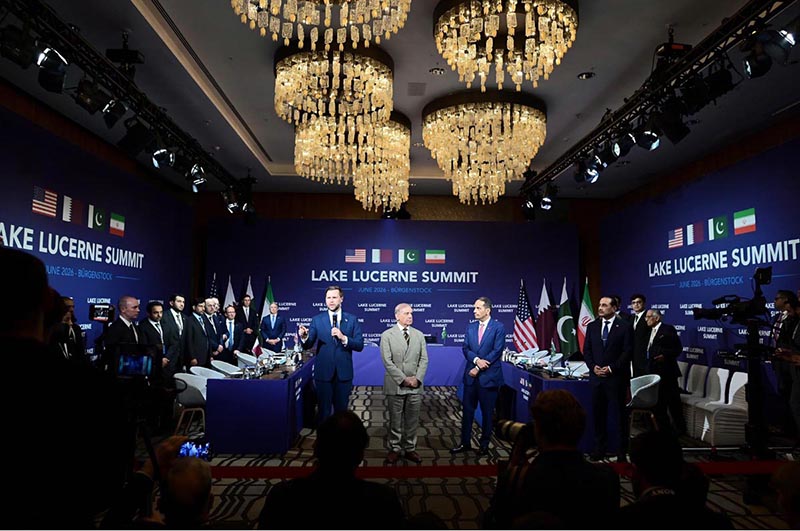
ISLAMABAD, Aug 8 (APP): Pakistan’s diplomatic efforts as a third-party mediator between the United States and Iran are fundamentally grounded in the realities of conflict resolution, and any setbacks in the peace process reflect the inherent dynamics of conflict management rather than mediation failure, according to a prominent geopolitical analysis.
In an article titled “Why Pakistan Should Not Be Blamed When Peace Falters,” published in the Washington-based online magazine South Asian Voices, author Ibrahim Al-Marashi highlights that mediators are often unfairly scapegoated when long-term peace proves far more complex and elusive than initially expected, particularly following public criticism from figures like the late U.S. Senator Lindsey Graham and regional detractors in India and Israel.
The report emphasizes that ending wars is a vastly more difficult task than celebrating those who wage them, noting that the diplomatic intervention led by Prime Minister Shehbaz Sharif and Field Marshal Asim Munir deserves to be understood through the established realities of international conflict management.
Highlighting the structural dynamics of the Memorandum of Understanding (MoU) brokered by Islamabad, the article explains that securing an enduring ceasefire relies heavily on timing, patience, and strategic location. Pakistan successfully leveraged its unique “geo-positional capital”—situated geographically between China and Iran while preserving its long-standing strategic alliance with the United States—to open direct channels of dialogue for all three nations.
The article traces how Pakistan, operating as a middle power, achieved a diplomatic coup reminiscent of its historic 1971 role in facilitating U.S. Secretary of State Henry Kissinger’s secret visit to China. During the spring 2026 U.S.-Iran conflict, Pakistan found itself at the center of a distinct web of relationships. Following a strategic rapprochement after the May 2025 conflict—which included Islamabad nominating Donald Trump for the Nobel Peace Prize and hosting Field Marshal Munir at the White House—Pakistan retained unique access to Washington while sharing a 900-kilometer border with Iran.
The analysis underscores that Pakistan’s leverage was built not on financial incentives or punitive power, but on geography, direct access to the U.S. leadership, and unmatched credibility in Tehran. As the only Muslim-majority military and nuclear power in West Asia opposing Israel that had explicitly condemned the assassination of Supreme Leader Ayatollah Ali Khamenei, Pakistan provided an essential bridge between two hostile powers.
According to the publication, the diplomatic intervention succeeded because it occurred precisely when the inter-state conflict reached a “mutually hurting stalemate”—a concept formulated by conflict resolution scholar William Zartman. This optimal window for mediation, known as “ripeness,” arrived after severe American and Israeli strikes on Iranian leadership and infrastructure were met with Iranian regional retaliation across the Gulf Cooperation Council (GCC) states and the closure of the Strait of Hormuz.
When President Trump issued an ultimatum on April 7 regarding the Strait, a broader disaster was averted through a pivotal phone call from Field Marshal Asim Munir that urged both sides to cease hostilities. This breakthrough resulted in a ceasefire and led to over 20 hours of historic direct talks in Islamabad between U.S. Vice President JD Vance and Iranian negotiators—marking the highest-level direct contact between Washington and Tehran since the 1979 revolution.
Addressing subsequent friction and claims that the MoU terms were suspended, Al-Marashi argues that blame directed at Pakistan stems from a fundamental misunderstanding of third-party mediation. Citing conflict management experts such as Herbert Kelman, Grace Wermenbol of the German Marshall Fund, and Professor Mehran Kamrava of Georgetown University in Qatar, the article stresses that deep-seated psychological mistrust, historical erosion of trust, and structural disputes over the Strait of Hormuz drive renewed volatility, rather than any structural failure by the mediating nation.
Furthermore, the publication notes that the perception of mutual hurt naturally shifts over time due to independent variables beyond any mediator’s control, such as domestic political timelines in Washington, strategic maneuvers by the Islamic Revolutionary Guard Corps in the Red Sea, or seasonal weather conditions in the Gulf.
The report said that despite military escalations and political rhetoric, neither Washington nor Tehran has abandoned the overall peace process. It reinforces that a third-party mediator’s primary task is not to artificially manufacture “ripeness,” but to remain steadily present and reliable whenever the conflicting parties are ready to return to the negotiating table in Islamabad.