Pakistan has urged the UN Security Council to address the ongoing repression in Indian-Illegally Occupied Jammu and Kashmir (IIOJK), warning that India has intensified its efforts to impose irreversible changes aimed at transforming the demographic, political, and cultural identity of the occupied territory.
Pakistan urges UN Security Council to halt India’s demographic engineering in occupied Kashmir

UNITED NATIONS, Aug 06 (APP):Pakistan has urged the UN Security Council to address the ongoing repression in Indian-Illegally Occupied Jammu and Kashmir (IIOJK), warning that India has intensified its efforts to impose irreversible changes aimed at transforming the demographic, political, and cultural identity of the occupied territory.
“Political repression remains pervasive throughout IIOJK,” Deputy Prime Minister and Foreign Minister Ishaq Dar wrote in a letter addressed to Ambassador Christina Markus Lassen, Denmark’s Permanent Representative and current President of the Security Council.
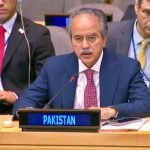
The letter was delivered to the Council’s president by Ambassador Asim Iftikhar Ahmad, Permanent Representative of Pakistan to the UN.
The diplomatic correspondence marks the seventh anniversary of India’s unilateral actions on August 5, 2019 that Pakistan and the UN say violate international law, the UN Charter, and relevant Security Council resolutions.
The Deputy Prime Minister’s letter draws the Council’s attention to India’s continued efforts to alter the demographic, political, and cultural character of IIOJK through changes to domicile laws, land ownership regulations, electoral arrangements, and administrative structures, including the issuance of approximately 3.4 million domicile certificates to non-residents.
The letter expresses grave concern over the continued deterioration of the human rights situation in IIOJK, pointing to arbitrary detentions, extrajudicial killings, enforced disappearances, torture, restrictions on freedoms of expression and peaceful assembly, and the continued application of draconian laws, including the Public Safety Act (PSA), Armed Forces Special Powers Act (AFSPA), and the Unlawful Activities (Prevention) Act (UAPA).
The letter also draws attention to the continued detention and persecution of Kashmiri political leaders, including Shabbir Ahmed Shah, Yasin Malik, and Asiya Andrabi, as well as journalists, lawyers, human rights defenders, and civil society activists. It further notes the continued restrictions on sixteen political organizations representing the aspirations of the Kashmiri people.
The letter also raises serious concerns regarding restrictions on religious freedom in IIOJK, including repeated curbs on congregational prayers at Srinagar’s historic Jamia Masjid, increased monitoring of religious institutions, the closure and regulation of seminaries, the takeover of 215 community-run schools, and concerns arising from the implementation of the Waqf (Amendment) Act.
Noting the implications of the Indian action for regional peace and security, the Deputy Prime Minister warned that India’s increasingly aggressive posture, inflammatory rhetoric, deployment of an estimated 700,000–900,000 security personnel in IIOJK, and its illegal and unilateral decision to place the Indus Waters Treaty (IWT) in abeyance have heightened tensions and increased the risks to peace and stability in South Asia.
The letter calls upon the UN Security Council to implement its resolutions on Jammu and Kashmir by urging India to reverse its unilateral measures of 5 August 2019, cease all actions aimed at altering the status and demographic composition of the occupied territory, respect the human rights of the Kashmiri people, and engage in a genuine process of dialogue to achieve a peaceful settlement in accordance with the relevant Security Council resolutions and the wishes of the people of Jammu and Kashmir.
The Deputy Prime Minister also urged the Secretary-General of the United Nations to actively employ his good offices to facilitate a just, peaceful, and durable resolution of the Jammu and Kashmir dispute, emphasizing that the unresolved dispute continues to pose a serious threat to regional and international peace and security.