
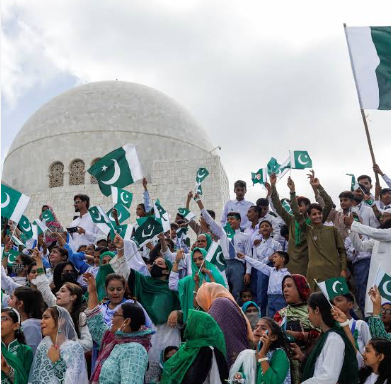
Pakistan is painted green and white in August, with a new generation visiting museums and historic sites to explore the nation’s story. Surrounded by flags, patriotic songs and Independence Day festivities, students and children discover the courage, sacrifices and dreams behind Pakistan’s creation.
As Pakistan turns green, young visitors discover story behind independence
Fakhar-e-Alam
PESHAWAR, Aug 4 (APP)::Pakistan is painted green and white in August, with a new generation visiting museums and historic sites to explore the nation’s story. Surrounded by flags, patriotic songs and Independence Day festivities, students and children discover the courage, sacrifices and dreams behind Pakistan’s creation.
From the lush green valleys of Chitral to the sunlit shores of Karachi, markets fill with fluttering green-and-white flags, homes are decorated with colorful bunting, and children excitedly count down the days to Independence Day of Pakistan.
For many, the celebrations are about music, festivities and patriotic songs. But for a group of schoolchildren visited the historic Islamia College Peshawar earlier this week, August 14 became something far deeper a journey into the story of the matchless sacrifices, struggles and dreams that gave birth to Pakistan on August 14, 1947.
Walking through the college’s grand corridors adorned with historic photographs, eighth-grade student Malaika Bibi paused before a portrait of Quaid-e-Azam Muhammad Ali Jinnah who visited the Alma- mater three times in his life.
Beside her, sixth-grade student Anaya Gul, third-grade student Ibrahim Khan and others listened intently as teachers narrated how generations of students once gathered in these very halls to debate, organize and support the Pakistan Movement.
“It feels different when you stand in the place where history was made,” Malaika Bibi remarked during the ICP’s visit. The two girls, accompanied by classmates from Peshawar Model Schools, explored the famous Khyber Union debating society and viewed rare photographs of Quaid-e-Azam Muhammad Ali Jinnah, who visited Islamia College Peshawar three times including as Governor General of Pakistan in 1948 and praised its students for their historic role in the struggle for a separate homeland for Muslims of South Asia.
The curiosity of students reflected a larger national mood as Pakistan prepares to celebrate its 79th Independence Day on August 14.
Welcoming the students dressed in green and white colors, Dr Shahbaz Khan, Chairman of the Pakistan Studies Department at Islamia College Peshawar, described the institution as one of the intellectual centers that nurtured the Pakistan Movement.
He explained how, after the failure of the 1857 uprising, Muslims in the subcontinent experienced political, educational and economic decline under British colonial rule. “It was a difficult period for the Muslim community,” he told the students. “Education became the key to revival.”
According to Dr Shahbaz, great educationist Sir Syed Ahmed Khan emerged as a visionary leader who believed that education was the strongest weapon for rebuilding the confidence of Muslims. Through modern educational institutions, culminating in Aligarh College in 1877, he laid the intellectual foundation of Muslims for political awakening.
“Sir Syed led an intellectual revolution of Muslims through educational, political and social reforms,” Dr Shahbaz said. “His continuous efforts helped Muslims regain confidence and prepared them to compete in every sphere of life with Hindus and other communities.”
The establishment of the All India Muhammadan Educational Conference in 1886 further strengthened this movement by promoting modern education and social reform, eventually creating a politically aware generation that played a decisive role in the demand for a separate homeland.
“The creation of Pakistan was a turning point in world history,” he said, adding it represented the aspiration of a nation to live with dignity, free from domination and discrimination.
He explained that the intellectual efforts of Sir Syed Ahmed Khan were later carried forward by leaders such as national poet philosopher Allama Muhammad Iqbal, Chaudhry Rehmat Ali, Nawabzada Liaquat Ali Khan, Maulana Muhammad Ali Johar, Sardar Abdul Qayyum Khan, Abdur Rab Nishtar, Mohtarma Fatima Jinnah and, above all, father of the nation Quaid-e-Azam Muhammad Ali Jinnah.
The Pakistan Movement gained political momentum with the establishment of the All India Muslim League in Dhaka in 1906. Over the following decades, constitutional struggles, political negotiations and growing public support strengthened the demand for a separate homeland for Muslims in the United India.
Dr Shehbaz highlighted several milestones, including Quaid-e-Azam’s famous Fourteen Points, Allama Iqbal’s historic Allahabad Address in 1930, Chaudhry Rehmat Ali’s proposal of the name “Pakistan” in 1933. “Rehmat Ali’s slogan, ‘Now or Never’, energized the Muslim youth and laid a clear direction for the struggle of Pakistan,” said Dr Shehbaz, noting that students from KP like caliber of Aslam Khattak and Inayatullah Khan, supported the Pakistan Movement while Pakistan Resolution adopted in Lahore on March 23, 1940 set clear direction for a separate nationhood.
In 1945, Quaid-e-Azam Muhammad Ali Jinnah received a rousing welcome at Khyber Pakhtunkhwa as well as in ICP where students and Muslim Students Federation (MSF) presented him Rs 8,000 as a fund for Pakistan Movement. They assured him to present 8,000 committed educated workers when he came again to this great alma-mater.
KP people had shown an immense love for Quaid-i-Azam and that is why Muslim League secured maximum seats in the 1946 election and after that historic victory nobody could stop the independence movement from this province.
The decisive victory of the All India Muslim League in the 1945-46 elections reinforced the demand for Pakistan, eventually leading to the June 3, 1947 Partition Plan and the creation of Pakistan on the world map on August 14, 1947.
In July 1947 Referendum, Muslim League clinched a landslide victory in KP by securing over 200,000 votes and its people announced to become part of Pakistan,’ he said. “The spirit and enthusiasm of people was historic when Quaid-e-Azam came to Peshawar as first governor general of Pakistan on April 12, 1948. Peshawarites decorated their houses, markets, vehicles and bazaars with national flags looking
festive.
The great Quaid presented glowing tributes to the services of its students towards making Pakistan in these words. ‘I am indeed very happy to be present here today and to have the privilege of addressing students of this great Darul Uloom, who are the future builders of Pakistan.’
The great Quaid reminded the students, “We have achieved the national goal of Pakistan and now it is our collective responsibility to work hard in our respective professions with a high-level of dedication, commitment and sincerity to make it one of the greatest countries of the world.”
Advised students to develop a sound sense of discipline, character, solid academic background and devote themselves towards studies, Quaid-e-Azam said, “Remember your government is like your own garden. Your garden flourishes by the way you look after it and the efforts that you put towards its improvement.
Similarly, your government can only flourish by your patriotic, honest and constructive efforts to improve
it.”
Following a gap of one year, the Government established University of Peshawar near ICP in 1949 in line with the Quaid’s vision and later two more universities UET and Agriculture University were formed besides Pakistan Forest Institute.
Dr Shebaz said the great Quaid also addressed a Grand Tribal Jirga at Governor House, Peshawar on April 17, 1948 and highly praised strong commitment, patriotism and support of tribesmen for Pakistan. He laid great emphasis on education and socio-economic development of tribesmen.
The love of Quaid-i-Azam, who became an honorary member of Khyber Union debating society of the college set up in 1936, can be judged from his “Will” written on May 30, 1939 in Bombay in which he declared ICP, Muslim University Aligarh and Sindh Madrassatul Islam, Karachi as among the inheritors of his property.
For the young students, however, history was no longer confined to textbooks or curriculum copies while standing beneath the towering architecture of Islamia College built in 1913 by Sahibzada Abdul Qayyum Khan; rather they imagined the speeches, debates and hopes that once echoed through its classrooms and
courtyards.
The key visit on the occasion of arrival of Pakistan Independence Day transformed familiar names into living stories and connected them with a generation whose sacrifices shaped the country’s future.
Beneath the glow of illuminated streets, fluttering flags and echoes of patriotic songs, Pakistan’s Independence Day celebrations carry a deeper story of sacrifice and struggle.
Historic institutions like Islamia College Peshawar stand as living reminders for younger generations that behind every celebration lies a remarkable journey of courage, resilience and determination.
For visitors like Malaika and Anaya, the unique experience offered more than a history lesson; rather it inspired a renewed appreciation of the struggles that culminated in the creation of Pakistan, and a shared responsibility to significantly contribute to Pakistan’s future with unity, dedication and hope to make it economically prosperous.