
FO spokesperson said that despite a relative calm over the past few days, the overall security situation in the Gulf and the Strait of Hormuz remains precarious, and that the attacks, particularly from non-state actors against Saudi Arabia, were utterly condemnable.
US-Iran negotiations ongoing to de-escalate tensions; Islamabad MoU remains foundational: FO spox
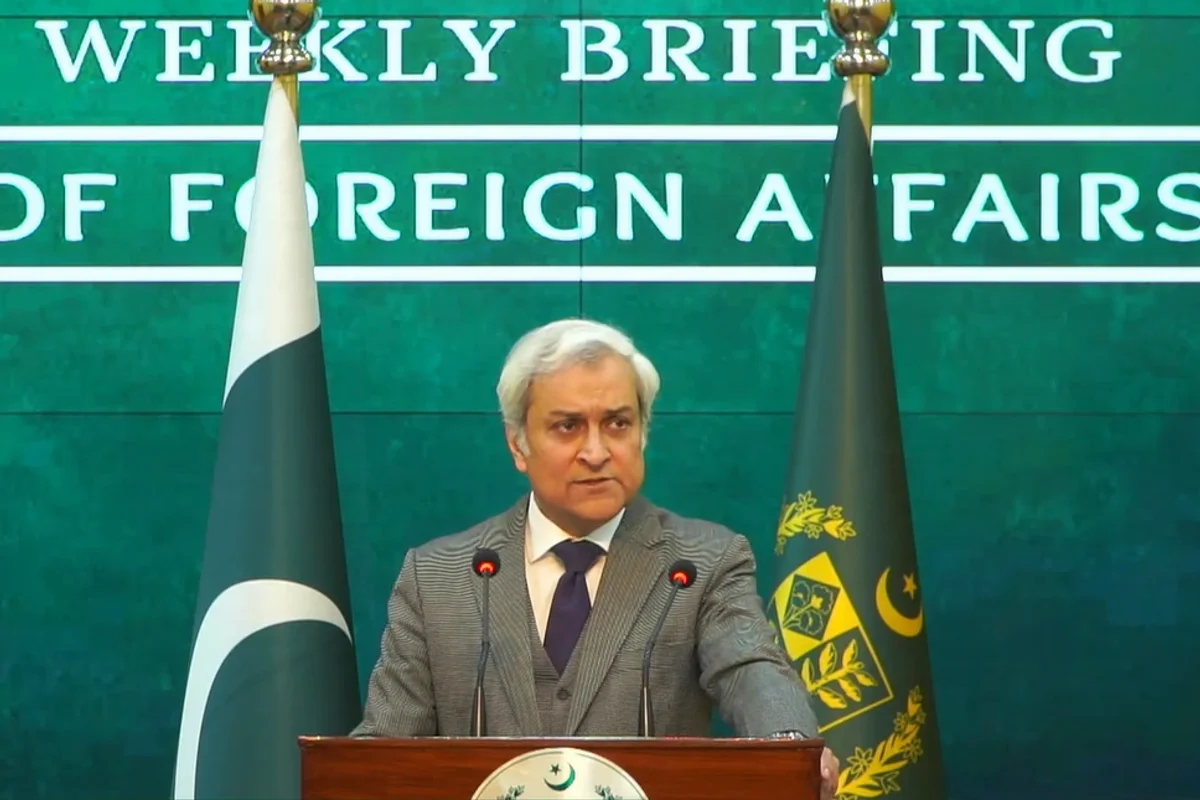
ISLAMABAD, Jul 30 (APP): Pakistan on Thursday said that negotiations between the United States and Iran were ongoing to de-escalate tensions in the Gulf region, emphasizing that the Islamabad MoU and the Pakistan-Qatar Joint Statement continued to serve as the vital framework for a durable peace process.
“Amid the prevailing tensions and hostilities, Pakistan reiterates that dialogue and diplomacy remain the only viable path forward… We are doing our utmost to bring the parties back to the Islamabad MoU… We encourage the parties to exercise maximum restraint and fully adhere to their commitment to resume technical-level talks,” Foreign Office spokesperson Tahir Hussain Andrabi said at his weekly press briefing here.
He said that despite a relative calm over the past few days, the overall security situation in the Gulf and the Strait of Hormuz remained precarious, and that the attacks, particularly from non-state actors against Saudi Arabia, were utterly condemnable.
“We remain hopeful for de-escalation and peaceful settlement of issues. We also remain hopeful that the parties will return to technical-level talks,” he said. Under the leadership of Prime Minister Shehbaz Sharif, Field Marshal Syed Asim Munir, and Deputy Prime Minister and Foreign Minister Ishaq Dar, the foreign ministry and all relevant institutions are fully geared to handle all these nuances and Pakistan could play its role smoothly with all the diplomatic and strategic tools.
Referring to the recent official visit of the Foreign Minister of Kuwait Sheikh Jarrah Jaber Al-Ahmad Al-Sabah to Islamabad, he said that both nations agreed to deepen cooperation in trade, investment, energy, IT, and agriculture.
He welcomed Kuwait’s ratification of the Pakistan-Kuwait Defense Cooperation Agreement, describing it as a “significant step towards strengthening institutional defense ties.
However, responding to a question, he said that mediation and defence cooperation were not mutually contradictory as the two roles did not crosscut each other. “Our role as a mediator is not compromised by the fact that we have defence agreements, nor does a defence agreement limit our mediator role. The two operate in their own separate streams.”
He strongly rejected a recent documentary broadcast by Deutsche Welle (DW) regarding Pakistan’s nuclear program, describing it as a “regurgitation of hackneyed and speculative commentary and biased sourcing.”
“The documentary reflects either a profound misunderstanding or a deliberate disregard of the history, evolution, and rationale of Pakistan’s nuclear programme,” the spokesperson said, reiterating that Pakistan maintained full confidence in its robust command and control architecture, which meets the highest international standards.
Addressing India’s decision to block access to the social media accounts of Pakistan TV and other outlets, the spokesperson condemned the move as part of an established pattern of suppressing free speech and factual reporting.
“Factual reporting has no place in the captive ecosystem prevailing in India,” he said, urging the international community to take notice of shrinking media space.
Spokesperson Andrabi strongly rejected Indian commentary on the recent democratic elections in Azad Jammu and Kashmir and attempts to normalize the illegal occupation of Indian Illegally Occupied Jammu and Kashmir (IIOJK).
“The Jammu and Kashmir issue is to be settled in accordance with the UN Security Council resolutions… which clearly state that any decision by the local assembly or government cannot erode the need for a UN-administered plebiscite,” the spokesperson said, while also condemning the historical and ongoing use of pellet guns against Kashmiri civilians.
To a query about border security and Afghanistan, he rejected insinuations regarding civilian casualties in counter-terrorism operations, emphasizing that precision strikes exclusively targeted terrorists and their masterminds in Afghanistan.
“I think this is an issue that needs to be internalised, thought about, chewed, and digested by our media: that these are terrorist elements operating from Afghanistan—sometimes even Afghan nationals—who are committing terrorist acts in Pakistan. So, we have to take measures for the security of our citizens and the security of our law enforcement agencies, and we will continue to do so in the future.”
On Palestine, he said that Pakistan joined seven other Arab-Islamic nations in issuing a joint statement condemning Israeli restrictions at the Al-Aqsa Mosque in Jerusalem.
He also apprised the media of the launch of 2026 issue of the Journal of Science Communication and Diplomacy, published by the Ministry of Foreign Affairs in collaboration with COMSTECH, featuring 11 analytical articles, including a contribution by Foreign Secretary Ambassador Amna Baloch, bridging the gap between scientific innovation and international diplomacy.
Highlighting Pakistan’s proactive diplomatic engagement, the spokesperson mentioned Prime Minister Shehbaz Sharif’s telephonic interaction with Saudi Crown Prince Prince Mohammed bin Salman bin Abdulaziz Al Saud which followed DPM Dar’s telephone conversations with his counterparts from Saudi Arabia, Jordan, and Egypt.
He told the media that DPM Dar represented Pakistan at the Shanghai Cooperation Organization (SCO) Council of Foreign Ministers meeting in the Kyrgyz Republic, where he confirmed that Pakistan would assume the SCO chairmanship for 2026–27, holding of the SCO Foreign Ministers Conference in the middle of next year, followed by the SCO Heads of State Summit towards the second half of 2027.

