Federal Minister for Information Technology and Telecommunication Shaza Fatima Khawaja on Friday said Pakistan’s future economic competitiveness depends on the adoption of robotics, automation and other emerging technologies, stressing that industrial automation is no longer a choice but a necessity.
Industrial automation essential for Pakistan’s economic future: Shaza Fatima
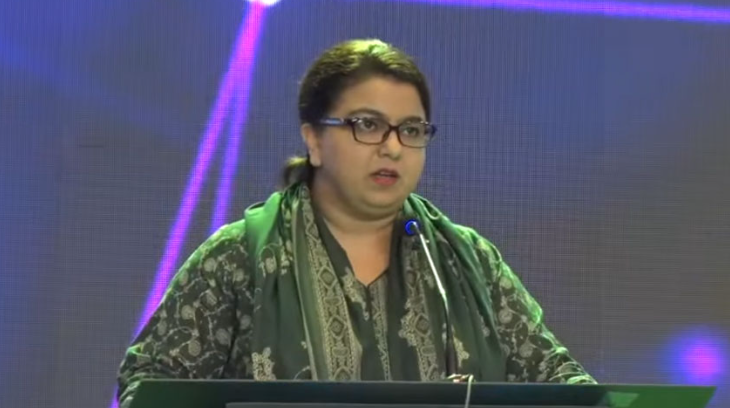
ISLAMABAD, Jul 24 (APP):Federal Minister for Information Technology and Telecommunication Shaza Fatima Khawaja on Friday said Pakistan’s future economic competitiveness depends on the adoption of robotics, automation and other emerging technologies, stressing that industrial automation is no longer a choice but a necessity.
Speaking at the closing ceremony of the two-day Indus RAS (Robotics and Autonomous Systems) Expo 2026 at the Pak-China Friendship Centre in Islamabad, the minister said, “If Pakistan wants to remain economically competitive, every traditional industry must move towards automation.”
She added that reducing taxes or energy costs alone would not be enough unless industries integrated robotics and automation into manufacturing, agriculture and supply chains.
Shaza said the Indus RAS (Robotics and Autonomous Systems) Expo 2026 attracted more than 20,000 visitors, including children, students, researchers, policymakers, industry leaders and technology professionals.
She said the large and diverse turnout reflected growing national interest in robotics and autonomous technologies and demonstrated Pakistan’s expanding technological capabilities.
Shaza Fatima credited the successful organisation of the expo to the leadership of Prime Minister Shehbaz Sharif, saying his support for the technology sector and recognition of digital technologies as an enabler of the entire economy had helped accelerate progress in the country’s digital transformation agenda.
She thanked the Ministry of Information Technology and Telecommunication, the National Technology Fund (Ignite), the National Centre for Robotics and Automation, industry partners and young innovators for making the event a success.
The minister said the global economy was rapidly transitioning from an industrial economy to a knowledge-based economy driven by artificial intelligence, semiconductors, quantum computing, blockchain and robotics.
Describing robotics and autonomous systems as the practical application of advanced digital technologies, she said the Indus RAS Expo built on the momentum generated by the recently held Indus AI Week.
Shaza Fatima said the expo was not merely about entertainment through immersive experiences, simulators and Robo Wars, but about initiating a national conversation on sustainable economic growth.
She warned that countries failing to embrace automation risked losing their competitiveness, noting that fully automated “dark factories” operating without human labour had already become a reality in several parts of the world.
Addressing farmers, manufacturers, exporters and industrialists, the minister urged them to modernise production systems, improve supply chains and enhance assembly lines through robotics and automation to strengthen Pakistan’s export competitiveness.
She said Prime Minister Shehbaz Sharif had directed the government to expand engagement with industrial sectors through dedicated roadshows, adding that the Ministry of Industries and Production and the Ministry of Commerce were fully supporting the initiative to promote the adoption of robotics across key sectors.
Highlighting the response to the expo, the minister said organisers received more than 500 applications from robotics companies wishing to exhibit their products, although only 54 companies, including 10 startups, could be accommodated.
She said the overwhelming response indicated that Pakistan already possessed significant indigenous capability in robotics and autonomous systems.
The next step, she said, would be to connect technology companies with industry, strengthen collaboration between academia and industry, and raise awareness among young people to build a sustainable innovation ecosystem.
Shaza Fatima said the expo also served as a platform to bring together all stakeholders through seminars, policy dialogues, technical training sessions and plenary discussions to promote collaboration across government, academia, industry and startups.
She said the exhibition showcased a wide range of indigenous technologies, including robotic prosthetic limbs, drone-control software, autonomous systems, AI-powered chess-playing robots, satellite development kits, logistics robots, firefighting robots, search-and-rescue robots, military autonomous systems and advanced simulators.
The minister said the technologies on display demonstrated Pakistan’s growing expertise and provided confidence that the country could become a regional leader in robotics and autonomous systems.
She said the strong public response encouraged the government to organise similar events in the future and reaffirmed its commitment to accelerating the adoption of advanced technologies across the country’s economy.
Shaza Fatima Khawaja said Prime Minister Shehbaz Sharif had announced two major initiatives—Elevate and Spark—along with a $20 million fund to support startups as part of the government’s efforts to strengthen Pakistan’s innovation and technology ecosystem.
She said the prime minister had also directed the ministry to establish an Experience Centre dedicated to simulation technologies and research and development (R&D).
The minister said the centre would develop industrial simulators and provide a platform where businesses could simulate assembly lines, manufacturing processes and real estate projects before implementing automation solutions.
She said the initiative was aimed at demonstrating that automation should be regarded as an investment rather than an expense, as it offers substantial returns through improved productivity, greater competitiveness and increased business revenues.
Shaza Fatima rejected concerns that automation would lead to widespread job losses, saying technological advancement changes the nature of employment rather than eliminating it.
“Machines will not take people’s jobs. The opportunities will belong to those who have the skills to build, operate and work alongside these technologies,” she said.
She urged students and young people to pursue careers in emerging disciplines such as mechatronics, mathematics and electrical engineering, saying Pakistan urgently needed a skilled workforce capable of supporting the country’s transition towards an innovation-driven economy.
The minister said developing a critical mass of professionals with expertise in robotics, automation and advanced technologies was essential to creating the “Jobs of the Future” and ensuring long-term economic growth.
Shaza Fatima thanked the Ministry of Information and Broadcasting, the Prime Minister’s Office, media organisations, digital influencers, organisers and all participating teams for supporting the successful conduct of the expo.
She also expressed appreciation to the thousands of young participants and visitors whose enthusiasm and active participation contributed to the success of the event