
Federal Minister for Information Technology and Telecommunication Shaza Fatima Khawaja on Wednesday said that Pakistan will own the full value chain of robotics and artificial intelligence because achieving advanced technological self-reliance is a national decision, and the country is now ready to realise that vision.
AI, robotics to drive Pakistan’s future economy: Shaza Fatima
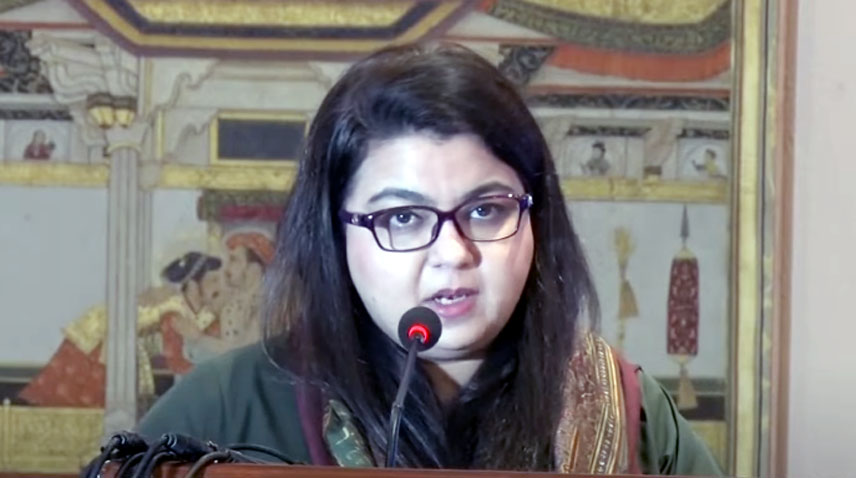
ISLAMABAD, Jul 22 (APP): Federal Minister for Information Technology and Telecommunication Shaza Fatima Khawaja on Wednesday said that Pakistan will own the full value chain of robotics and artificial intelligence because achieving advanced technological self-reliance is a national decision, and the country is now ready to realise that vision.
Addressing the two-day Indus RAS (Robotics and Autonomous Systems) Expo 2026, she said that, under the visionary leadership of Prime Minister Muhammad Shehbaz Sharif, the government has embraced a clear direction for Digital Nation Pakistan.
“A Pakistan where technology is not simply another lever of the economy but the true engine of productivity, employment and national competitiveness. This vision recognises that digital transformation is no longer optional,” she said.
The minister said that, as the world moves from the digital era into the intelligent era, artificial intelligence is itself moving into the physical world.
“It is becoming the foundational building block of value creation. Robots are moving from factories to warehouses, farms, roads, critical infrastructure, disaster areas and even national security.”
She said countries that lead these technologies will define the future economy, while those that remain mere consumers will continue to depend on others. Pakistan, she added, has chosen to lead.
“It is the foundational building block of sustained economic growth. Only yesterday, the Prime Minister launched the AI-enabled, evidence-led Prime Minister’s Office system, which is going to completely transform how the country is governed.”
Furthermore, she said the country’s defence leadership has transformed the military from a purely kinetic force into a robust cyber-centric institution.
“As the Ministry of IT and Telecom, we stand for the execution of this vision. We invest in digital infrastructure, innovation ecosystems, entrepreneurship, digital skills and emerging technologies.”
“We are creating an environment where innovators can build, startups can scale, investors can grow, young Pakistanis can compete globally and, most importantly, where the government serves as the ultimate enabler.”
She said the results were already visible.
“The export figures show that ICT exports grew by almost 21% this year. This is a testament to the resilience of our industry and the effectiveness of our policies.”
She said Pakistan’s progress was also reflected in international rankings.
“Pakistan today ranks among the top-tier countries in cybersecurity according to the ITU. We have moved up 14 places in the E-Government Development Index and 27 places in the ITU’s ICT Development Index.”
She said artificial intelligence has become the defining technology of the current generation, with robotics serving as its physical arm.
“The question is not simply whether Pakistan will use these technologies. The question is whether Pakistan will own them. Building indigenous capabilities and developing talent that will shape our future and safeguard our sovereignty is absolutely critical.”
She said sovereignty is increasingly measured not only by the ability to defend territorial boundaries but also by a nation’s ownership of and command over advanced technologies.
Referring to Marka-e-Haq, she said the operation demonstrated not only Pakistan’s conventional military capabilities but also the effectiveness of cyber and autonomous systems under the leadership of the Prime Minister and Field Marshal Syed Asim Munir.
She said the country’s defence institutions, together with industrial leaders, are driving digital innovation.
“These achievements give me confidence to stand before you today as your minister and as a member of the Prime Minister’s team to assure you that we are second to none.”
She said Pakistan’s ambitions must be rooted in reality and move beyond automation towards transformation.
“Our people, especially our youth, are Pakistan’s greatest asset. Today, we are building complete talent pipelines.”
She said the Prime Minister chairs productive employment meetings every month and that nearly one million young people have been trained this year, ranging from basic digital skills to advanced semiconductor and chip design programmes.
“My second core pillar is real-world testbeds. Robots become valuable when they leave factories and operate in real-world environments. We must establish more centres of excellence, and our robotics and autonomous systems must be tested under real-world conditions.”
She said the public sector must become the first intelligent buyer by creating opportunities for the private sector to develop solutions.
“Third is infrastructure and computing. Every one of us understands how critical data sovereignty has become.”
She said artificial intelligence requires data, connectivity, computing power and secure infrastructure, while robotics depends on sensors, edge computing, communications, control systems and reliable power.
“We must invest across the entire technology stack. Through our National AI Policy and National AI Initiative, approved by the cabinet last year, we are addressing every layer of this ecosystem.”
She said the fourth pillar is industry and investment.
“Our universities, factories, startups, investors and the public sector must act in unison. This must happen in a coordinated and disciplined manner.”
She called for financing mechanisms for deep technologies that can attract larger pools of risk capital.
“Procurement pathways must be opened for startups, shared fabrication facilities should be established, and partnerships between Pakistani companies and leading international firms must include guaranteed technology transfer.”
She said advanced technologies are rewriting the rules, reshaping realities and giving nations a once-in-a-generation opportunity to leapfrog decades of development. “This is an opportunity we cannot afford to miss.”

