
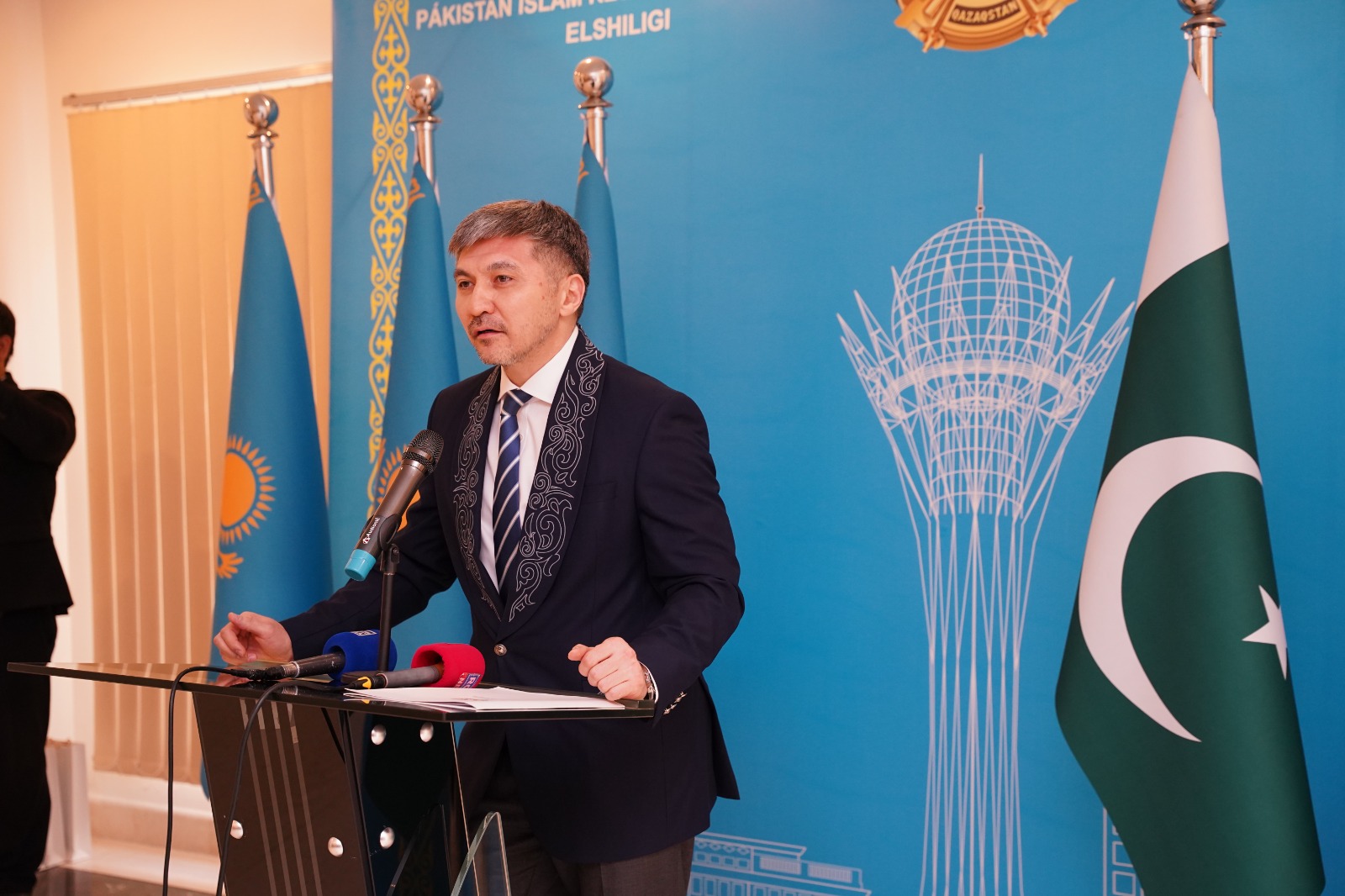
Ambassador of Kazakhstan to Pakistan H.E Yerzhan Kistafin on Monday has underscored the importance of rail and road connectivity for enhancing trade between Pakistan and Central Asia, saying that future cooperation between Pakistan and Kazakhstan in the energy sector would also depend on the development of regional infrastructure.
By Shams Abbasi
ISLAMABAD, Jul 20 (APP): Ambassador of Kazakhstan to Pakistan H.E Yerzhan Kistafin on Monday has underscored the importance of rail and road connectivity for enhancing trade between Pakistan and Central Asia, saying that future cooperation between Pakistan and Kazakhstan in the energy sector would also depend on the development of regional infrastructure.

Addressing a reception hosted for senior journalists at the Embassy of Kazakhstan, Ambassador Kistafin said stronger transport links, including rail, road and air connectivity, were indispensable for unlocking the full potential of regional trade and economic integration.
He added that the North-South and Middle Corridor initiatives could emerge as major drivers of regional commerce in the coming years.
The ambassador said Kazakhstan had emerged as one of the fastest-growing economies in Central Asia, with an annual Gross Domestic Product (GDP) of around US$ 300 billion , a per capita GDP of approximately $15,000 , and inflation maintained at a single-digit level.
He noted that Kazakhstan’s stable macroeconomic indicators and investor-friendly policies had created new opportunities for regional economic cooperation.
Speaking about Kazakhstan’s ongoing political and constitutional transformation, Ambassador Kistafin said the country had introduced wide-ranging reforms aimed at strengthening democratic institutions, improving governance and promoting sustainable economic growth.
He said nearly 300 new laws had been enacted over the past three years, laying the foundation for the country’s political, constitutional and economic transformation.
The envoy said the constitutional reforms would further strengthen Kazakhstan’s democratic and political system by enhancing the role of representative institutions and ensuring greater public participation in governance.
He added that the vision of a “New Kazakhstan” was focused on building a more transparent, accountable and inclusive state.
He said President ,Kassym-Jomart Tokayev was leading a comprehensive reform agenda centred on institutional strengthening, economic diversification, modernization of infrastructure, digital transformation and investment in human capital. These reforms, he added, were aimed at ensuring long-term economic resilience and sustainable development.
Reviewing his five-year diplomatic tenure in Pakistan, Ambassador Kistafin, who is expected to complete his assignment in the coming months, said bilateral relations had witnessed remarkable progress across political, economic and diplomatic spheres. He highlighted that, for the first time, Kazakhstan’s President, Prime Minister, foreign ministers and other senior officials had exchanged high-level visits with Pakistan, resulting in stronger bilateral engagement and expanded cooperation.
The ambassador said several institutional mechanisms had also been established during his tenure, including a bilateral Business Council and joint working groups on trade, information technology and education.
These platforms, he noted, were helping both countries identify new opportunities for investment, commercial partnerships and knowledge exchange.
Ambassador Kistafin said Kazakhstan remained committed to strengthening economic diplomacy with Pakistan and promoting regional integration through practical initiatives.
He stressed that enhanced connectivity would not only increase bilateral trade but also facilitate energy cooperation, transit, logistics and investment across Central and South Asia.
He expressed confidence that with improved transport infrastructure and sustained political commitment, Pakistan and Kazakhstan could transform their strategic partnership into a comprehensive economic relationship, benefiting the wider region through increased trade, connectivity and shared prosperity.