
Pakistan Thursday told an emergency meeting of the UN Security Council that it had stepped up its diplomatic engagement with key regional and international stakeholders to facilitate follow-up and implementation of the Islamabad Memorandum of Understanding (MoU) by Iran and the United States that is aimed at ending the Middle East conflict.
At UNSC, Pakistan says it has stepped up diplomatic engagement aimed at ending US-Iran conflict
By Iftikhar Ali
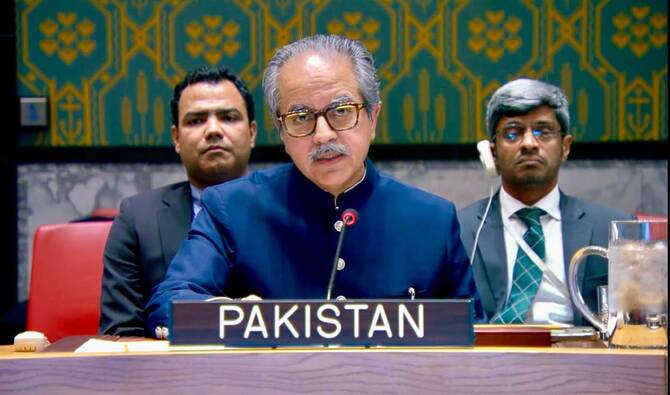
UNITED NATIONS, Jul 02 (APP): Pakistan Thursday told an emergency meeting of the UN Security Council that it had stepped up its diplomatic engagement with key regional and international stakeholders to facilitate follow-up and implementation of the Islamabad Memorandum of Understanding (MoU) by Iran and the United States that is aimed at ending the Middle East conflict.
“It has been Pakistan’s consistent belief that the only way to settle the situation in the region, conclusively and comprehensively, is through diplomacy, dialogue and negotiations,” Ambassador Asim Iftikhar Ahmad, permanent representative of Pakistan to the UN, said at the session convened by Bahrain to address the escalating tensions in the Gulf region following Iran attacks in recent days on Bahrain and Kuwait.
Pakistan, he said, has maintained a principled position on the inadmissibility of any use of force outside the bounds of international law – the unwarranted strikes against Iran and those targeting the Gulf Cooperation Council (GCC) countries, and has been condemning attacks against the GCC countries and once again expresses its full solidarity with “our brothers and sisters in Bahrain and Kuwait”.
Ambassador Asim Ahmad said Pakistan has been engaged from the beginning, under the firm conviction that any further escalation would only exacerbate human suffering and carry grave consequences for regional and international peace and security.
In this regard, he said the Islamabad Memorandum of Understanding between Iran and the United States is a “victory for diplomacy”.
On Wednesday, he added, Pakistan and Qatar concluded separate meetings with the United States and Iranian negotiators in Doha, he said, adding that the parties agreed to continue discussions.
“The fact that the talks are continuing and the parties are at the negotiating table is a significant positive outcome,” the Pakistani envoy pointed out, adding that the channels of communication remain open.
“Pakistan’s leadership remains engaged with the parties, our partners and the regional countries,” he said, adding, “We continue to facilitate dialogue and confidence building measures to prevent any escalation, and to sustain the diplomatic engagement.”
On his part, Bahrain’s Minister for Foreign Affairs Abdullatif bin Rashid al Zayani claimed that, since 28 February, Bahrain has been subjected to a total of 808 attacks, comprising 203 ballistic missiles and 605 armed drones.
“These attacks deliberately targeted civilian facilities, critical infrastructure and residential areas, resulting in the deaths of three innocent civilians and injuries to 465 others,” he said.
The facts on the ground disprove Iran’s claim that these attacks are directed solely against military objectives, Zayani said, citing the 5 April incident, when he said an Iranian drone struck an ammonia storage tank located within a densely populated residential area.
“Had it not been for precautionary measures and the decision to empty the tank beforehand, the release of toxic ammonia gas could have caused a catastrophic humanitarian disaster,” he said.
These attacks constitute a clear violation of the UN Charter and Council resolution 2817 (2026), which was supported by 136 Member States, Bahrain’s foreign minister said.
U.S. Ambassador Michael Waltz told that 15-member Council that “Iran cannot, and we cannot allow it to, hold the world’s economy hostage,” noting that Teheran stopped every ship from transiting the Straits of Hormuz.
“It didn’t matter if the ship was carrying fertilizers to farmers in Africa, aid to Sudan, fuel to Japan” or “whether they were involved in this conflict or not”.
He disputed an argument that Iran hit back on military sites, fired back on United States bases in the region and on Israel, citing that the UN Trade and Development Agency found that Iran’s closure of the Strait of Hormuz will have lasting effects on 61 developing economies.
On the other hand, Iran’s UN Ambassador Amir Saeid Iravani accused the United States of having resorted to lies and disinformation against Iran in a desperate attempt to justify the US’s unlawful acts of aggression.”
“The facts are clear,” he said. Amid negotiations, together with the Israeli regime, the United States “betrayed diplomacy twice” and launched two wars of aggression against Iran in blatant violation of the UN Charter and international law.
“Iran is the main victim of the wars of aggression launched by the United States and the Israeli regime. The role of the victim and the aggressor must not be reversed,” he stressed.
He also rejected “unfounded accusations made by certain Western members of the Council and the representative of Bahrain”.
Instead of addressing the root cause of the current crisis, they have ignored the unlawful aggression committed against Iran and sought to shift blame onto the victim.
“Their double standards and hypocritical behaviour have deprived them of any credibility to lecture others,” he stressed.
The United States has repeatedly violated the 8 April ceasefire and its commitments under the Islamabad Memorandum of Understanding by launching further attacks against Iran’s sovereignty and territorial integrity, he said.
Despite this deep betrayal, Iran engaged in diplomacy in good faith through negotiations facilitated by Pakistan resulting in the 17 June memorandum of understanding.
The presence of US military bases and foreign interference in the Persian Gulf region brings nothing but insecurity. “The US has no coastal border in our region. It is not their waters. It is not their neighborhood,” he said.
“The priority must be the full implementation of the MoU and the continuation of negotiations towards a comprehensive deal,” he said, stressing the Security Council should support this process, encourage full compliance with the memorandum of understanding and “refrain from provocative actions that could undermine diplomacy or further escalate tensions”.

