Key national stakeholders highlighted the challenges and opportunities of Pakistan’s climate and energy transition, with a focus on labour rights, social protection, employment and social dialogue.

ISLAMABAD, Jun 30 (APP): Key national stakeholders highlighted the challenges and opportunities of Pakistan’s climate and energy transition, with a focus on labour rights, social protection, employment and social dialogue.
During the 5th National Labour Conference on the theme “Decent Work and Just Energy Transition”, organized here by Friedrich-Ebert-Stiftung (FES), key national stakeholders deliberated on the challenges and opportunities emerging from Pakistan’s climate and energy transition, with a particular focus on labour rights, social protection, employment and social dialogue.
The conference was inaugurated by Federal Minister for Overseas Pakistanis and Human Resource Development Chaudhry Salik Hussain, who reaffirmed the Government’s commitment to promoting decent work, strengthening labour institutions and ensuring that workers were not left behind during Pakistan’s economic and environmental transformation.
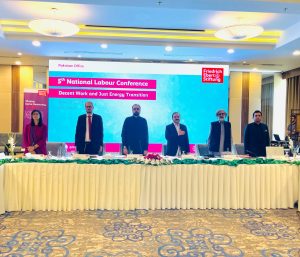
As Pakistan accelerates its transition towards a low-carbon and climate-resilient economy, experts, policymakers, trade union leaders, academia and civil society have stressed that the country’s energy transition must be inclusive and centered on the rights and livelihoods of workers.
Welcoming the participants, Felix Kolbitz, Country Director of FES Pakistan emphasized that a successful energy transition cannot be achieved without meaningful social dialogue, strong labour protections, gender-responsive policies and active participation of workers’ organizations in policymaking.
Presenting the objectives of the conference, Sidra Saeed, Regional Climate Coordinator at FES Pakistan, underlined the need for evidence-based policy dialogue to ensure that climate action simultaneously advances social justice, employment security and sustainable development.
The inaugural session also featured a presentation by Badar Alam, Chief Executive Officer (CEO) of the Policy Research Institute for Equitable Development (PRIED), who outlined the concept of a “Just Transition” within Pakistan’s socio-economic and institutional context. He stressed that climate policies should be designed to generate decent employment while protecting vulnerable workers and communities.
The second session focused on policy research examining Pakistan’s transition towards a sustainable energy future. Three research papers were presented covering adaptive social protection for women informal workers, the role of trade unions in advancing a just energy transition and the implications of power sector reforms on workers and consumers. The discussion highlighted that effective climate adaptation required expanding social protection systems, strengthening collective bargaining, investing in skills development and ensuring that labour voices were integrated into national energy planning.
The conference concluded with a high-level dialogue among leading representatives of Pakistan’s labour movement. Trade union leaders representing the power sector, industrial workers, home-based women workers and different labour federations shared ground realities from across the country and called for stronger labour laws, revisit the policies of privatization of public sector, expanded social security coverage, workplace safety, investment in green jobs and institutionalized social dialogue between government, employers and workers.
Participants collectively emphasized that Pakistan’s transition towards a greener economy should not merely focus on environmental sustainability but must focus on decent work and equitable economic opportunities. They called upon the Government, employers and development partners to work together in designing a comprehensive national framework for a just energy transition that protected workers’ rights while promoting sustainable economic growth.