ISLAMABAD, Jun 29 (APP):Experts at a policy consultation have called for an integrated economic governance framework to help Pakistan break free from recurring cycles of economic instability, emphasizing that sustained growth would only be possible through policy coherence, institutional coordination and long-term reforms. The consultation on "Pakistan's Reform Agenda for Integrated Economic Governance," was jointly organized by Sustainable Development Policy Institute (SDPI) and Friedrich-Ebert-Stiftung (FES) here on Monday. In his …
Experts for adopting integrated economic governance to break economic crisis cycle
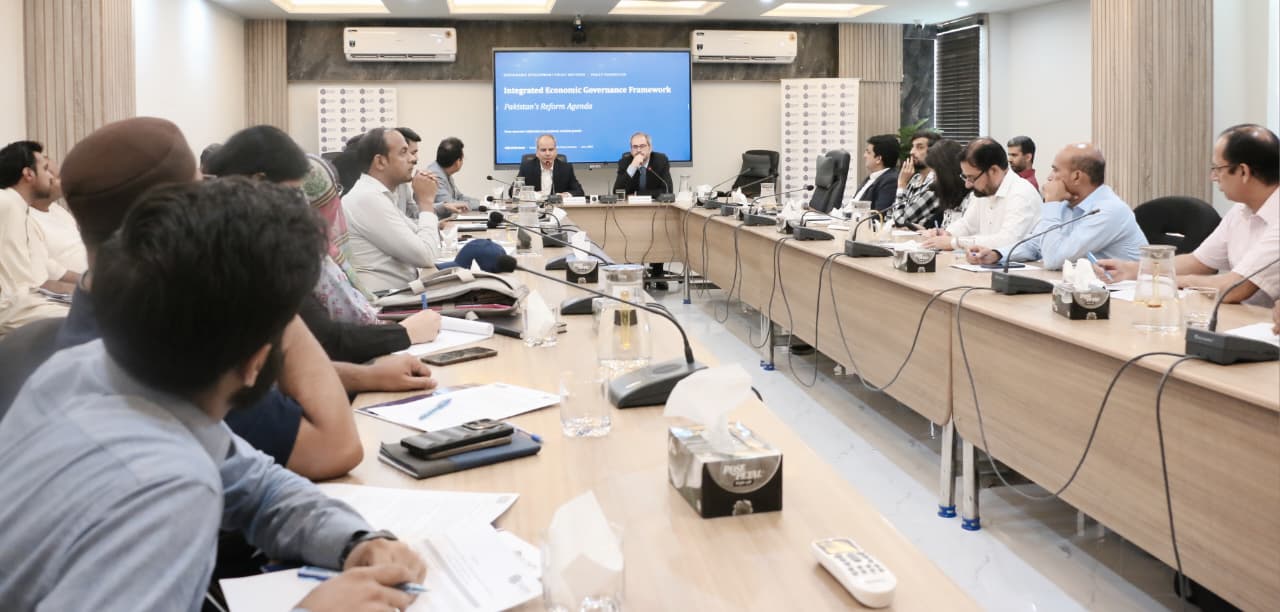
ISLAMABAD, Jun 29 (APP):Experts at a policy consultation have called for an integrated economic governance framework to help Pakistan break free from recurring cycles of economic instability, emphasizing that sustained growth would only be possible through policy coherence, institutional coordination and long-term reforms.
The consultation on “Pakistan’s Reform Agenda for Integrated Economic Governance,” was jointly organized by Sustainable Development Policy Institute (SDPI) and Friedrich-Ebert-Stiftung (FES) here on Monday.
In his opening remarks, Dr Sajid Amin Javed, SDPI Deputy Executive Director (Research), said Pakistan has repeatedly achieved short-term macroeconomic stabilization but has failed to sustain it. “Almost every third fiscal cycle, Pakistan achieves stabilization but subsequently loses it,” he said, adding that the consultation aimed to identify policy interventions capable of ensuring consistent and sustainable economic growth.
Recalling the economic uncertainty during the recent financial crisis, Dr. Javed said public discourse at the time revolved around fears of sovereign default. “Pakistan’s challenge was not a shortage of policies but the lack of continuity, coordination and coherence in implementing them, he said, adding that an integrated economic governance framework must align fiscal, monetary, trade, industrial and social policies to avoid conflicting policy objectives.
Dr. Javed noted that Pakistan’s long-term average economic growth has remained around four per cent, significantly below regional competitors such as Bangladesh and India.
He observed that Pakistan’s growth has been low, short-lived and consumption-driven, thus failed to generate sufficient employment or reduce poverty. Although GDP growth rose to 3.7 per cent during the last fiscal year, poverty, unemployment and income inequality also increased, which means the poor quality of growth.
He pointed out that Pakistan was the fastest-growing economy in South Asia during the 1980s with average annual growth exceeding 6.5 per cent, but its average growth during the current decade has fallen to nearly 2.5 per cent.
Highlighting policy contradictions, Dr. Javed said Pakistan frequently advocates export-led growth while simultaneously pursuing an overvalued exchange rate policy that discourages exports. He also questioned the incentive structure under the National Finance Commission (NFC) Award, where provincial resource allocation remains heavily population-based, limiting incentives for provinces to improve tax collection.
Terming the government efforts towards tariff rationalization and a more market-based exchange rate regime describe as steps in the right direction, he stressed that sectoral policies must be aligned with national development goals.
Felix Kolbitz, the FES Country Director, Pakistan said economic reform was fundamentally an act of political courage rather than a technocratic exercise. Referring to former German Chancellor Willy Brandt’s famous pledge of “more democracy,” he said Pakistan similarly needed bold institutional reforms to build an integrated economic governance system capable of preventing repeated crises instead of merely responding to them.
Felix observed that Pakistan had experienced a familiar pattern of crisis, stabilization packages, reform promises and partial recoveries before slipping back into economic distress. He argued that genuine reform required strong institutions, effective coordination among economic policies and governance frameworks capable of ensuring continuity.
He emphasized that economic policy should ultimately improve people’s lives rather than simply producing favourable macroeconomic indicators. Growth that excludes women, young people and marginalized communities, he said, cannot be considered sustainable development.
Dr. Aliya Hashmi, Senior Economist and academician, emphasized the need for clearly defined national growth targets supported by a comprehensive reform agenda, implementation framework and effective monitoring and evaluation mechanisms.
She said Pakistan must prioritize the creation of productive employment opportunities for its rapidly growing youth population, warning that improvements in GDP figures alone would not deliver meaningful development without quality job creation.
Dr. Hashmi also stressed the importance of increasing women’s participation in the labour force, noting that greater female employment had contributed to lower fertility rates and stronger economic outcomes in several regional countries, including India.
Meanwhile, Dr. Muhammad Ali Talpur, Joint Chief Economist at the Ministry of Planning, identified political instability, weak policy coordination and lack of continuity as major obstacles to effective economic governance.
Endorsing SDPI’s diagnosis of Pakistan’s economic challenges, he said the government had already identified key governance weaknesses and initiated 142 policy actions across 58 departments to address them. He said significant reforms had already been undertaken, including separating tax policy from tax administration within the Federal Board of Revenue (FBR), reflecting the government’s recognition of structural weaknesses.
Dr. Talpur noted that Pakistan continued to struggle with persistent internal and external deficits, which had constrained economic policymaking for decades. He stressed that future reforms should focus on investing in human capital, boosting exports through deregulation and tariff rationalization, and enhancing export competitiveness.
He added that the National Economic Council, as the country’s highest planning forum with representation from both federal and provincial governments, was well positioned to promote coordinated national development planning and strengthen integrated economic governance.