Federal Minister for Climate Change and Environmental Coordination, Musadik Malik said on Monday that Pakistan was taking the Indus Waters Treaty (IWT) issue beyond a bilateral dispute, as a global question of justice, fundamental rights and the protection of downstream nations’ access to water.
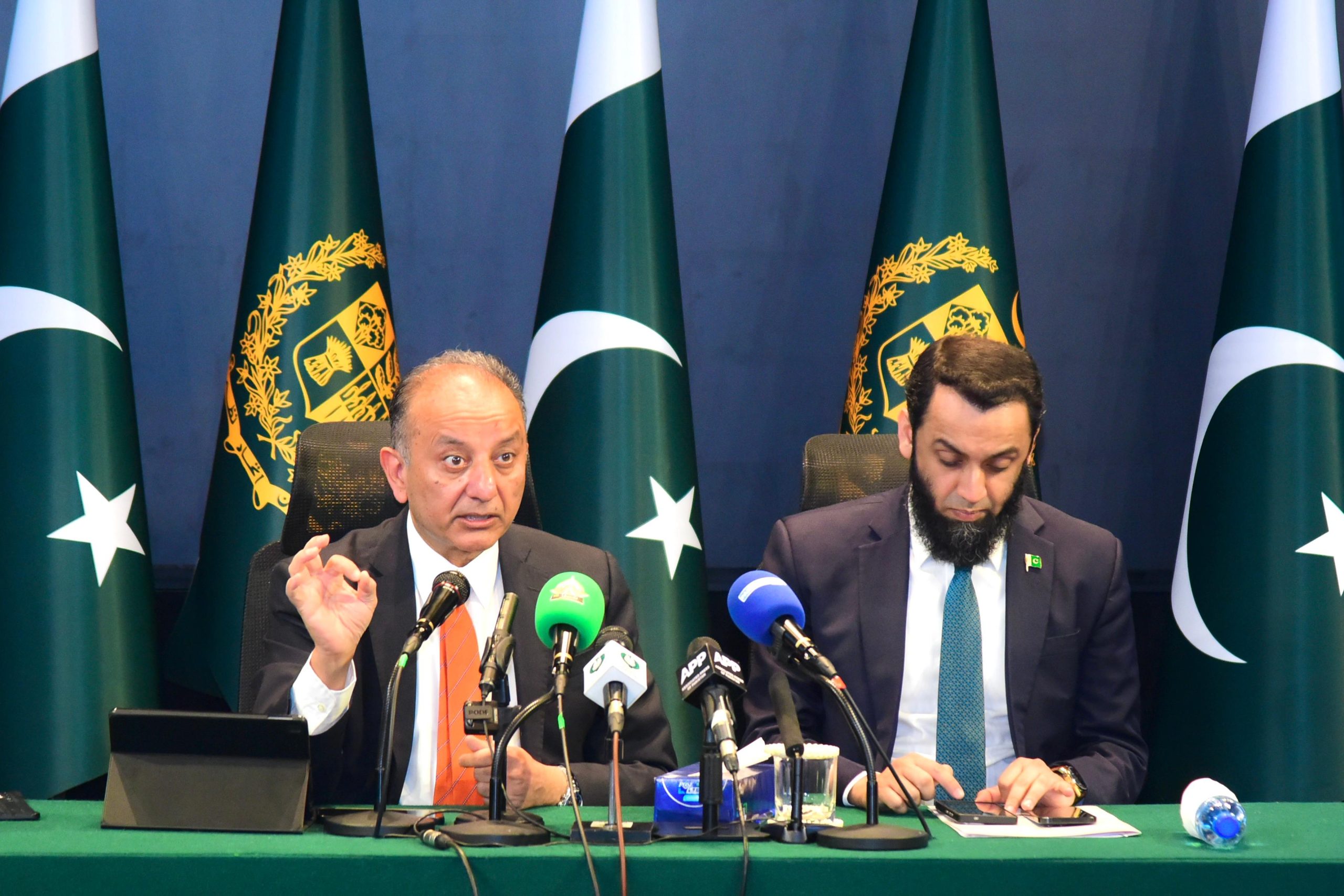
ISLAMABAD, Jun 29 (APP): Federal Minister for Climate Change and Environmental Coordination, Musadik Malik said on Monday that Pakistan was taking the Indus Waters Treaty (IWT) issue beyond a bilateral dispute, as a global question of justice, fundamental rights and the protection of downstream nations’ access to water.
Addressing a joint press conference with the Federal Minister for Information and Broadcasting Attaullah Tarar, Malik said Pakistan had raised the issue within the United Nations, its affiliated institutions and international arbitration forums, where, he said, Pakistan’s position had been endorsed.

He said the central question was not merely what would be discussed at the upcoming seminar on IWT, but what broader issue laid behind it.
“I will tell you a small story,” Malik said, introducing the case of “Iqbal Solangi,” a farmer living near the Sindh-Balochistan border, as a symbol of millions of Pakistanis affected by recurring floods and droughts.
According to the minister, Solangi’s village was devastated by the 2010 floods, again by floods in 2012, and once more during the 2022 floods. At other times, he said, the land became so dry that deep cracks appeared in the soil, making cultivation impossible.
Malik said many observers attributed such hardships solely to climate change, but argued that another factor also determined whether farmers received water or suffered drought.
“There is a tap whose handle is in the hands of the prime minister of our neighbouring country, who says not a single drop of water will be allowed to flow into Pakistan,” he said.
He argued that Solangi’s story represented millions of Pakistanis whose livelihoods depended on agriculture.
According to Malik, between 40 and 50 per cent of Pakistan’s population depended on agriculture for employment, the sector contributed between 20 and 25 per cent of the country’s economy, and Pakistan’s food security depended entirely on water availability.
“Our food security, our economy and the livelihoods of millions are linked to this water,” he said, adding that decisions affecting river flows should not rest in the hands of another country.
Malik said Pakistan had been presenting this argument at international forums, including discussions he recently attended in Brussels, where, he said, the issue was framed as one extending beyond Pakistan.
He argued that if upstream countries were allowed to stop or manipulate river flows to downstream states, it would create consequences for river systems across the world.
Referring to other international rivers, he questioned whether Spain had ever stopped water flowing to Portugal, or whether countries sharing rivers across Europe had prevented downstream states from receiving water.
“If this becomes acceptable here, what about all the other countries that depend on rivers flowing across borders?” he asked.
Malik said the conference would therefore focus not only on the Indus Waters Treaty but also on justice and fundamental rights.
“This conference is about justice,” he said. “This conference is about rights. It will decide whether children living downstream around the world have a right to water.”
He said Pakistan would present legal, technical and treaty-related aspects of the issue to journalists and international audiences, including explanations of international conventions governing transboundary rivers.
Drawing a broader comparison, Malik said much of the peace established after the Second World War rested upon international agreements and treaties. He argued that disregarding such agreements weakened the international rules-based order.
Responding to a question, Malik said concerns had previously existed that a series of run-of-the-river hydropower projects could enable India to temporarily retain enough water at critical agricultural periods to damage crops downstream.
He said international rulings had already accepted Pakistan’s position that water storage associated with run-of-the-river projects was subject to technical engineering limits and could not be carried out without restriction.
Malik said recent events had demonstrated that while water could not be withheld indefinitely, even short-term interruptions reinforced earlier concerns regarding the timing of river flows needed for agriculture.
He stressed that Pakistan also had a responsibility to improve its own water management by expanding storage and regulating seasonal flows.
“The purpose of dams is not merely storage,” he said. “Their purpose is to regulate water so that farmers receive it when crops actually need it.”
He noted that during major floods, water equivalent to several Mangla or Tarbela reservoirs could flow into the sea, while farmers experienced shortages during planting seasons.
Calling for national consensus, Malik urged all political parties to support water storage and regulation projects, saying the issue should rise above political controversy because it concerned the welfare of farmers across Pakistan.
Asked about progress on the Diamer-Bhasha and Dasu dams, Malik said detailed information fell under the Ministry of Water Resources, but added that Pakistan was not relying exclusively on international financing for the projects.
“We are doing this for our own children,” he said, adding that while international loans and grants were appreciated, Pakistan remained committed to completing the projects even if progress took longer without external support.
He said federal development resources were constrained by debt servicing obligations and constitutional transfers to provinces, but added that a significant portion of the development budget had been allocated to water projects, with the government intending to increase both funding and implementation speed.
Malik also said consultations among political stakeholders on water-related issues were continuing and would gain renewed momentum in light of recent developments surrounding the Indus Waters Treaty.
Concluding the press conference, the minister said Pakistan would continue presenting its case internationally and inviting debate.
“We are not asking the world simply to listen to us,” he said. “We are asking the world to question us. And when there are no questions left, then ask yourselves whether this is justice.”