ISLAMABAD, Jun 25 (APP):The Central Development Working Party (CDWP) on Thursday approved 15 development projects worth Rs34.74 billion and recommended nine major projects, costing Rs431.02 billion, to the Executive Committee of the National Economic Council (ECNEC) for final approval. Chairing the meeting, Federal Minister for Planning, Development and Special Initiatives/Deputy Chairman of the Planning Commission Professor Ahsan Iqbal stressed that strategic investments in technology, connectivity and infrastructure would accelerate economic …
CDWP approves 15 projects worth Rs34.74bn, refers nine schemes of Rs431bn to ECNEC
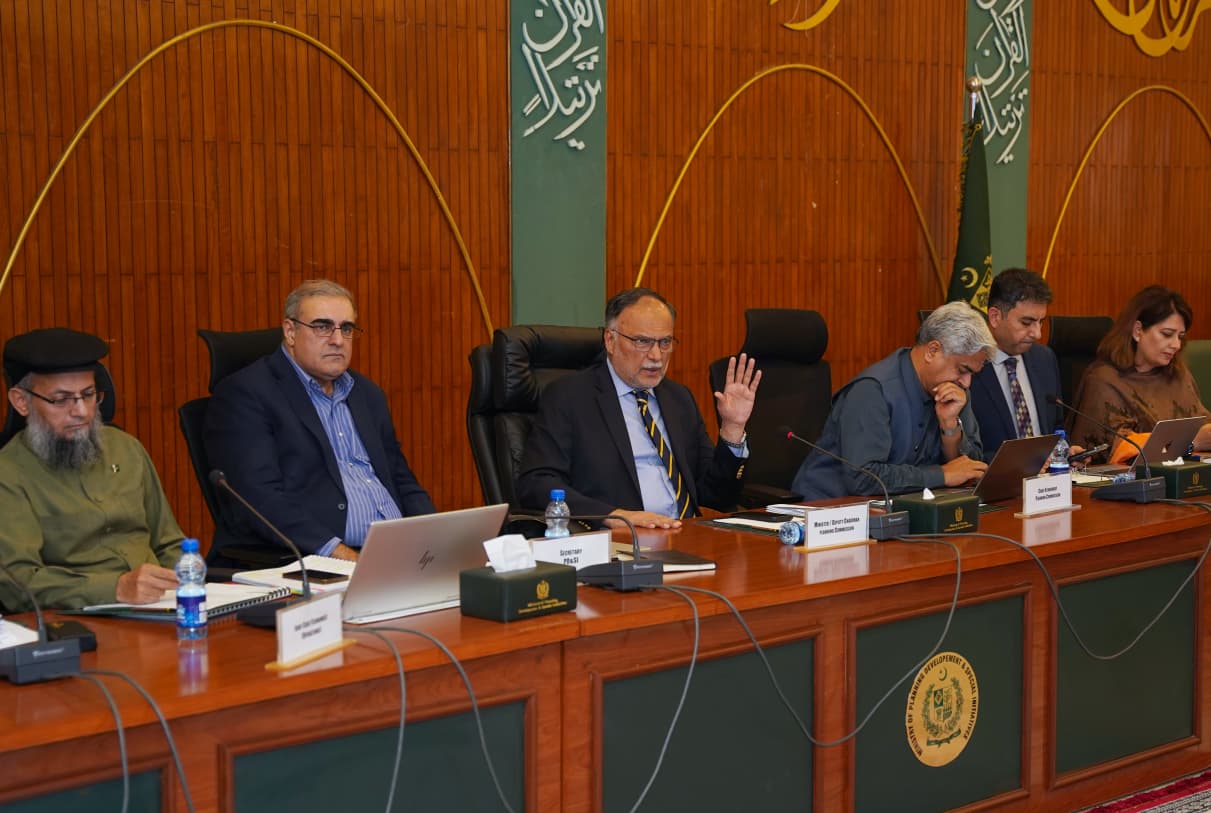
ISLAMABAD, Jun 25 (APP):The Central Development Working Party (CDWP) on Thursday approved 15 development projects worth Rs34.74 billion and recommended nine major projects, costing Rs431.02 billion, to the Executive Committee of the National Economic Council (ECNEC) for final approval.
Chairing the meeting, Federal Minister for Planning, Development and Special Initiatives/Deputy Chairman of the Planning Commission Professor Ahsan Iqbal stressed that strategic investments in technology, connectivity and infrastructure would accelerate economic growth.
The meeting was attended by the Secretary Planning Awais Manzur Sumra, Chief Economist, VC PIDE, Members of the Planning Commission, Federal Secretaries, heads of Provincial Planning & Development Board Departments, and senior representatives from relevant federal ministries and provincial governments.
The minister said the projects were aligned with the vision of Uraan Pakistan, focusing on digital transformation, modern infrastructure, human capital development and sustainable growth.
He emphasized that investments in artificial intelligence, data infrastructure and connectivity were essential for building a competitive, knowledge-based economy.
Among the projects approved by the CDWP were exploration of radioactive minerals in the Marwat Range, installation of CT Scan and MRI machines in DHQ and teaching hospitals of AJ&K, establishment of Prime Minister’s E-Sports Arenas and Training Centres in higher education institutions, and development of the Geospatialx Complex (GEO-AI Development and Innovation Hub).
The forum also approved upgradation of IT infrastructure at the Faculty of Security Studies of the National Defence University, the PAKAWAZ Secure Mobile Communication Ecosystem, construction of accommodation and operational facilities for Intelligence Bureau and Frontier Corps personnel, a 120-bed hospital for Frontier Corps South in Turbat, and establishment of a Robotics Centre of Excellence.
In the power sector, approval was granted for the supply of three-phase Advanced Metering Infrastructure (AMI) meters under LESCO’s Power Distribution Strengthening Project-II, while two revised road connectivity schemes in Punjab were also cleared.
The projects referred to ECNEC included the Rs7.93 billion Establishment of Emerging Technologies Data Centre, aimed at providing sovereign AI and high-performance computing infrastructure, and the Rs13 billion National Artificial Intelligence Ecosystem Development Programme (NAIEDP) to strengthen Pakistan’s AI ecosystem through detailed feasibility and implementation planning.
The CDWP also recommended the Rs37.19 billion Pakistan Communication Satellite-2 (PakSat-2) project, which will enhance national satellite communication capabilities through deployment of a new communication satellite and upgradation of ground control facilities.
Other projects referred to ECNEC included establishment of a Special Protection Unit facility for Islamabad Police, strengthening and improvement of electricity supply networks in AJ&K, construction of the Lalamusa Bypass on N-5, upgradation of the 996-kilometre ML-3 railway section from Rohri to Taftan, construction of the Mashkel-Chedgi Road in Balochistan, and the revised Rathoa Haryam Bridge project in Mirpur, AJ&K.
While reviewing the Rathoa Haryam Bridge scheme, Ahsan Iqbal noted that the project had remained stalled for years and said the government had prioritized its revival after assuming office in 2022.
He said completion of long-delayed projects reflected the government’s commitment to ensuring timely delivery of development initiatives and improving regional connectivity.