
By Iftikhar Ali UNITED NATIONS, Jun 11 (APP):As the United States launched new strikes against multiple targets in Iran, Pakistan told the UN Security Council that it remains actively engaged in facilitating dialogue and mediation aimed at reducing the US-Iran tensions. Addressing the 15-member Council, Ambassador Asim Iftikhar Ahmad, permanent representative of Pakistan, also said that Pakistan remains actively engaged in efforts to advance the Gaza Peace Plan, a 20-point …
Amid escalating Mideast conflict, Pakistan vows to continue US-Iran mediation
By Iftikhar Ali
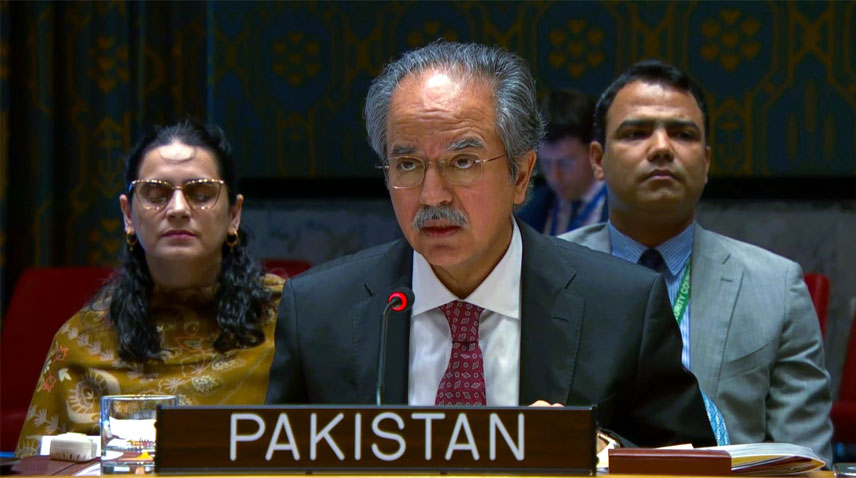
UNITED NATIONS, Jun 11 (APP):As the United States launched new strikes against multiple targets in Iran, Pakistan told the UN Security Council that it remains actively engaged in facilitating dialogue and mediation aimed at reducing the US-Iran tensions.
Addressing the 15-member Council, Ambassador Asim Iftikhar Ahmad, permanent representative of Pakistan, also said that Pakistan remains actively engaged in efforts to advance the Gaza Peace Plan, a 20-point multilateral agreement brokered by the United States which is aimed at halting hostilities,
“Navigating these complex and sensitive issues demand patience, resolve and objectivity by all– That continues to guide Pakistan’s approach,” he said during a Council debate on “Advancing Political Solutions in the Middle East: Mediation and Dialogue for Lasting Peace”.
The debate was one of the signature events of the Colombian presidency of the Council for the month of June.
The Pakistani envoy stressed that the “Arab-Israeli conflict” is one of the largest, oldest issues on the Council’s agenda. “The illegal occupation of Arab lands must end, ceasefires must be respected and humanitarian assistance must flow unimpeded”, he said. In the Middle East, history, culture and religion “interact profoundly”, and he stressed that any efforts towards peace in the region must account for this reality.
“Peace efforts must therefore account for these sensitivities with care, balance, objectivity and deep understanding,” Ambassador Asim Ahmad added.
In Gaza, he said, after nearly three years of devastating conflict and Israeli onslaught, humanitarian suffering reached catastrophic proportions. However, despite the ceasefire, violations and killings of the Palestinians continue and in the West Bank, a deliberate policy of settlement expansion, settler violence, and unilateral actions undermine the viability of a two-state solution.
In Lebanon, the Pakistani envoy said that relentless Israeli bombardment has killed thousands while the illegal occupation of Southern Lebanon keeps on expanding.
Syria, with its new leadership and bold political decisions is making efforts towards gradual stabilization, yet it continues to face occupation in south, he pointed out.
In Yemen, he said, only an inclusive Yemeni-led and Yemeni-owned political process under UN auspices can deliver peace.
Pakistan, he added, views the developments in West Asia and broader Gulf region with great concern. Concerted mediation efforts by Pakistan, together with other partners, including Turkiye, Egypt and Saudi Arabia, and others including Qatar and China, and cooperation of the parties to bring about a ceasefire, and de-escalation enabling the parties to return to the negotiations, but the situation remains tense.
“Our immediate priority must be to continue diplomacy, achieve complete cessation of hostilities and normalization of the situation in the Strait of Hormuz, which is vital for all countries in the region and beyond,” the Pakistani envoy said, adding. “A comprehensive peaceful settlement of all issues is imperative for lasting peace and stability.”
Pakistan, he said, supports the sovereignty, territorial integrity, political independence and security of all brotherly countries in the region. Pakistan had also expressed continued and unwavering support and complete solidarity with the fraternal Gulf countries in these challenging times.
“The Middle East today requires peace and so does the rest of the world,” Ambassador Asim Ahmad said.
“The costs of continued conflict are no longer confined within borders; they reverberate globally. The responsibility before this Council is therefore clear: to place diplomacy above confrontation, dialogue above division, and international law above expediency”, he said.
“This is the path toward lasting peace, and this is the path that we must collectively pursue.”

