
ISLAMABAD, Jun 11 (APP):Defying global uncertainty, devastating floods and regional tensions, Pakistan’s economy rebounded with a robust 3.7 per cent GDP growth in fiscal year 2025-26, showcasing resilience and disciplined economic management, Federal Minister for Finance and Revenue Senator Muhammad Aurangzeb said on Thursday. Unveiling the Economic Survey of Pakistan 2025-26, he said the country stayed firmly on its path from stabilization to growth despite multiple external shocks, reflecting renewed …

ISLAMABAD, Jun 11 (APP):Defying global uncertainty, devastating floods and regional tensions, Pakistan’s economy rebounded with a robust 3.7 per cent GDP growth in fiscal year 2025-26, showcasing resilience and disciplined economic management, Federal Minister for Finance and Revenue Senator Muhammad Aurangzeb said on Thursday.
Unveiling the Economic Survey of Pakistan 2025-26, he said the country stayed firmly on its path from stabilization to growth despite multiple external shocks, reflecting renewed confidence in the economy.
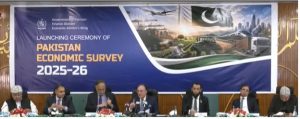
The minister, accompanied by Federal Minister for Planning, Development and Special Initiatives Professor Ahsan Iqbal, Federal Minister for Information and Broadcasting Attaullah Tarar, Minister of State for Finance and Revenue Bilal Azhar Kayani and senior officials from the Ministry of Finance and Revenue, highlighted key economic indicators and performance.
“The survey is not just an economic document but a story of resilience shown over the past year,” Aurangzeb said, adding that Pakistan remained steadfast on its journey from stabilization to growth.
He said that the fiscal year began with global trade uncertainty due to tariff-related issues, followed by devastating floods in August and September and later a regional conflict. “These exogenous factors tested Pakistan’s resilience, and we responded effectively while maintaining our growth trajectory,” he remarked.
Despite these challenges, the country recorded its highest GDP growth in four years. He recalled that the economy had contracted by 0.2 per cent in 2023, followed by growth of 2.6 per cent in 2024 and 3.2 per cent in 2025.
Aurangzeb said Pakistan’s economic size reached a historic level of Rs126.9 trillion, equivalent to $452.1 billion, while per capita income increased to $1,901 from $1,751 last year.
He said the growth was broad-based, with agriculture expanding by 2.89 per cent despite flood-related losses. The crop sector returned to positive growth while livestock, contributing around 60 per cent to agricultural GDP, continued to perform strongly, he added.
The industrial sector, he said, also showed significant improvement, with large-scale manufacturing growing by 6.1 per cent, the highest in four years. Out of 22 manufacturing sectors, 16 recorded positive growth, including food, textiles, automobiles, petroleum products and electrical equipment.
On the demand side, he pointed to strong consumption trends, including a 10 per cent increase in cement demand, 17 per cent in fertilizer, 31 per cent in automobiles and notable growth in petroleum and mobile phone usage.
The services sector remained a key driver of the economy, growing by 4.9 per cent and contributing nearly 58 percent to GDP. Information and communication services recorded a remarkable 7.52 per cent growth, reflecting the expanding role of the digital economy.
Highlighting fiscal consolidation, the minister said the fiscal deficit was reduced to 0.7 per cent of GDP from 2.6 per cent last year, while primary surplus improved. Federal Board of Revenue collections increased by 10.1 percent and markup payments declined by 23 per cent, creating additional fiscal space, he added.
“Despite global slowdown, where growth declined to 3.1 per cent, Pakistan has outperformed expectations,” Aurangzeb said, reiterating the government’s commitment to sustaining inclusive and broad-based economic growth.
More to follow

