
Pakistan has told the UN Security Council that the Tehrik-i-Taliban Pakistan (TTP) and other terror factions continue to operate with impunity from Afghan soil, warning that Islamabad would respond to any attacks in self-defence whenever needed.
Pakistan vows self-defence against India-backed TTP terrorist attacks: ‘We won’t sit Idle’
Iftikhar Ali
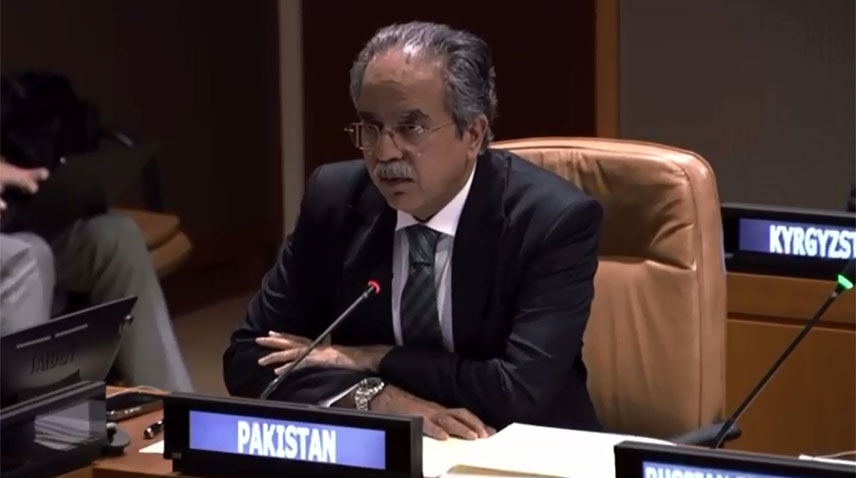
UNITED NATIONS, Jun 09 (APP):Pakistan has told the UN Security Council that the Tehrik-i-Taliban Pakistan (TTP) and other terror factions continue to operate with impunity from Afghan soil, warning that Islamabad would respond to any attacks in self-defence whenever needed.
“We will not sit idle while suffering from terrorist acts,” Ambassador Asim Iftikhar Ahmad, permanent representative of Pakistan to the UN, said during a 15-member Council debate on the deteriorating situation in Afghanistan on Monday.
Pakistan, he said, has experienced an “exponential rise” in terrorist attacks, many planned in Afghanistan and carried out with munitions left behind by departing foreign armed forces.
“It is deplorable that the Taliban have reverted back to their old tactics of providing safe havens to terrorist groups and chosen the perilous path of complicity, backed by an outside actor, the historic spoiler and instigator of chaos, that has moved fast as an opportunist to wage a proxy war against Pakistan,” the Pakistani envoy said, in an obvious reference to India.
While remaining open to dialogue, Ambassador Asim Ahmad said, “Pakistan will defend itself against whosoever attempts to harm our sovereignty, territorial integrity and national security.”
Numerous diplomatic efforts were made to counsel the Taliban, the Pakistani envoy said, as he thanked Qatar, Turkiye, Saudi Arabia and most recently, China, to find amicable solutions.
“Yet,” he said, “the Taliban’s continued intransigence and even refusal to publicly denounce and condemn terrorist groups such as the TTP and Balochistan Liberation Army (BLA) is deeply disturbing — it is evidence enough of their complicity and active support for these groups”.
In this regard, Ambassador Asim Ahmad reaffirmed Pakistan’s resolve to “respond in self-defense, as and when needed and always in conformity with international law and IHL (International Humanitarian Law.”
While the United Nations Assistance Mission in Afghanistan (UNAMA), he said was swift in reporting incidents of cross-border actions and casualties, it fails to provide the overall context — which is the grave terrorist threat emanating from Afghanistan and its cross-border impact directed at Pakistan that is harming Pakistan and killing innocent Pakistanis.
Neither the secretary-general’s report provides information on the destabilizing accumulation of small arms and light weapons inside Afghanistan, nor does it adequately shed light on Afghanistan’s illicit economy, with its complex web of money laundering and terror financing networks, including Hundi and Hawala networks. Instead, the report resorts to shifting the blame to external dynamics, with little regard for the Taliban’s own policies that have brought Afghanistan to the brink of disaster.
“We must not lose sight of the fact that it is the Taliban’s reckless style of governance and flawed ideologies of extremism, suppression, and radicalization that have brought upon Afghanistan the calamities it faces today,” the Pakistani envoy said.
Noting the underfunding of humanitarian needs, he said this was a direct result of the Taliban’s unwillingness to prioritize the welfare of Afghans over their own interest and authoritarian control.
He also clarified that the closure of the Pak-Afghan border does not affect the movement of humanitarian supplies. While Pakistan has been processing and facilitating the passage of humanitarian goods and material, the Afghan Taliban regime refuses to let them pass and keeps the border closed on its side.
The worsening situation of human rights is also aligned with the Taliban’s “failings and deceitful narrative” to meet the demands of the international community, with women and girls are denied their fundamental human rights and dignity, the Pakistani envoy said. The Afghan people are being held hostage to these inhumane restrictions, oppression and selfish behaviour, he pointed out.
For over four decades, he said, Pakistan welcomed millions of Afghan refugees despite limitations and insufficient international support, dealing with huge caseloads of illegal Afghans, including those without documentation, posing a serious threat to its security. “But these were never meant to be indefinite stays,” he said.
Ambassador Asim Ahmad urged the UN chief to outline the status of third-country resettlement cases of Afghans in a transparent manner — cases that are pending for years, despite being a tiny fraction of what Pakistan had to deal with, in the face of national security threats that no country would tolerate. “Shifting the blame of Afghanistan’s woes to the inflow of Afghan returnees will not solve the problem.”
Pakistan and Afghanistan, he said, are bound by geography, deep-rooted ties, civilizational links dating back centuries, and fraternal bonds of faith, culture and ethnicity.
“No country has suffered more from the consequences of conflict and instability in Afghanistan than Pakistan. So we understand, and we also know, that no country stands to benefit more from peace, prosperity and stability in Afghanistan than Pakistan.”
Pakistan’s demand from the Taliban is simple and clear: verifiable and non-reversible action against terrorists, the Pakistani envoy said.
“The window for course correction is narrowing, but is still open. We hope the Taliban realize this in earnest and cooperate with the international community for the long-term peace and development of Afghanistan and, above all, in the best interest of all Afghans.”
At the outset, Georgette Gagnon, Deputy Special Representative for Afghanistan and Officer-in-Charge of UNAMA, said that nearly 5.9 million people have returned since 2023, but “Afghans are returning to communities and an economy that cannot fully reintegrate them”, she said. More than half the population is under the age of 25, and young Afghans are coming of age with limited employment prospects, declining household incomes and environmental problems undermining livelihoods.
An estimated 3.8 million girls between 7 and 18 years of age are not in school. Such “imposition of systemic and institutionalized harm” is creating a lost generation of talent and potential, which is already costing the economy and undermining Afghanistan’s economic development. She also highlighted “the continued exclusion of UN female national staff from UN premises”.
Relations between Afghanistan and Pakistan remain strained, with continued border closures and security incidents, Ms. Gagnon added. The Doha Process participants must sustain engagement that supports Afghanistan’s eventual reintegration, and the de facto authorities must establish a structured mechanism for further engagement with UNAMA. With “principled and pragmatic” engagement, the international community can make incremental progress that supports the Afghan people, she added.
However, “prioritize principles over pragmatism” was the appeal from civil society representative Metra Mehran, who described the “gender apartheid” documented by her organization, the Afghanistan Justice Archive.
Since August 2021, she said, the Taliban have enacted over 230 decrees, criminalizing even “women’s faces and voices, she highlighting the Criminal Procedure Code of January 2026, which legalizes violence against women. That Code divides society into “free” and “enslaved”, criminalizes same-sex sexual conduct and treats men as the primary legal authority.
Edem Wosornu, Director of the Office for the Coordination of Humanitarian Affairs’ Crisis Response Division, said Afghanistan remains one of the world’s largest and most complex humanitarian crises.”
Nearly half the country’s population needs help, driven by insecurity, economic fragility, climate shocks and restrictions on women and girls, she said.
In late February, Ms. Wosornu said, fighting re-erupted between Afghanistan and Pakistan, displacing over 100,000 people and causing several hundred civilian casualties.
“Already struggling families were pushed even closer to the edge,” with damage to health facilities and schools, disrupting services for tens of thousands.
“Hunger is growing across Afghanistan,” she continued, noting that some 4.7 million people are at risk of severe food insecurity – 50 per cent higher than the same period last year.