ISLAMABAD, Jun 4 (APP):Indonesia has warned that future international competition and conflicts could increasingly be driven by access to and control over freshwater resources, replacing traditional disputes centered on oil, land, and other strategic assets. Speaking at the 4th High-Level International Conference on the International Decade for Action “Water for Sustainable Development” held in Dushanbe from May 25-28, Indonesian Deputy Minister for Foreign Affairs Arrmanatha Nasir stressed that water security …
Indonesia warns future global conflicts may revolve around water security
ISLAMABAD, Jun 4 (APP):Indonesia has warned that future international competition and conflicts could increasingly be driven by access to and control over freshwater resources, replacing traditional disputes centered on oil, land, and other strategic assets.
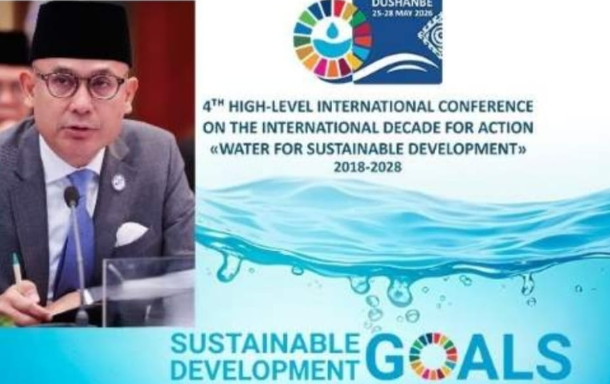
Speaking at the 4th High-Level International Conference on the International Decade for Action “Water for Sustainable Development” held in Dushanbe from May 25-28, Indonesian Deputy Minister for Foreign Affairs Arrmanatha Nasir stressed that water security has become a defining challenge for sustainable development and global stability.
Addressing delegates from around the world, Nasir said billions of people continue to face inadequate access to clean water and sanitation, while growing demand, climate change, industrial expansion, and technological development are intensifying pressure on global water resources.
“Water is the invisible resource powering the digital economy. If managed poorly, it could become the world’s next major crisis,” Nasir warned.
He highlighted emerging threats posed by critical mineral mining, artificial intelligence infrastructure, data centers, and digital industries, noting that these sectors consume billions of liters of water annually, with demand expected to rise significantly in the coming years.
Indonesia’s participation in the Dushanbe conference formed part of its broader commitment to global water diplomacy and efforts to strengthen cooperation ahead of the 2026 United Nations Water Conference in Abu Dhabi. The conference, jointly organized by the Government of Tajikistan and the United Nations, brought together representatives from 110 countries and 75 international organizations to accelerate implementation of global water commitments and Sustainable Development Goals.
Nasir emphasized that the growing water crisis should not be viewed solely as a development challenge but also as a potential source of geopolitical instability.
He said the multilateral system responsible for addressing global water issues must be strengthened through meaningful United Nations reforms capable of responding to future challenges.
Indonesia has been actively engaged in the Dushanbe Water Process, a UN-backed initiative aimed at advancing global water goals. According to Indonesian officials, cooperation with Tajikistan and UN agencies played an important role in preparations for the 10th World Water Forum hosted by Indonesia in Bali in 2024.
Despite being rich in freshwater resources, Indonesia faces its own domestic water challenges, including groundwater pollution, excessive extraction, and limited access to piped water services in many urban areas. Participation in international initiatives such as the Dushanbe Process enables Indonesia to explore financing mechanisms, infrastructure solutions, and policy approaches to address these concerns.
Nasir said Indonesia remains committed to leading regional and international efforts to enhance water and climate resilience. Since hosting the World Water Forum, the country has established a Center of Excellence for Water and Climate Resilience and provided training to more than 2,000 participants from over 40 Asia-Pacific countries.
He also revealed that Indonesia is prioritizing water infrastructure through strategic national financing initiatives, including investments facilitated by its sovereign wealth fund, Danantara.
Outlining Indonesia’s future agenda, Nasir identified four key priorities: strengthening regional cooperation, increasing strategic investment in the water sector, developing water governance frameworks for the AI and digital economy era, and accelerating reforms in global water governance through the United Nations.
“The world has knowledge, capital, and technology. What it lacks is collective political will and an effective multilateral system bold enough to turbocharge action on water,” he said.
Indonesia also participated in an Asia-Pacific preparatory meeting focused on advancing Sustainable Development Goal 6, which seeks to ensure universal access to clean water and sanitation. Officials said the country’s growing role in global water diplomacy reflects its recognition of water security as a cornerstone of food security, economic growth, and long-term sustainable development.
Experts at the conference agreed that addressing water scarcity and ensuring equitable access to freshwater resources will be critical to maintaining peace, stability, and prosperity in an increasingly interconnected world.