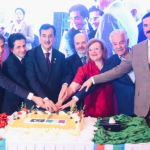
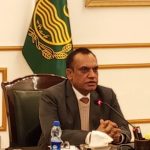
Interfaith Harmony Committee Punjab, under the patronage of the Punjab Auqaf Department and led by Chairman of the Central Ruet-e-Hilal Committee Pakistan and Khateeb of Badshahi Mosque Lahore, Maulana Syed Muhammad Abdul Khabir Azad, arrived here on Wednesday as part of province-wide “Peace Caravan” initiative to ensure peace and harmony during Muharram-ul-Haram.
Interfaith harmony caravan reaches Bahawalpur to promote peace during Muharram
BAHAWALPUR, Jun 03 (APP): Interfaith Harmony Committee Punjab, under the patronage of the Punjab Auqaf Department and led by Chairman of the Central Ruet-e-Hilal Committee Pakistan and Khateeb of Badshahi
Mosque Lahore, Maulana Syed Muhammad Abdul Khabir Azad, arrived here on Wednesday as part of province-wide “Peace Caravan” initiative to ensure peace and harmony during Muharram-ul-Haram.
A divisional-level meeting was held under the chair of Mualama Abdul Khabir Azad which was attended by Bahawalpur Commissioner Irfan Ali Kathia, Regional Police Officer (RPO) Ghazi Muhammad Salahuddin, Deputy Commissioner Bahawalpur Syed Hassan Raza, District Police Officer (DPO) Bahawalpur Rana Abdul Wahab, Deputy Commissioner Bahawalnagar Zulfiqar Ahmad Bhawn, Deputy Commissioner Rahim Yar Khan Zaheer Anwar Jappa, DPOs from Bahawalnagar and Rahim Yar Khan, senior religious scholars, spiritual leaders,
members of peace committees, and representatives from all schools of thought.
The Peace Caravan delegation include: prominent scholars and religious leaders from across Punjab, while a large number of local scholars, clerics, and community representatives also participated in the conference.
Following recitation from the Holy Quran and the presentation of Naat, Maulana Syed Muhammad Abdul Khabir Azad addressed the gathering and emphasized that the government’s “Azm-e-Istehkam” initiative for national security and stability enjoys the full support of the nation’s religious scholars and citizens. He expressed gratitude to Chief Minister Maryam Nawaz Sharif for dispatching Interfaith Harmony Caravans across Punjab to strengthen peace and sectarian harmony during Muharram.
He stated that Islam is a religion of peace that promotes love, brotherhood, tolerance, and mutual respect.
He urged religious scholars to utilize their pulpits and platforms to discourage sectarianism and contribute actively to maintaining peace throughout Muharram.
Maulana Azad highlighted that Pakistan was founded on the principles of Islam and the Kalima Tayyaba, making its protection and defense a collective national responsibility.
He stressed that promoting interfaith harmony, national stability, the defense of Pakistan, and the message
of “Paigham-e-Pakistan” remains a pressing national need.
He described Paigham-e-Pakistan as a comprehensive code of conduct against extremism and violence, adding that its dissemination was the responsibility of every citizen. He reaffirmed the religious community’s full cooperation with the government and security institutions in maintaining law and order.
Paying tribute to the armed forces, Maulana Azad praised the sacrifices of Pakistan armed forces and described the success of Operation Bunyan-un-Marsoos against Indian aggression as a victory for peace and national resilience. He remarked that Pakistan’s defense remains in capable hands and that every passing day was strengthening the country further.
He called upon scholars, religious leaders, and the public to remain united against elements seeking to undermine Islam, Pakistan, and national peace. He urged citizens to stay vigilant against disruptive and anti-state forces and to extend full cooperation to the administration.
The Chairman also advised religious scholars and speakers to avoid provocative speeches during Muharram gatherings and to adhere to the guiding principle: “Remain steadfast in your own beliefs without interfering in the beliefs of others.” He noted that the martyrdom of Hazrat Umar Farooq (RA) on the first of Muharram and Hazrat Imam Hussain (RA) on the 10th of Muharram teach invaluable lessons of sacrifice, peace, unity, brotherhood, and devotion, serving as a guiding light for the Muslim Ummah.
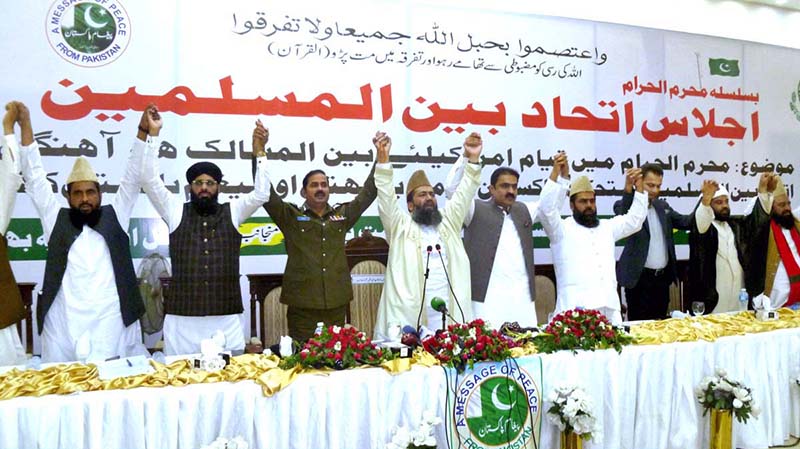
At the conclusion of conference, prominent scholars and spiritual leaders from all schools of thought joined hands to demonstrate solidarity and unity. Special prayers were offered for Pakistan’s security, development, and
prosperity, for unity in the Muslim world, for the protection of Two Holy Mosques, and for the freedom of occupied Kashmir, Gaza, and Palestine.