ISLAMABAD, May 08 (APP):Speakers at an international webinar on Friday emphasized the need to reinvigorate Pakistan-Japan relations by expanding trade, development cooperation, and strategic engagement in the backdrop of evolving regional and global dynamics. The webinar was organized by the Consortium of Asia Pacific and Eurasian Studies (CAPES) in collaboration with Area Study Center for Far East and South East Asia (FESEA) at University of Sindh, said a press release. …
Scholars explore avenues for rethinking Japan-Pakistan ties amid changing global dynamics
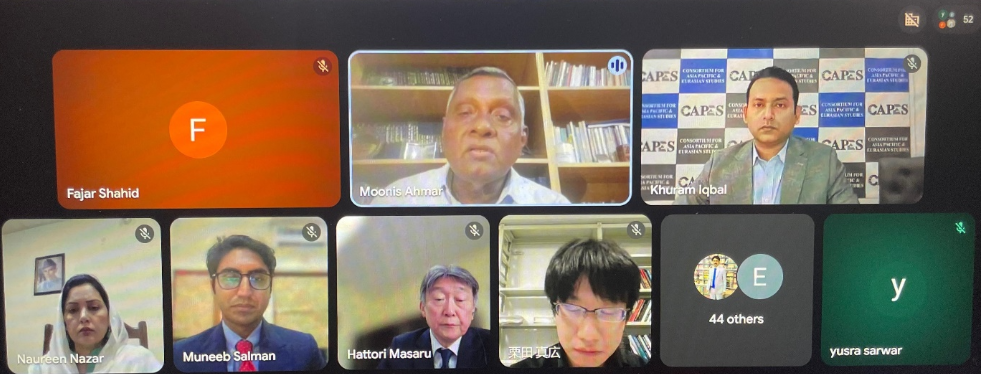
ISLAMABAD, May 08 (APP):Speakers at an international webinar on Friday emphasized the need to reinvigorate Pakistan-Japan relations by expanding trade, development cooperation, and strategic engagement in the backdrop of evolving regional and global dynamics.
The webinar was organized by the Consortium of Asia Pacific and Eurasian Studies (CAPES) in collaboration with Area Study Center for Far East and South East Asia (FESEA) at University of Sindh, said a press release.
The event brought together diplomats, scholars, academicians, practitioners, and students to discuss the future trajectory of bilateral relations between Pakistan and Japan.
Among the keynote speakers were Hattori Masaru, Consul General of Japan in Karachi, Dr. Masahiro Kurita from Chukyo University Japan, and Professor Moonis Ahmar, former Dean of Karachi University.
Dr. Masahiro Kurita observed that despite existing commercial relations and limited naval cooperation between the Japan Maritime Self-Defense Force and the Pakistan Navy in the Indian Ocean region, high-level exchanges between the two countries had remained limited.
Avenues of future cooperation between the two countries may involve the Free and Open Indo-Pacific construct of Japan, whereby Pakistan has successfully mediated the crisis in the Middle East, Dr. Kurita noted. Furthermore, the cooperation between Pakistan and the United States on critical minerals may also open avenues for possible role of Japan in the value chains.
Professor Moonis Ahmar, former Dean of Social Sciences at Karachi University, emphasised that the work ethic and professionalism in Japanese society has been instrumental in alleviating the country post-war to become the second largest economy globally. He added that Pakistan must learn from Japan’s example to enshrine values and produce quality human resource for contributing to economic growth.
Speaking on the occasion, Consul General Hattori Masaru highlighted ongoing cooperation between Pakistan and Japan in multiple sectors, including business and information technology.
He referred to the participation of 51 delegates from 28 sectors in the Pakistan-Japan Business Forum and acknowledged Pakistan’s growing potential in the IT industry.
Earlier, Dr Khuram Iqbal, President of CAPES, delivered the welcome address, while Naureen Nazar Soomro, Director of the Area Study Center FESEA at the University of Sindh, presented the vote of thanks.
The webinar concluded with an interactive question-and-answer session.