ISLAMABAD, May 5 (APP): Speakers at a webinar titled ‘Truth Beyond Borders: Combating Fake News in Conflict Situations’ on Tuesday identified major forms of misinformation risks and stressed the need for coordinated global response to protect facts during conflicts. The webinar was organized by External Publicity Wing of the Ministry of Information and Broadcasting in collaboration with Institute of Regional Studies Islamabad, and the Defence and Strategic Studies Department, Quaid-e-Azam …
Webinar on ‘Truth Beyond Borders’ highlights key risks of fake news
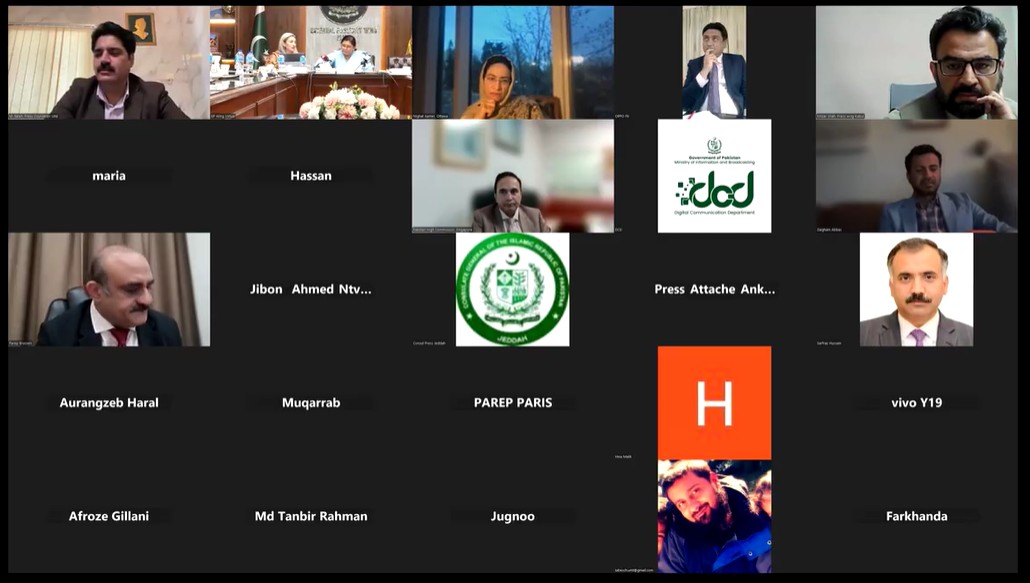
ISLAMABAD, May 5 (APP): Speakers at a webinar titled ‘Truth Beyond Borders: Combating Fake News in Conflict Situations’ on Tuesday identified major forms of misinformation risks and stressed the need for coordinated global response to protect facts during conflicts.
The webinar was organized by External Publicity Wing of the Ministry of Information and Broadcasting in collaboration with Institute of Regional Studies Islamabad, and the Defence and Strategic Studies Department, Quaid-e-Azam University Islamabad.
Minister for Information and Broadcasting Attaullah Tarar speaking as chief guest said close coordination between civil and military leadership, timely dissemination of verified information, and responsible conduct by the media enabled Pakistan to effectively counter fake news and strengthen its narrative during Marka-e-Haq (The Battle of Truth) with India, last year.
He said the government had deployed all available resources to ensure that accurate and verified information reached the right audience at the right time during the conflict situation last year.
“There was a lot going on and so much information was coming up that we had to deploy all our resources in order to not only verify information, but make sure that the right information is going to the right audience at the right time,” he said.
Tarar termed accurate and timely communication “absolutely crucial and important,” particularly during conflicts and rapidly evolving situations.
Referring to the tensions on the border last year, with India the minister said all divisions and departments of the Ministry of Information and Broadcasting were mobilized to respond effectively and maintain a smooth flow of credible information.
He said one of the key factors behind Pakistan’s success in combating misinformation and fake news was the strong cohesion between the civil and military leadership, as well as close coordination between the Ministry of Information and Broadcasting and the Inter-Services Public Relations (ISPR).
“We had a very smooth flow of information and very accurate, which we gave out very timely to the media,” he added.
The minister also appreciated Pakistan’s media and social media users for demonstrating responsibility and unity during the conflict situation.
“I must also compliment Pakistan’s media, which played a very responsible role during that time. The social media users too,” he remarked.
Tarar said there was unity of thought and action among all stakeholders, including citizens, who stood firmly behind the armed forces and the government.
He said the collective national response enabled Pakistan to strengthen its narrative both domestically and internationally.
“We saw an exemplary display of unity which enabled us to give our narrative strength at the local and the global level,” he noted.
Highlighting another factor that strengthened Pakistan’s position, the minister said the adversary lacked effective spokespersons and sufficient outreach in the international media to project its narrative effectively.
He said Pakistan emerged stronger because the information being shared was verified, accurate and based on truth.
“The main reason being that we knew that whatever information we were giving out was 100 per cent accurate, was verified, and was the truth. And the truth always prevails,” he added.
Tarar said success in conflict situations depended on creating complete cohesion and synergy among stakeholders while ensuring the dissemination of accurate information through the appropriate forums.
Recalling the events of May 6 and 7 last year, he said that when India attacked Pakistan, he addressed the international media within half an hour, while live feeds were simultaneously provided to local television channels and social media platforms.
He said timely information sharing was made possible through effective institutional coordination and support from the ISPR.
The minister said Pakistan had also established fact-checking forums and verification mechanisms that played a significant role in combating misinformation and fake news.
He noted that the creation of Pakistan’s first digital communication department had significantly strengthened the country’s ability to respond to disinformation challenges.
“Because we had the right kind of resources and systems in place, when we deployed those systems and put them to the test, we passed with flying colours,” he added.
Executive Director General of External Publicity Wing, Ms Raisa Adil, welcomed the participants and said that the discussion was aimed at addressing the growing challenge of misinformation in conflict situations.
She noted that the spread of unverified and misleading information affected public trust and complicated efforts aimed at stability. She stressed upon cooperation among institutions and countries to deal with these challenges and promote accurate information sharing.
She said that the webinar provided a platform for experts to discuss information trends and to suggest practical steps for strengthening credibility in communication.
Speaking on the occasion, Ambassador Jauhar Saleem, President of the Institute of Regional Studies, said that the issue of fake news had become central in the current information scenario. He said that the rise of digital platforms had increased the spread of fabricated content, making it difficult to separate fact from fiction. He said that while the internet was expected to improve access to verified information, it had also enabled the rapid circulation of unverified reports. He noted that states were investing in disinformation campaigns as part of hybrid warfare strategies.
Referring to recent regional tensions, he said conflicts were no longer limited to military action but were followed by competing narratives. He said efforts to influence global opinion through delegations and campaigns had limited impact when claims were not supported by evidence. He added that consistent messaging based on facts remained important for countries seeking to present their position internationally. He said misinformation campaigns could lose credibility if they were not aligned with verifiable information.
Vice Chancellor of Quaid-i-Azam University, Dr Zafar Nawaz Jaspal, said the first anniversary of Maarka-e-Haq provides a time to review events and assess how the national narrative has been presented. He said it is important to examine whether the position shared by government institutions, researchers and scholars has reached the international community or it reflects facts. He said that before the events of April 2025, global perceptions about regional dynamics were shaped by specific narratives. However, developments during the conflict period from April 22 to May 10 led to a reassessment of those views.
Jaspal said the situation demonstrated changes in military engagement patterns and highlighted the role of deterrence and response strategies. He also referred to international reactions and said global recognition of events depended on how information was presented and verified. Dr Jaspal said the role of major powers and international experts remained significant in shaping outcomes and narratives. He said that the shift from non-state conflicts to state-level engagements required updated strategies in both communication and policy.
Associate Professor Dr Salma Malik spoke about the role of misinformation and propaganda in conflict reporting. She said that these three elements needed to be clearly understood. Misinformation involved the spread of inaccurate information, while disinformation referred to deliberately false content created to mislead, she said and added that propaganda was used to influence opinion through selective or false text.
Dr Malik said that during conflicts, information itself became a battleground. She said that narratives were often shaped through selective reporting and digital content, which could affect public perception both domestically and internationally. She said that it was necessary to identify false content and ensure responsible communication. She also stressed the role of academic institutions and media in verifying information before dissemination.
Wang Shengjie, Political Counsellor at the Embassy of China in Pakistan, discussed the role of artificial intelligence in modern information systems. He said that technological developments had transformed how information was produced and shared. He said that artificial intelligence had enabled new methods of manipulating content, including altered audio and visual material. He noted that information warfare had become a common feature of modern crisis.
Referring to global trends, he said that conflicts were increasingly accompanied by digital campaigns aimed at influencing public opinion. He said that it was essential for media institutions to adapt to technological changes in maintaining responsibility. He also referred to statements issued on World Press Freedom Day by Pakistani leadership, noting that technological platforms played a major role in shaping narratives.
Afzal Reza, Bureau Chief of Iran’s state IRNA news agency termed narrative-building as the main war in present era as the dissemination of fake news and propaganda through technology such as artificial intelligence could pose severe risks to peace.
He emphasized the importance of correct and timely news to prevent targeted actions and recalled that in the Operation Bunyanum Marsoos last year how Pakistan had effectively thwarted the enemy’s attack while simultaneously fighting the war against fake news and propaganda.
Caitilin Doornbos, Washington-based journalist of the NewYork Post spoke about her experience in Islamabad while her stay to cover the recent U.S.-Iran conflict, and said the importance of credible news rather than feeding fillers and opinions to the audience was important in such scenarios.
Andi Asrul Sni Fauza, representing TVRI Indonesia said the Indonesian government was serious in stopping fake and promoted the tagline as ‘Be sure before you share” that endorsed fact-checking with multiple sources.
Aamir Jahagir, public policy expert said the recent regional conflicts revealed the fragility of truth in the face of coordinated narratives, adding that hence the countering of fake news became vital.
Muhammad Tabish, Crisis Communication and Digital Diplomacy Expert discussed the challenges of artificial intelligence and the need to debunking the fake content in the information space. He stressed the need to grasp the window of opportunity and integrate AI-enabled and digital public diplomacy framework in a robust manner.
The participants agreed that misinformation posed risks to peace efforts and public understanding. They called for stronger coordination between governments, media organizations and academic institutions to address the issue.
A detailed presentation was also given by the Digital Communication Department, highlighting trends in online misinformation and tools used to counter false narratives.
The webinar concluded with a discussion on policy measures, digital literacy and international cooperation to counter false information in conflict situations.