
The European Union, in collaboration with the Government of Pakistan, today inaugurated the first-ever “High-Level EU-Pakistan Business Forum” in Islamabad, marking an important milestone in strengthening bilateral economic relations.
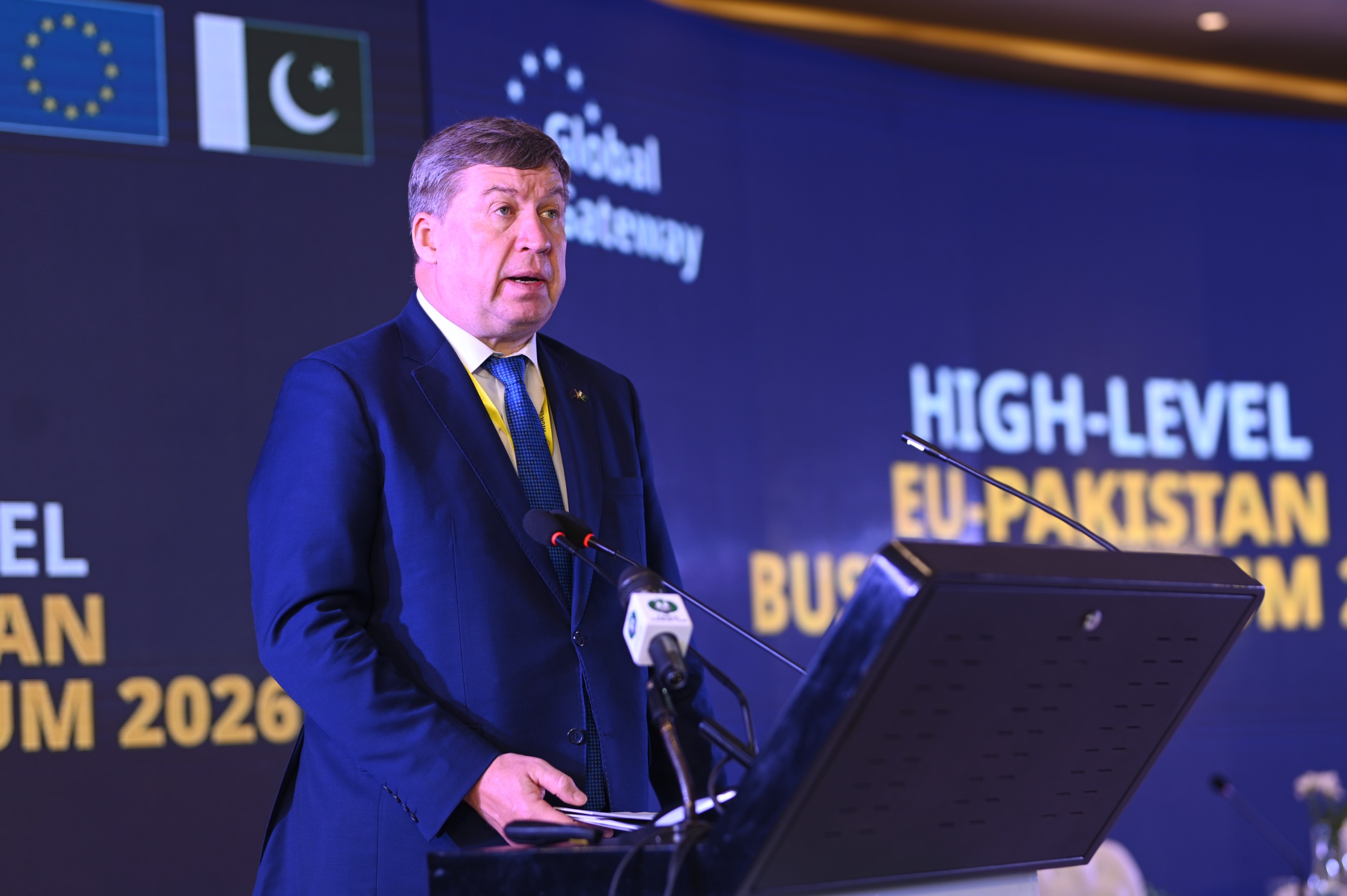
ISLAMABAD, Apr 28 (APP):The European Union, in collaboration with the Government of Pakistan, today inaugurated the first-ever “High-Level EU-Pakistan Business Forum” in Islamabad, marking an important milestone in strengthening bilateral economic relations.

The Forum brings together around 1000 senior policymakers, European and Pakistani business leaders, investors and financial institutions. With the EU being the largest single market in the world, a leading exporter of outward Foreign Direct Investment globally and Pakistan’s number one export destination, the Forum represents a significant opportunity to further the EU-Pakistan economic partnership. It aims to turn strong trade ties into increased investment flows, technology partnerships, greater innovation, and sustainable industrial growth.

The European Union Ambassador to Pakistan, H.E. Raimundas Karobolis, opened the Forum, stating:
“The European Union enjoys strong economic relations with Pakistan. It is a source of pride for me to say, that the European Union is the top export destination for Pakistan.
The purpose of the forum is not just to celebrate our trade relations, but to deepen, diversify, “green,” and transform them into long-lasting investments. Through this, our mutual prosperity will thrive.”
Federal Minister of Finance, Muhammad Aurangzeb highlighted the solid work done to improve macroeconomic fundamentals, undertake structural reforms and through this enhance potential for future investments. He emphasised Pakistan’s stability and readiness for business under the theme “Pakistan Means Business.”
Mr. Haroon Akhtar, Special Assistant to the Prime Minister for Industries and Production Division delivered a keynote address at the inaugural session.
The opening session also marked the launch of the EU-Pakistan Business Network, which brings together more than 300 EU companies active in Pakistan. The Network aims to serve as a collective voice of EU businesses in the country, facilitating dialogue with policymakers and supporting new European companies exploring opportunities in Pakistan.
The opportunities emanating from the EU’s Global Gateway initiative, the EU’s largest investment program outside of the EU which aims to mobilise and de-risk 400 billion EUR of investments in the period 2021-2027 – were presented in a dedicated plenary session with Mr Peteris Ustubs, Director for Asia and the Pacific at the Directorate-General for International Partnerships,European Commission ; Ms Thouraya Triki, Director at the *European Investment Bank ; and Mr Hans Bogaard, Director of Agribusiness, Food and Forestry at FMO, (the Entrepreneurial Development Bank from the Netherlands).
Discussions throughout the day focused on opportunities and challenges in priority sectors such as agribusiness, digital innovation and fintech, green logistics, sustainable textiles, and responsible mining.
Throughout the two-day Forum more than 600 B2B meetings are scheduled reflecting strong interest from both European and Pakistani companies in forming joint ventures and partnerships.
New financial programmes and partnerships are also expected to be signed during the Forum.
The event provides a structured platform for high-level dialogue and deal-making between a combined economy of over 700 million people.
The EU–Pakistan Business Forum 2026 serves as a strategic platform to catalyze economic collaboration, showcase Pakistan’s investment potential, and address regulatory challenges by connecting stakeholders to exchange expertise, leverage EU financial instruments, and promote sustainable business practices.
The forum connects industry leaders and policymakers to unlock trade potential across key sectors—from digital innovation and green energy to agribusiness—by leveraging GSP+ tariff-free access and EFSD+ financial instruments to drive sustainable, long-term economic partnership.
The EU’s GSP+ status fosters sustainable development and export competitiveness by providing duty-free access to approximately 66% of EU tariff lines for eligible developing countries.
Pakistan maintains this status through full compliance with the framework, having successfully ratified all 27 required international conventions spanning human rights, labor, environmental protection, and good governance.
Since 2012, Pakistan has strengthened protections for minority and child rights through key legislative reforms—including the 2017 Federal Hindu Marriage Act, the 2016 Sindh Hindu Marriage Act, and the 2013 Sindh Child Marriages Restraint Act—which collectively formalize legal recognition for marriages, safeguard inheritance rights, and criminalize child marriage.
Human rights narratives are increasingly weaponized by external actors as political leverage against Pakistan, often creating a double standard that ignores significant systemic issues elsewhere, as highlighted by critical data regarding India in recent 2026 international reports.
Domestically, Pakistan addresses such allegations through its independent Commission of Inquiry on Enforced Disappearances (CoIoED), which transparently manages cases through due process and clarifies that many reported disappearances involve lawful detentions or individuals who have absconded.
Despite these challenges in international perception, Pakistan remains steadfast in its commitment to strengthening its multidimensional socio-economic and trade partnership with the European Union.
While criticism is directed at Pakistan, comparable human rights concerns elsewhere receive limited scrutiny, as documented in HRW World Report 2026, USCIRF Annual Report 2026 and RSF World Press Freedom Index 2025, which record in India 113 police custody deaths, 1,535 judicial deaths, 132 alleged extrajudicial killings, over 80 internet shutdowns, targeting of 34 journalists and a press freedom ranking of 151/180, alongside a 5th consecutive CPC recommendation.

