ISLAMABAD, Apr 14 (APP):Minister of State for Finance and Railways Bilal Azhar Kayani on Tuesday said the government had intensified enforcement measures to curb the illicit cigarette market, which is causing massive revenue losses and undermining tax-compliant businesses, as authorities move to restore fairness and strengthen the documented economy. Speaking at the launch of a research report titled “An Economic Assessment of the Illicit Cigarettes Market in Pakistan” prepared by …
Crackdown on illicit cigarette trade intensified to protect tax-compliant sector: Bilal
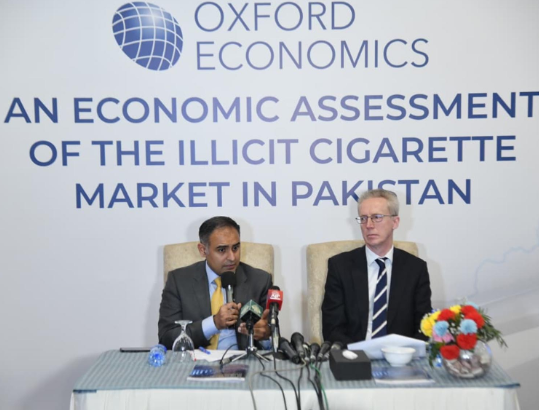
ISLAMABAD, Apr 14 (APP):Minister of State for Finance and Railways Bilal Azhar Kayani on Tuesday said the government had intensified enforcement measures to curb the illicit cigarette market, which is causing massive revenue losses and undermining tax-compliant businesses, as authorities move to restore fairness and strengthen the documented economy.
Speaking at the launch of a research report titled “An Economic Assessment of the Illicit Cigarettes Market in Pakistan” prepared by Oxford Economics, the minister described the issue as critical, noting that the illegal trade was resulting in an estimated annual revenue loss of around Rs200 billion.
He said the government was pursuing a dual strategy, facilitating compliant businesses while taking strict action against illegal operators.
“The prime minister has consistently emphasized that businesses complying with tax laws should be facilitated and rewarded rather than penalized,” he added.
Bilal said a nationwide crackdown had been launched in coordination with provincial governments to eliminate the widespread availability of untaxed cigarette brands.
He added that district administrations, including deputy commissioners and assistant commissioners, were actively engaged to ensure effective enforcement at the local level.
He expressed confidence that sustained enforcement would enhance revenue collection, ensure fair competition and provide better-quality products to consumers.
Stressing the urgency of the issue, he termed curbing the illegal cigarette trade “unavoidable,” warning that the unchecked market was inflicting heavy losses on the national exchequer, discouraging honest taxpayers and weakening the formal economy.
The minister said several illegal manufacturing units had already been shut down, while raids against retailers selling illicit products were continuing across the country.
Highlighting reforms within the Federal Board of Revenue (FBR), he said the government had introduced measures such as faceless customs systems, strengthened enforcement mechanisms and production monitoring across key sectors including tobacco, cement and sugar.
These reforms, he added, were being closely monitored by the prime minister to ensure timely implementation.
He noted that, for the first time, enforcement-driven revenue collection had been recognized as a credible component in discussions with the International Monetary Fund (IMF).
Technology-driven solutions, including track-and-trace systems, were also being implemented to monitor production while
safeguarding trade secrets. “Any gaps in implementation will be addressed to ensure the system functions effectively,” he added.
According to the report, illicit cigarettes now account for more than half of Pakistan’s tobacco market, highlighting the scale of the challenge.
The volume of illicit cigarettes stands at 43.5 billion sticks, placing Pakistan among the largest illegal cigarette markets globally.
While total consumption has remained stable at around 80 billion sticks annually over the past decade, legal sales have steadily declined due to the rise of untaxed products.
The report identifies sharp increases in excise duties as a major driver of this shift.
Between the first quarter of 2022 and the second quarter of 2023, real excise taxes rose by 107 percent, widening the price gap between legal and illegal cigarettes.
Illicit products remain about 36 percent cheaper on average, encouraging consumers to switch.
It further noted that nearly 64 percent of illicit cigarettes are produced domestically, particularly in Azad Jammu and Kashmir and Khyber Pakhtunkhwa, while the remaining 36 percent are smuggled, mainly through Afghanistan with links to brands from the UAE and South Korea. Weak enforcement, porous borders and organized networks continue to fuel the illegal trade.
The report warned that revenue losses from illicit cigarettes, estimated between Rs274 billion and Rs343 billion, could exceed total excise collections from the legal tobacco sector.
It stressed that a coordinated, long-term strategy combining predictable taxation, stronger enforcement and full implementation of track-and-trace systems would be essential to effectively curb the menace.