ISLAMABAD, Apr 08 (APP):The National Judicial (Policy Making) Committee (NJPMC), reiterated its commitment to strengthening institutional capacity, improving access to justice and ensuring efficient case disposal remain top priorities, as the 59th meeting of the National Judicial (Policy Making) Committee (NJPMC) reviewed key reforms and policy initiatives. The meeting, chaired by Chief Justice of Pakistan on April 6, was attended by the Chief Justice of the Federal Shariat Court, chief …
CJP chairs NJPMC meeting, pushes reforms for faster justice and institutional strengthening
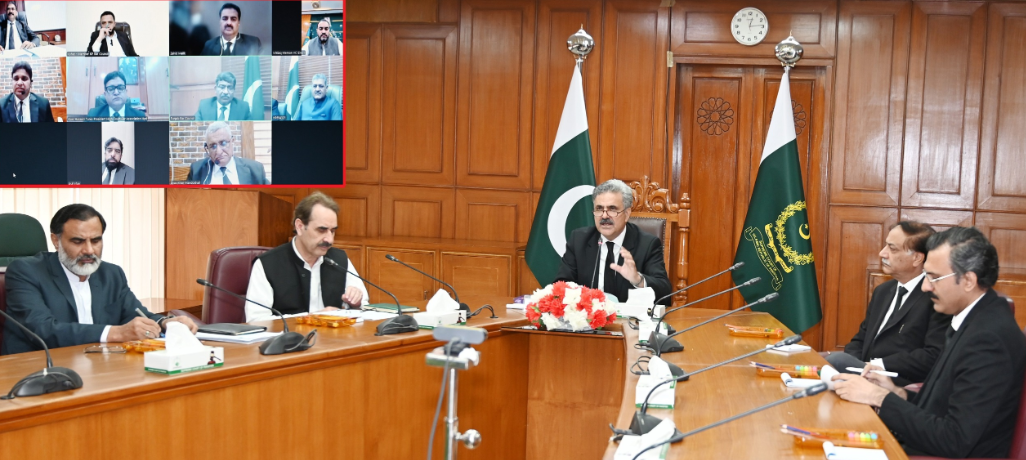
ISLAMABAD, Apr 08 (APP):The National Judicial (Policy Making) Committee (NJPMC), reiterated its commitment to strengthening institutional capacity, improving access to justice and ensuring efficient case disposal remain top priorities, as the 59th meeting of the National Judicial (Policy Making) Committee (NJPMC) reviewed key reforms and policy initiatives.
The meeting, chaired by Chief Justice of Pakistan on April 6, was attended by the Chief Justice of the Federal Shariat Court, chief justices of all high courts, the Attorney General for Pakistan and senior officials of the Law and Justice Commission of Pakistan.
The committee reviewed progress on decisions taken in its earlier session and reiterated its commitment to an effective and responsive justice system.
On enforced disappearances, the Attorney General informed the forum that the federal government has approved the nomination of a former Supreme Court judge to head a commission as part of a redressal mechanism, with a formal notification expected soon. The committee directed that it be regularly updated on progress.
The NJPMC expressed satisfaction over the establishment of designated benches in high courts to deal with foreign arbitral awards and related matters, including cases under tariff and anti-dumping laws. It noted that specialization would improve consistency in judicial decisions and enhance the ease of doing business.
Reviewing case disposal timelines, the committee appreciated the performance of high courts in clearing priority and old cases. Data presented showed that over 1.03 million cases were disposed of out of approximately 1.22 million pending cases between September 2025 and March 2026. District judiciary in Punjab and Balochistan achieved disposal rates of 92 per cent and 88 per cent respectively.
The committee also noted significant progress in clearing long-pending succession cases, with Sindh, Peshawar and Balochistan high courts eliminating backlog entirely, while only a small number of cases remain pending in Lahore High Court.
Performance of model trial courts was also reviewed, with over 8,400 civil and 14,800 criminal cases decided during the reporting period. The committee directed high courts to further strengthen monitoring through data-driven evaluation to ensure quality alongside speed.
On discouraging frivolous litigation, the committee was informed that work is underway to develop a legal and policy framework in line with existing laws. It emphasized strict compliance with procedural rules and called for broader consultation with stakeholders, including bar councils.
The NJPMC reviewed progress on the Prison Reform Action Plan aimed at aligning Pakistan’s prison system with international standards, including the UN’s Nelson Mandela Rules.
It directed the organization of a national conference in June 2026 to promote stakeholder engagement and coordinated implementation.
The committee approved a Gender Fair Language Framework 2026 as non-binding guidelines to promote respectful and neutral language in legal discourse. It directed its dissemination among courts, bar councils and training institutions, along with translation into Urdu for wider accessibility.
It also endorsed the Gender-Responsive Justice Initiative (GRJI) 2026–27, including the establishment of Women Facilitation Centres to provide free legal aid, mediation and family support services. A national design competition will be held to develop inclusive architectural models for these centres.
The NJPMC approved the governance framework for a National Judicial Analytics Dashboard to ensure data-driven judicial management, stressing timely data sharing, coordination among institutions and strong cybersecurity measures. High courts were also encouraged to consider implementation of e-office systems.
In a step aimed at improving family access, the committee approved the opening of child visitation facilities in district courts on public holidays, subject to administrative arrangements by respective high courts.
On district judiciary reforms, the committee called for anonymized surveys to gather feedback from judicial officers on reform measures, with results to be presented in the next meeting for policy refinement.
The meeting concluded with appreciation for the efforts of high courts, the Attorney General’s office and the Law and Justice Commission in strengthening the justice system and enhancing public confidence.