
Hours before the ceasefire agreement, Prime Minister Shehbaz Sharif had earnestly requested the US to extend its deadline for the bombing of Iran for two weeks, and also requested Iran to open the Strait of Hormuz for the corresponding period as a goodwill gesture.

By Ishtiaq Ahmed
ISLAMABAD, Apr 8 (APP): As the United States and the Islamic Republic of Iran reached an agreement on a two-week ceasefire, world leaders warmly welcomed the long-awaited development, particularly praising Pakistan’s effective mediation, which helped avert a catastrophic escalation in the region.
During the US-Iran war, Pakistan emerged as a key diplomatic player as the country avoided taking sides, having condemned the US and Israel attacks on Iran and on the friendly Gulf countries by Iran. Pakistan also hosted the quadrilateral talks in Islamabad and announced a seven-point peace plan, which followed an almost identical five-point plan in Beijing.
On Tuesday night, Prime Minister Shehbaz Sharif earnestly requested the US to extend its deadline for the bombing of Iran for two weeks, and also requested Iran to open the Strait of Hormuz for the corresponding period as a goodwill gesture.
As the world acknowledged Pakistan’s crucial mediatory role in de-escalation, Prime Minister Shehbaz Sharif’s request to the conflicting countries became the centre of international focus just before President Trump’s deadline expired, who also renewed his threat that “a whole civilisation will die tonight.”
United States

Hours after Prime Minister Shehbaz’s request on his X timeline, US President Donald Trump also took to his social media platform Truth Social, announcing the suspension of the bombing and attack on Iran for a period of two weeks.
He said that the announcement was based on conversations with Prime Minister Shehbaz Sharif and Field Marshal Asim Munir, who requested that the “destructive force” being sent tonight to Iran be held.
Iran
Foreign Minister of Iran Seyed Abbas Araghchi, in a statement, on behalf of the Iranian Supreme National Security Council, thanked Prime Minister Shehbaz Sharif and Field Marshal Syed Asim Munir for their tireless efforts to end the war in the region.

The Council announced that the Iranian armed forces would cease the “defensive operations” if attacks against Iran were halted, and that for a period of two weeks, safe passage through the Strait of Hormuz would be possible via coordination with Iran’s armed forces and with due consideration of technical limitations.
UN Secretary-General
UN Secretary-General Antonio Guterres has welcomed the announcement of ceasefire, describing it as a positive step toward de-escalating tensions in the Middle East.
He also expressed appreciation for the mediation efforts led by Pakistan and other nations working to facilitate the ceasefire agreement.
OIC
In a statement, the General Secretariat of the Organization of Islamic Cooperation (OIC) welcomed the temporary ceasefire calling it a positive step towards de-escalation in the region and an opportunity that must be seized to move towards a serious negotiation process.
The Muslim world body commended the efforts made by the member states to de-escalate the situation, and appreciates the effective role played by Pakistan, in particular Prime Minister Shehbaz Sharif, to reach the agreement.
European Union
EU High Representative for Foreign Affairs and Security Policy Kaja Kallas called the ceasefire a “step back from the brink” after weeks of escalation.
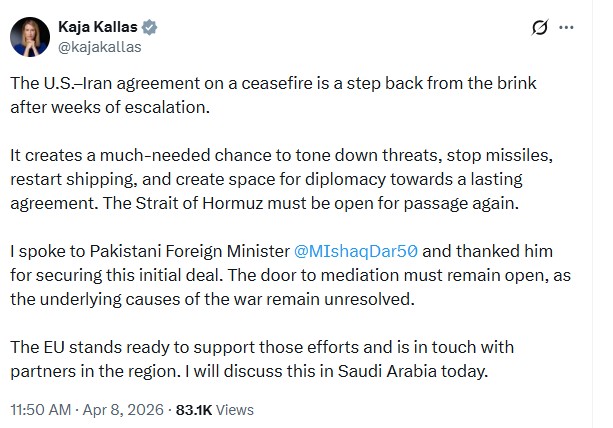
“It creates a much-needed chance to tone down threats, stop missiles, restart shipping, and create space for diplomacy towards a lasting agreement. The Strait of Hormuz must be open for passage again.”
Referring to her telephonic conversation with Deputy Prime Minister and Foreign Minister Ishaq Dar, she said she thanked him for securing this initial deal. The door to mediation must remain open, as the underlying causes of the war remain unresolved, she added.
Germany
“We thank Pakistan for its mediation. The aim now is to negotiate a lasting end to the war. We are in close coordination with our partners on this matter,” German Chancellor Bundeskanzler Friedrich Merz wrote on X, welcoming the ceasefire between the US and Iran.

“Finally, some good news in politics too,” German Foreign Minister Johann Wadephul separately wrote on X.
“Our thanks, and the thanks of the people of an entire region, go to all those who have supported this agreement—especially Pakistan,” he remarked.
Malaysia
Malaysian Prime Minister Anwar Ibrahim also welcomed the ceasefire and appreciated Pakistan for its “tireless and courageous diplomacy”.
Ibrahim, in a post on X, reiterated his support for Pakistan’s diplomatic efforts, appreciating its “willingness to speak to all sides, without fear or favour”.
He said that Pakistan’s efforts manifested “the highest traditions of Muslim solidarity and international responsibility”.
Australia
Australian Prime Minister Anthony Albanese, in a statement, welcomed the truce deal and said that Australia had been working with international partners in support of diplomatic efforts to reopen the Strait of Hormuz so critical supplies could flow to those who need it, including the most vulnerable.

“We thank and support the work of negotiators, including Pakistan, Egypt, Türkiye and Saudi Arabia, in advancing de-escalation efforts.”
Australian High Commissioner Timothy Kane also congratulated Pakistan on its “effective diplomacy” in the ceasefire.
In a post on X, the Australian envoy said, “Congratulations, Pakistan, on your effective diplomacy and efforts to bring peace! Australia wants to see the ceasefire upheld and a resolution to the conflict”.
UK
“I welcome the ceasefire agreement reached overnight, which will bring a moment of relief to the region and the world,” Prime Minister of the United Kingdom Keir Starmer said.

In a post on X, he called for concerted efforts to support and sustain this ceasefire, turn it into a lasting agreement and reopen the Strait of Hormuz.
On her X timeline, British High Commissioner to Pakistan Jane Marriott appreciated Pakistan’s role in the mediation efforts.
“Thank you, Pakistan, for the quiet, effective, diplomatic role you have played in bringing about this vital ceasefire”.
Kazakhstan
Kazakhstan President Kassym-Jomart Tokayev, in a post on X, said that the truce was “reached with the mediation of Prime Minister of Pakistan Shehbaz Sharif and Chief of Army Staff of Pakistan, Field Marshal Asim Munir”

“This agreement became possible due to the goodwill and wisdom of the President of the United States, Donald Trump and the senior leadership of Iran, as well as all countries involved in the military conflict,” he added.
Turkiye
Turkish President Recep Tayyip Erdogan, in a statement on X, hoped that the truce would be fully implemented on the ground without providing any opportunity for possible provocations and sabotage.
“We wholeheartedly congratulate all actors who contributed to the process leading to the declaration of the ceasefire, especially our friendly and brotherly Pakistan…Türkiye will continue to raise the voice of peace in its region and in the world,” he remarked.
He expressed the desire that “our geography, which has suffered greatly from wars, conflicts, tensions, and oppressions, will soon attain peace, tranquility, and stability.”
The Turkish Ministry of Foreign Affairs, in a separate statement, assured that Turkiye would continue to extend all necessary support for the successful conclusion of the negotiations to be held in Islamabad.
“We congratulate brotherly Pakistan for its role throughout this process and express our wish for the continuation of all initiatives that contribute to peace,” it added.
Lebanon
President of Lebanon Joseph Aoun commended the efforts of all parties behind reaching the truce, particularly those of Pakistan, Egypt, and Turkey.
He also expressed hope that this announcement would be a first step toward a final and comprehensive agreement on the various issues that constitute triggers for our region, in a manner that preserves the sovereignty of each of its states.
The President affirmed the continuation of the Lebanese state’s efforts to include Lebanon in regional peace in a fixed and permanent manner, in accordance with the principles agreed upon by the Lebanese, with regard to the full sovereignty of their state over all its territories and the liberation thereof from any occupying presence.
Romania
President of Romania Nicușor Dan welcomed the ceasefire and that Romania was grateful to Pakistan and other regional mediators for their work.
“It is now time that all commitments are respected in order to facilitate diplomatic negotiations and a lasting solution, bringing stability and security to the region, including the safety of navigation through the Strait of Hormuz,” he added.
In a separate statement, Romanian Foreign Minister Toiu Oana appreciated the efforts of the regional mediators, particularly those of Pakistan, which was collaborating with Egypt and Turkey.
She said that Romania supported the diplomatic efforts aimed at resolving all major issues between the parties and that Romania would continue to contribute to the stability and security of the region.
Austria
Chancellor of Austria Christian Stocker said the ceasefire opened the window for diplomacy a little wider again and created space for serious talks and negotiations.
“For only in this way can a lasting peace emerge from a ceasefire and a global energy and economic crisis be averted. Our thanks go to our partners in Pakistan and Prime Minister Shehbaz Sharif for the successful mediation efforts,” he remarked.
Saudi Arabia
The Ministry of Foreign Affairs of Saudi Arabia, in a statement, welcomed the announcements by US President Donald Trump and Prime Minister Shehbaz Sharif regarding the truce agreement reached between the US and Iran.

The ministry noted in this context the fruitful efforts made by Pakistan’s leadership, including Field Marshal Syed Asim Munir, in reaching this agreement.
Egypt
Egypt’s Ministry of Foreign Affairs, in a statement, welcomed the truce and affirmed that the suspension of military operations, alongside the response from the Iranian side, represented a critical opportunity to advance diplomatic efforts and initiate constructive dialogue.

Egypt also reaffirmed its support for all initiatives aimed at achieving peace and stability, highlighting its continued coordination with Pakistan and Türkiye, as well as other regional and international partners, to advance these objectives.
Oman
Oman’s foreign ministry, in a statement, also welcomed the truce, and appreciated the efforts by Pakistan in this regard.

“The Ministry of Foreign Affairs expresses the Sultanate of Oman’s welcome of the announcement of the truce between the Islamic Republic of Iran and the United States of America, and appreciates the efforts exerted by the Islamic Republic of Pakistan in this regard and all parties calling for an end to the war,” the statement said.
New Zealand
New Zealand Foreign Minister Winston Peters also lauded Pakistan, Türkiye and Egypt for helping reach a resolution.
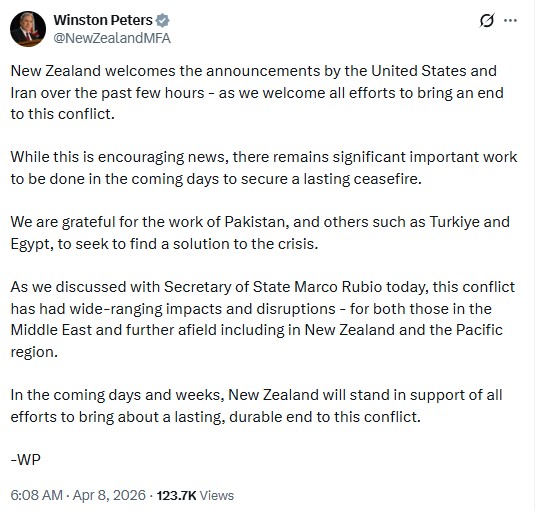
He said, “We are grateful for the work of Pakistan, and others such as Turkiye and Egypt, to seek to find a solution to the crisis.”
“While this is encouraging news, there remains significant important work to be done in the coming days to secure a lasting ceasefire,” he added.
Iraq
Iraq’s foreign ministry said it welcomed the two-week truce between the United States and Iran, calling for “serious and sustainable dialogue” between the nations.
The ministry “calls for building upon this positive step by launching serious and sustainable dialogue tracks that address the root causes of the disputes and strengthen mutual trust,” it posted on social media.
Indonesia
Indonesia also welcomed the two-week truce as country’s foreign ministry spokesperson Yvonne Mewengkang said that the move reflected the willingness of the conflicting parties to pursue diplomatic channels.
“Indonesia views this momentum as a positive beginning and encourages that this opportunity be utilised optimally to advance a sustainable peaceful resolution.
Russia
In her statement, Russian Foreign Ministry spokesperson Maria Zakharova said, “We welcome the ceasefire agreement reached between the US and Iran. Serious negotiations now lie ahead to achieve a final settlement of the conflict.
She said that the outcome must guarantee that such military crises never happen again.
Palestine
Palestinian Foreign Ministry lauded the initiatives led by countries and the efforts of Pakistan in reaching the ceasefire, and affirmed that diplomacy and dialogue must be the basis of the solution.
The ministry called for the necessity that the truce include the land of the occupied State of Palestine, and the cessation of the genocide in the Gaza Strip, and the crimes and assaults of the Israeli occupation forces and the terrorism of the settlers in the West Bank including East Jerusalem.
African Union
The Chairperson of the African Union Commission Mahmoud Ali Youssouf welcomed the ceasefire announcement by Prime Minister Shehbaz Sharif, describing it a “a significant step that reflects commendable leadership and a shared commitment to de-escalation.”
The AUC chairperson noted that the development aligned with the African Union Commission’s consistent calls for restraint and the peaceful resolution of disputes.
Spain
Spanish Foreign Minister José Manuel Albares, said that after nearly 40 days, the ceasefire brought hope to the Middle East and the world.
“We support the crucial work of the mediators, particularly Pakistan. The ceasefire prevents an escalation with irreparable consequences. Diplomacy, negotiation, and international law are the only path to the lasting peace that the citizens of the Middle East deserve.”
Sweden
Foreign Minister of Sweden Maria M Stenergard welcomed the ceasefire following important mediation efforts by, among others, Pakistan, which could also create conditions for restoring free passage through the Strait of Hormuz.
“It is crucial that all parties now exercise the utmost restraint – to safeguard security in the region, to secure vital global supply chains, and to protect innocent civilians,” the minister added.
European Council
President of European Council António Costa urged all parties to uphold the terms of ceasefire in order to achieve sustainable peace in the region.
“The EU stands ready to support ongoing efforts and remains in close contact with its partners in the region. I thank Pakistan and all other parties involved in facilitating this agreement,” he added.
Kuwait
Kuwait’s Foreign Ministry, in a statement, appreciated the efforts exerted to reach the ceasefire, and primarily the role played by Pakistan in sparing the region from further escalation.
The ministry reaffirmed its support for all mediation efforts and endeavors aimed at restoring calm, expressing hope that this announcement will lead to a comprehensive and sustainable settlement that enhances security and stability in the region.
Norway
Norwegian Foreign Minister Espen Barth Eide said that the ceasefire gave diplomacy a chance, at a moment when the world stood on the brink of a dangerous escalation.
“I commend Pakistan, working with Türkiye and Egypt, for their tireless efforts for dialogue.”
Armenia
Prime Minister of Armenia Nikol Pashinyan, welcoming the “crucial decision” between US and Iran to cease all hostilities, and commend the mediation efforts, including those of Pakistan.
He firmly believed that diplomacy should prevail to resolve all outstanding issues & preserve peace in the Middle East.
Ukraine
Ukrainian Foreign Minister Andrii Sybiha welcomed the agreement to unblock the Hormuz Strait and ceasefire, as well as Pakistan’s mediation efforts.
Lithuania
Lithuanian Foreign Minister Kęstutis Budrys also commended the efforts of Pakistan to make the truce possible.
“This step offers a window for diplomacy and de-escalation. Attention must now turn to ensure a safe and speedy reopening of the Strait of Hormuz and work towards rebuilding trust and a lasting resolution,” the minister urged.
European Commission
European Commission President Ursula von der Leyen, in a statement, thanked Pakistan for its mediation, and said the truce brought much-needed de-escalation.
“Now it is crucial that negotiations for an enduring solution to this conflict continue. We will continue coordinating with our partners to this end.”
Ishtiaq Ahmed, APP’s Foreign Editor, leads coverage of the Prime Minister, President and Foreign Office, bringing over 20 years of journalism experience from local and international publications – Reach out at 03335293238/ [email protected]/ X: ishtiaqrao