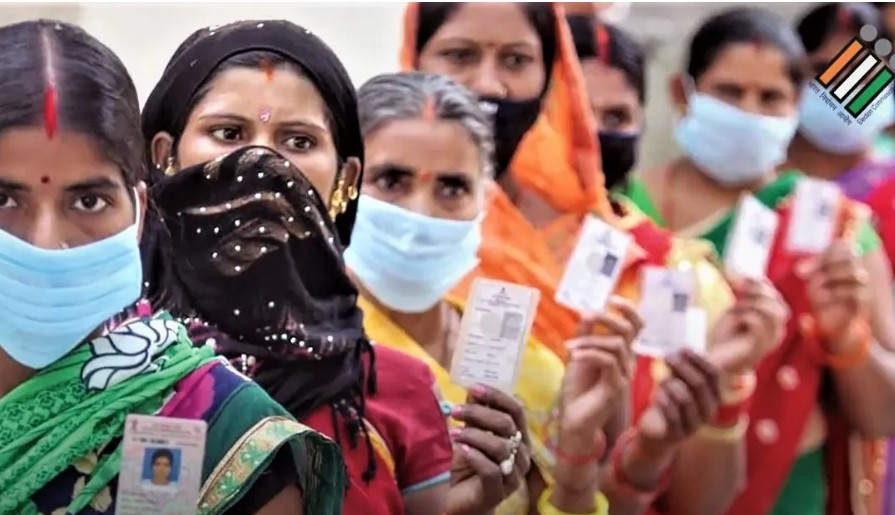
“It feels like you’ve given us hands, feet and head to move and see, but you muted our voice,” says a Muslim voter criticising the controversial delimitation exercise ahead of upcoming polls in India’s Assam state.
BJP’s ‘communal gerrymandering’ silences Muslim voices ahead of Assam polls
ISLAMABAD, Apr 3 (APP): As Assam gears up for assembly elections on April 9, concerns are mounting over a controversial delimitation exercise that critics say is systematically marginalising the state’s 11 million Muslims of India through deliberate redrawing of electoral boundaries.
In Katigorah constituency, bordering Bangladesh, 55-year-old retired teacher Islam Uddin has long gone door-to-door urging fellow Muslims to cast their votes, emphasising the need to send representatives who can speak for their community.
“It’s about sending our representative to speak for us,” Islam Uddin said, though his enthusiasm is now overshadowed by deep worry about whether such efforts will yield any results.
The 2023 Election Commission order to redraw parliamentary and state legislature constituencies has dramatically altered the electoral landscape in Katigorah and across Assam.
Previously, the constituency had a near-equal split between Hindus and Muslims, allowing parties like Congress and All India United Democratic Front (AIUDF) to field Muslim candidates, while BJP typically chose Hindu ones.
Now, around 40,000 Hindu voters from neighbouring areas have been merged into Katigorah, transforming it into a predominantly Hindu-majority seat. Former Katigorah legislator from Congress, Khalil Uddin Mazumder, highlighted the shift:
“The chances of electing a Muslim candidate from here have suffered significantly.” Major parties have accordingly chosen Hindu candidates for the seat.
This pattern is not isolated. Across Assam’s 126 legislative constituencies, boundary changes have raised fears of further political marginalisation of Muslims, who form over 34 percent of the state’s population – a proportion higher than in most Indian states except Jammu and Kashmir and Lakshadweep.
Prominent poll analyst Yogendra Yadav described the Assam delimitation as “communal gerrymandering” in The Indian Express, comparing it to historical racial gerrymandering in the United States.
He pointed to tactics of “cracking” – dispersing Muslim voters across multiple Hindu-majority constituencies to dilute their influence; “packing” – concentrating Muslim-dominated areas into fewer seats to limit the number of winnable Muslim constituencies; and “stacking” – merging Hindu population centres to create artificial majorities.
As a result, the number of Muslim-majority constituencies has reportedly dropped from about 35 to around 20, according to opposition leaders and experts.
Suprakash Talukdar, state secretary of the Communist Party of India (Marxist), explained: “Hindu areas from far-flung Muslim-dominated seats were merged into constituencies with mixed populations, while Muslims from majority seats were dispersed into Hindu-majority areas.”
Critics allege violations of the Election Commission’s own guidelines on contiguity and geographical features. Mazumder noted that Hindu areas from Badarpur, located far across the Barak River, were merged with Katigorah, despite natural barriers.
In Barak Valley’s Hailakandi district, home to over 1.7 million Bengali-speaking Muslims, the number of legislative seats was reduced from 15 to 13. Previously Muslim-represented seats like Algapur, Hailakandi, and Katlicherra have seen Hindu pockets carved out and merged, weakening Muslim prospects.
Political researcher Ahmed Tohidus Jaman pointed out how such moves have reshaped the region.
Similarly, in Naoboicha, a seat that elected Muslim legislators three times before, Muslim-dominated pockets were split into four neighbouring Hindu-majority constituencies. The seat has now been reserved for a Hindu candidate from a less privileged caste.
Azizur Rahman, a former AIUDF candidate, lamented: “They [the BJP] have crippled Muslim representation.”
In Barpeta, once a seat that elected Muslims four times, boundaries were redrawn by adding Hindu voters from Muslim-majority areas, turning it into a Hindu-majority constituency reserved for a lower-caste Hindu candidate.
Local voter Nabab Mezbahul Alam referred to a remark by Assam cabinet minister Jayanta Mallah Baruah, who reportedly said during campaigning: “We delimitated the constituency on such lines that there’s no point for miyas [a derogatory slur for Bengali-speaking Muslims] to try and win it this time.”
BJP spokesperson Kishore Kr Upadhya claimed the exercise was not communal and was conducted by the Election Commission. However, the delimitation was a key poll promise by the BJP to “protect the political rights” of so-called “indigenous people,” often used as a veiled reference against Bengali-speaking Muslims, who are frequently labelled as “foreigners” in Assam’s polarised politics.
Retired teacher Islam Uddin summed up the sentiment: “We have been politically emasculated.” Lawyer Alam from Barpeta added poignantly: “It feels like you’ve given us hands, feet and head to move and see, but you muted our voice.”