Pakistan has called for strengthening the role of MONUSCO, the UN peacekeeping mission in the Democratic Republic of Congo (DRC), to step up stabilization efforts as security in the central African country’s conflict-torn eastern region continues to deteriorate.
Pakistan urges strengthened UN peacekeeping mission to counter violence in DR Congo’s east
UNITED NATIONS, Mar 27 (APP): Pakistan has called for strengthening the role of MONUSCO, the UN peacekeeping mission in the Democratic Republic of Congo (DRC), to step up stabilization efforts as security in the central African country’s conflict-torn eastern region continues to deteriorate.
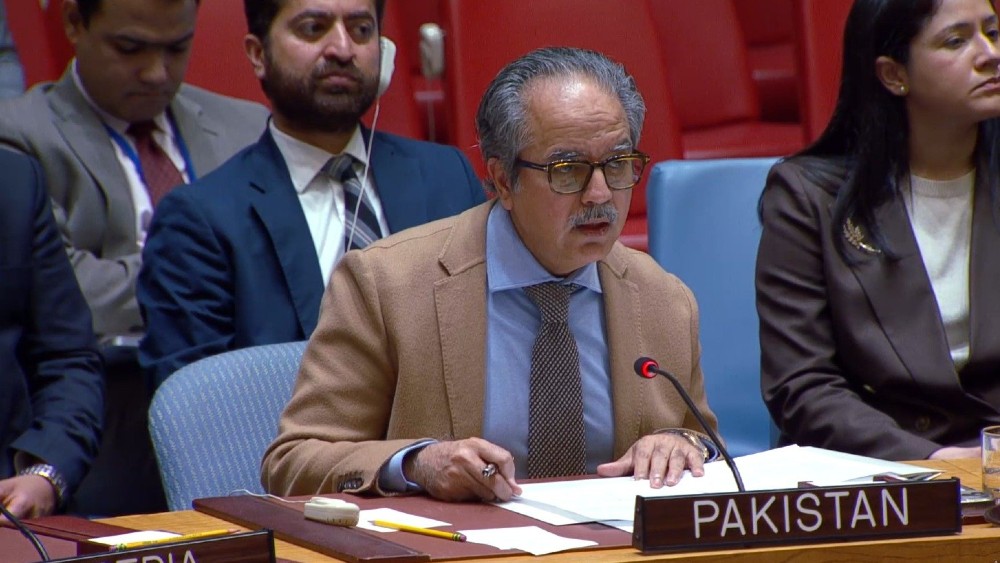
“We believe that MONUSCO remains uniquely positioned to support stabilization efforts and the protection of civilians,” Ambassador Asim Iftikhar Ahmad, permanent representative of Pakistan to the United Nations, told the UN Security Council, which debated the situation in DRC on Thursday.
“The Mission’s institutional experience, logistical reach and presence in key population centres are critical,” he said, citing UN secretary-general’s latest report
that underscores both the urgency of stabilizing the situation and the continued relevance of MONUSCO as an impartial force capable of supporting peace and advancing the protection efforts.
MONUSCO has been in the DRC since July 2010, taking over from an earlier UN peacekeeping operation in a conflict stemming from the 1994 genocide against the Tutsi in neighbouring Rwanda. MONUSCO’s mandate includes protecting civilians and helping the DRC to stabilize and consolidate peace.
The 15-member Council’s debate came as clashes between Rwanda-backed rebel militia groups, AFC and M23, and forces supporting the Government in Kinshasa intensify in the Kivus, despite the M23 militia’s withdrawal from Uvira in January.
The violence is also spreading toward Burundi’s border, raising fears of a broader regional conflict.
Voicing concern over he continued deterioration of the security situation in North and South Kivu, the Pakistani envoy said despite commitments undertaken under the Doha Framework and the Washington Agreement, the AFC/M23 continues its offenses and territorial expansion, undermining confidence in the peace processes and further complicates MONUSCO’s ability to implement its mandate.
“We stress the urgent need for full implementation of resolution 2773, including cessation of hostilities, M23’s withdrawal from controlled areas, and respect for the sovereignty and territorial integrity of the Democratic Republic of the Congo,” Ambassador Asim Ahmad said.
In this regard, he also drew attention to SG’s report which highlights the operational impact of funding cuts on the mission.
The Pakistani envoy pointed out that a total of 2,674 MONUSCO troops, military experts, police personnel and civilian staff have been repatriated or downsized amid funding cuts to UN peacekeeping operations. These reductions have adversely impacted the implementation of that mandate, as well as the safety and security of peacekeepers.
In that context, he said, any additional responsibilities entrusted to MONUSCO — including potential ceasefire-monitoring tasks — must be “matched with commensurate resources”.
Ambassador Asim Ahmad reiterates Pakistan’s support for ongoing diplomatic efforts aimed at achieving a durable political solution.
“We recognize the centrality of the African Union-led facilitation efforts and the important roles played by Qatar under the Doha Framework, the United States through the Washington Agreement and the United Nations Special Envoy for the Great Lakes Region,” he said, adding these initiatives must remain mutually reinforcing and anchored in respect DRC’s sovereignty, unity and territorial integrity.
At the outset, Vivian van de Perre, Deputy Special Representative for Protection and Operations with the mission, said that ‘blue helmets’ would continue the full spectrum of their activities in Ituri, supporting the ceasefire as well as offering protection to civilians in North Kivu – while focusing exclusively on ceasefire-related functions in South Kivu.
In Ituri province, “the situation remains alarming” with rebel attacks causing casualties, displacement, and damage to infrastructure, the UN official said.
“Recent hostilities between the government and AFC/M23 have also been marked by the growing use of offensive drones, as well as by continued jamming and spoofing of GPS signals,” Ms. van de Perre said.
Attacks from another rebel group, the ADF, have also resumed in the Mambasa territory, far from their traditional areas of operations.
“Despite these challenges, diplomatic efforts to support the implementation of ongoing peace processes are ongoing,” Ms. van de Perre said.
She welcomed the renewed commitment by the DRC and Rwanda to move forward with the Washington Accords following their 17–18 March meeting in the US capital, where both sides agreed on concrete steps to implement the peace agreement and reduce tensions.