The Sindh Cabinet presided over by Chief Minister Syed Murad Ali Shah approved a comprehensive austerity and fuel conservation plan along with a series of governance, economic, social protection, and education reforms aimed at addressing the prevailing energy situation and strengthening public service delivery across the province.
Sindh Cabinet approves fuel conservation plan, work from home, online classes, women’s property rights law
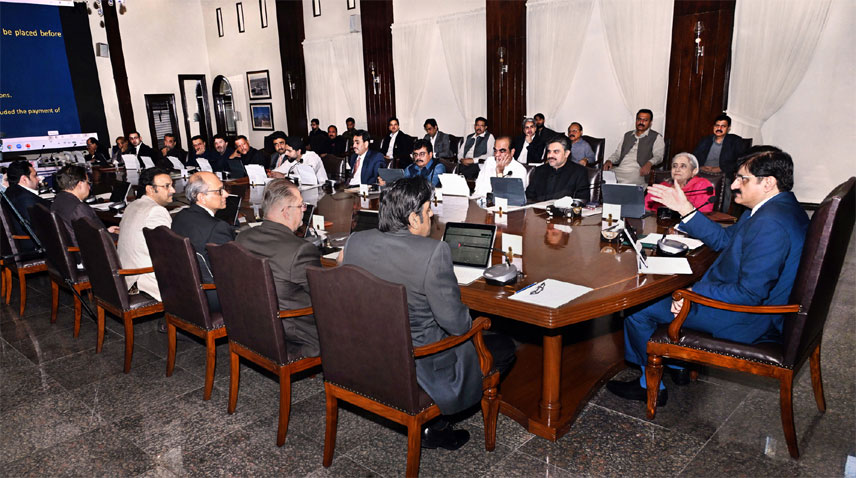
KARACHI, Mar 10 (APP): The Sindh Cabinet presided over by Chief Minister Syed Murad Ali Shah approved a comprehensive austerity and fuel conservation plan along with a series of governance, economic, social protection, and education reforms aimed at addressing the prevailing energy situation and strengthening public service delivery across the province.
The meeting, held at the CM House, was attended by provincial ministers, advisors, special assistants, Chief Secretary Asif Hyder Shah, and relevant administrative secretaries.
Senior Minister for Information Sharjeel Inam memon addressing the press conference, said that the cabinet considered a 23-point agenda, approving measures related to fiscal discipline, fuel conservation, education reforms, women’s rights, agriculture, healthcare, and institutional strengthening.
The cabinet decisions were shared by Minister Information Sharjeel Memon.
The cabinet approved the launch of a comprehensive austerity and fuel conservation drive aimed at reducing public expenditure and ensuring efficient use of energy resources in view of the prevailing economic pressures and uncertainty in global fuel markets.
The chief minister directed the chief secretary to implement a series of spending cuts, operational adjustments, and fuel conservation steps across government departments and public institutions.
Under the austerity plan, the government has reduced fuel allocations for official vehicles by 50 per cent for two months, a step expected to save around Rs960.55 million. Operational vehicles such as ambulances, buses and emergency services will remain exempt from the restriction.
In addition, 60 per cent of official vehicles in government departments will remain grounded for the next two months, while departments have been directed to promote carpooling among officers to reduce fuel consumption.
To demonstrate solidarity with the public during the economic strain, provincial ministers, advisers and special assistants have voluntarily decided to waive their salaries and allowances for three months April, May, and June. A 25 per cent voluntary cut in the salaries of provincial legislators has been suggested during the same period for which the Speaker of the provincial assembly would be informed of the cabinet decision.
Senior government officials in BS-20 and above earning more than Rs300,000 per month have also been encouraged to voluntarily forgo two days’ salary, except those serving in the health and education sectors.
The cabinet also approved a 20 per cent reduction in non-essential government expenditure for the final quarter of the current fiscal year, excluding electricity bills and medicine procurement. The measure is expected to generate savings of more than Rs12 billion.
A complete ban on the purchase of new vehicles and government durables will remain in force until June 2026. Procurement of IT equipment will only be allowed after scrutiny by the relevant authorities.
The government has also imposed a ban on official foreign visits, except in unavoidable cases. Ministers, parliamentarians and government officials undertaking official travel will be required to travel in economy class.
Similarly, official dinners and large ceremonial events have been banned, except for receptions for visiting foreign delegations. Government departments have been directed to conduct meetings through virtual or online platforms to minimise travel and lodging expenses.
To reduce fuel consumption caused by commuting, the government has approved work-from-home arrangements for up to 50 per cent of staff on alternate days, except for essential services.
Both public and private sector offices will also observe a four-day work week, with adjustments in working hours where necessary. However, these measures will not apply to the banking sector, industry and agriculture, which will continue normal operations.
As part of the fuel conservation plan, spring holidays will be observed in schools from March 16 to March 31, while colleges and universities will shift to 100 per cent online classes during this period.
The government has also introduced additional public measures to reduce fuel consumption. Speed limits on roads have been lowered, with motorways set at 90–100 km/h and highways at 65–80 km/h.
At the same time, the number of guests allowed at wedding functions and public gatherings has been restricted to 200, with the one-dish rule strictly enforced.
The provincial government has also strengthened monitoring mechanisms to prevent fuel hoarding and illegal storage of petroleum products.
The Energy Department is coordinating with the Oil and Gas Regulatory Authority and the Ministry of Energy (Petroleum Division) to ensure a stable fuel supply and regulatory compliance across Sindh.
Deputy commissioners across districts have been directed to conduct regular inspections, maintain strict vigilance against illegal storage of petroleum products, and take action against hoarders.
The CM said that the austerity drive is aimed at ensuring fiscal discipline, conserving fuel resources, and maintaining economic stability during the current regional and global energy uncertainties.
The cabinet also approved the landmark Student Attendance Monitoring and Redress System (SAMRS) Policy, a technology-based initiative designed to address student absenteeism and rising dropout rates.
The policy introduces a mobile application and digital dashboard to track enrolment and daily attendance across schools managed by the Sindh Education and Literacy Department, Sindh Education Foundation, and education management organisations.
The system will also identify risk factors affecting attendance and introduce interventions such as counselling and peer support. The programme is expected to be implemented in all schools across Sindh within one year.
Following consultations with the business community, the cabinet approved the Sindh Development and Maintenance of Infrastructure Cess (Second Amendment) Act, 2026, along with a revised Settlement Agreement (March 2026).
The amendments aim to streamline the collection and utilisation of the cess, which funds the development and maintenance of industrial and transport infrastructure across the province.
To stabilise wheat supply and prices, the cabinet approved the expansion of the wheat release policy to include private traders, in addition to flour mills and chakkis.
Under the policy, licensed traders will receive wheat at the government-notified rate of Rs8,000 per 100-kg bag. Around 300,115 metric tons of wheat are currently available for release, which could generate Rs30.398 billion in sales and help reduce the province’s wheat debt of Rs109.405 billion.
The cabinet finalised Sindh’s nominees for the National Commission for Minorities Rights, recommending Dr Rakesh Motiani and Ms Tushnamaity Patel as provincial representatives.
Administrative reforms were also approved to strengthen the Shaheed Benazirabad Municipal Corporation, including structured representation from the Local Government and Finance departments to improve accountability and governance.
The cabinet approved the allotment of four acres of state land in Deh Khanto, Taluka Ibrahim Hyderi, District Malir, for the establishment of a nursing school attached to the Hasan Suleman Memorial Hospital.
In addition, the cabinet approved $7.6 million (approximately Rs2.14 billion) in financial support for the hospital following an expansion of its covered area from 250,000 to 325,000 square feet and a rise in construction costs.
The 312-bed tertiary care hospital, located on the National Highway (N-5), will provide specialised healthcare services to residents of Karachi and surrounding districts. The CM said that the funding will be released from the 2026-27 fiscal year, subject to a matching contribution by the Hasan Suleman Foundation.
The cabinet approved the Sindh Women Agricultural Workers Rules, 2026, developed with technical assistance from the International Labour Organisation.
The rules formally recognise women’s contributions in farming, livestock and fisheries, ensuring equal wages, maternity benefits and protection against harassment and discrimination.
The cabinet also approved the Benazir Women Agricultural Worker Card for worker registration and the establishment of a BWSP Endowment Fund with an initial allocation of Rs500 million to support female agricultural workers.
The cabinet also discussed proposed amendments to the Special Economic Zones Act 2012 suggested by the Special Investment Facilitation Council.
The Sindh government formally opposed proposals for “Executive Zones” or “Executive NOCs,” stating that such measures bypass provincial authority and the Council of Common Interests, which would contradict the constitutional framework established after the Eighteenth Amendment to the Constitution of Pakistan.
However, the cabinet supported the establishment of a dedicated SEZ Appellate Tribunal to resolve disputes within three months and improve investor confidence.
Several appointments and extensions were approved to strengthen key institutions, including Mr Justice (R) Irshad Ali Shah appointed as Chairperson of the Sindh Revenue Board Appellate Tribunal.
Abdul Rahim Shaikh appointed as Member (Agricultural Income Tax) in SRB following the enforcement of the Sindh Agricultural Income Tax Act, 2025. Ali Ahmed Allawala was nominated as an Independent Director on the board of The Inclusive City initiative. Professor Syed Jamal Raza has been given a two-year extension as Executive Director of the Sindh Institute of Child Health and Neonatology. Dr Dur-e-Naz Jamal granted a two-year extension as Secretary of the Sindh Blood Transfusion Authority.
The cabinet also approved appointments of presiding officers for Anti-Terrorism Courts, including Advocate Irshad Dharejo for ATC Kashmore at Kandhkot, Advocate Aijaz Chandio for ATC Naushehro Feroze, and Ayaz Hussain Marri for ATC Dadu.
Concluding the meeting, the chief minister directed district administrations to ensure strict enforcement of austerity measures, maintain vigilance against fuel hoarding, and implement cabinet decisions effectively to maintain economic stability and improve service delivery across the province.