ISLAMABAD, Mar 05 (APP):Experts at a webinar on Thursday called for embedding climate adaptation within the governance structures at grass roots level, as Pakistan advances district-level adaptation planning under its National Adaptation Plan. The webinar, titled: “Strengthening Local-Led Climate Adaptation in Pakistan: Beyond Optics,” was organized by Sustainable Development Policy Institute (SDPI) in collaboration with the National Adaptation Plan (NAP) team, supported by the United Nations Environment Programme under funding …
Call to embed climate adaptation within governance structures at grass roots level
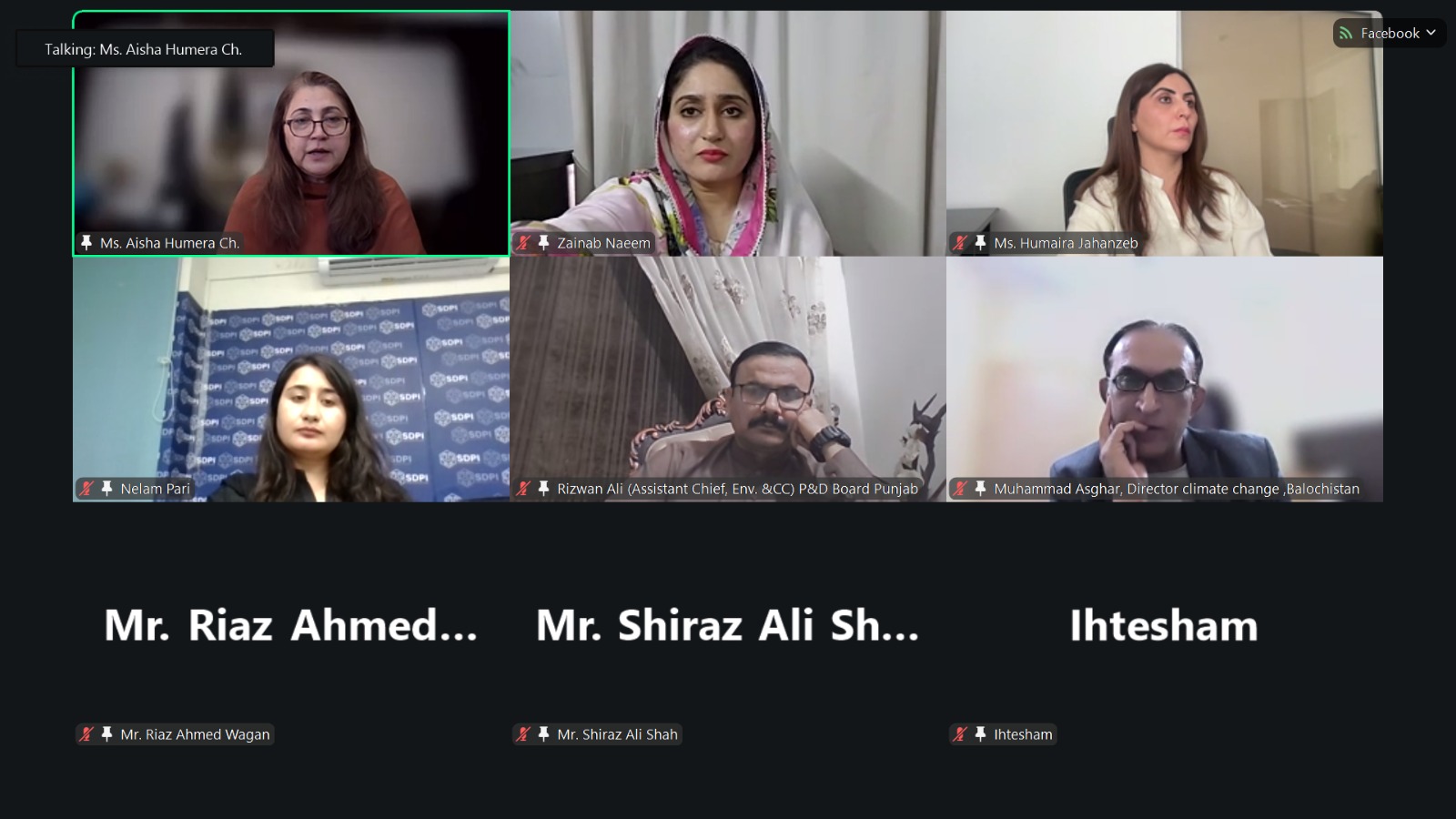
ISLAMABAD, Mar 05 (APP):Experts at a webinar on Thursday called for embedding climate adaptation within the governance structures at grass roots level, as Pakistan advances district-level adaptation planning under its National Adaptation Plan.
The webinar, titled: “Strengthening Local-Led Climate Adaptation in Pakistan: Beyond Optics,” was organized by Sustainable Development Policy Institute (SDPI) in collaboration with the National Adaptation Plan (NAP) team, supported by the United Nations Environment Programme under funding from the Green Climate Fund and implemented by the Ministry of Climate Change and Environmental Coordination.
Senior federal officials, provincial planners, UN representatives and civil society leaders participated in the webinar.
In her keynote address, Aisha Humera Chaudhary, the Federal Secretary for Ministry of Climate Change and Environmental Coordination, emphasized that adaptation must translate into tangible improvements for farmers, schoolchildren, pregnant women and vulnerable populations facing floods, heatwaves and glacial melt.
Acknowledging governance challenges, including weak local government structures and reduced public-sector extension services, she called for integrating local innovations into formal systems. She also proposed encouraging provincial challenge funds, reforming procurement rules to accommodate SMEs and tech entrepreneurs, and conducting joint studies to identify barriers to scaling successful local solutions. “We already have solutions,” she said, adding that the real challenge is scaling them.
Dr. Saad Khan, Additional Secretary at the Ministry of Climate Change and Environmental Coordination, addressing the structural and institutional challenges, pointed out that while Pakistan’s National Action Plan on security is widely recognized, a few stakeholders are aware of the National Adaptation Plan. Stressing the need to elevate adaptation as a national priority, he underscored the limited pool of climate specialists in the country and the bureaucratic delays affecting project timelines.
He emphasized that district plans should serve as pilot models and cautioned against replicating them mechanically across provinces with vastly different topographies and vulnerabilities.
Zainab Naeem, Lead Ecological Sustainability and Circular Economy Unit at SDPI, stressed that adaptation should not be viewed as an imported concept but as a lived experience of Pakistani communities. She emphasized that Climate Risk and Vulnerability Assessments (CRVAs) are essential to prioritize district-specific risks such as riverine floods, flash floods, droughts and heatwaves, ensuring that adaptation plans are evidence-based rather than theoretical.
Providing an overview of the National Adaptation Plan, Humaira Jahanzeb, Project Lead of the GCF-NAP Project at the Ministry of Climate Change and Environmental Coordination, explained that the NAP was approved in August 2023 and later submitted to the United Nations Framework Convention on Climate Change. The document identifies 117 adaptation measures across six vulnerable sectors, including the agri-water nexus, natural capital, human capital, disaster risk reduction, gender and social inclusion, and urban resilience.
Shiraz Ali Shah, Head of the Resilience, Environment and Climate Change Unit at the United Nations Development Programme (UNDP) Pakistan, emphasized that adaptation must begin at the community level, given Pakistan’s diverse geography. He referred to UNDP’s flood recovery programme following the 2022 floods, which focuses on resilient housing, infrastructure rehabilitation and community-level preparedness.
Dr. Ihtesham ul Haq, from Planning and Development Department, Khyber Pakhtunkhwa, appreciated SDPI’s role in strengthening district-level planning and said the updated DAPs would serve as guiding policy documents rather than remaining shelf documents. He confirmed that KP intends to incorporate DAP interventions into upcoming Annual Development Programmes starting July 2026 and is also revising earlier district plans using standardized templates introduced by the federal ministry.
Rizwan Ali, Assistant Chief for Environment and Climate Change at Planning and Development Board, Punjab shared that the Punjab has undertaken climate budget tagging for the current fiscal year. Out of the province’s Rs1,240 billion Annual Development Programme, Rs795 billion has been tagged for climate-related initiatives, of which approximately Rs277 billion is allocated specifically for adaptation. He stressed the importance of further downscaling adaptation planning to district, tehsil and union council levels.
Riaz Ahmed, Chief Conservator of Forests (Riverine and Inland), Sindh highlighted ecosystem-based adaptation efforts, particularly mangrove restoration through public-private partnerships. He said that mangrove cover has significantly recovered from a degraded baseline and announced that agreements are being signed to restore 100,000 acres of forest in Matiari and Jamshoro districts.
Mohammad Asghar, Director Climate Change at Environment Department, Balochistan spoke about the province’s allocation of Rs500 million for community-led adaptation initiatives. He explained that instead of relying solely on conventional bureaucratic procedures, funds are being directed to district-level adaptation committees to enable communities to design and implement localized solutions.
Environmental journalist and development practitioner Afia Salam underscored the communication gap between policy language and community realities. She urged policymakers to simplify climate terminology and ensure that adaptation planning drills down to union council and village levels. She cited grassroots innovations such as glacier grafting in northern areas, Miyawaki urban forests, traditional zero-carbon architecture, bamboo floating wetlands and permaculture initiatives as examples of “adaptation without optics.”
Neelam Pari, Research Associate at SDPI, moderated the session and outlined the objective of moving beyond symbolic approaches to operationalize local-led adaptation through improved access to climate finance, institutional strengthening, gender-responsive planning and multi-stakeholder coordination across governance levels.