ISLAMABAD, Feb 26 (APP): Minister of Federal Education and Professional Training (FE&PT), Dr Khalid Maqbool Siddiqui launched report under the title of "Girls' Education Statistics and Trends Report 2023-24," highlighting that the primary school completion rate for girls has surged from 75% to 89%, reflecting a significant return on infrastructure investment. The launching ceremony was held at PIE on Thursday, which was graced by Federal Minister for Education and Professional …
Primary completion female students rate soars to 89%, 96% schools buildings infrastructure completed: Report
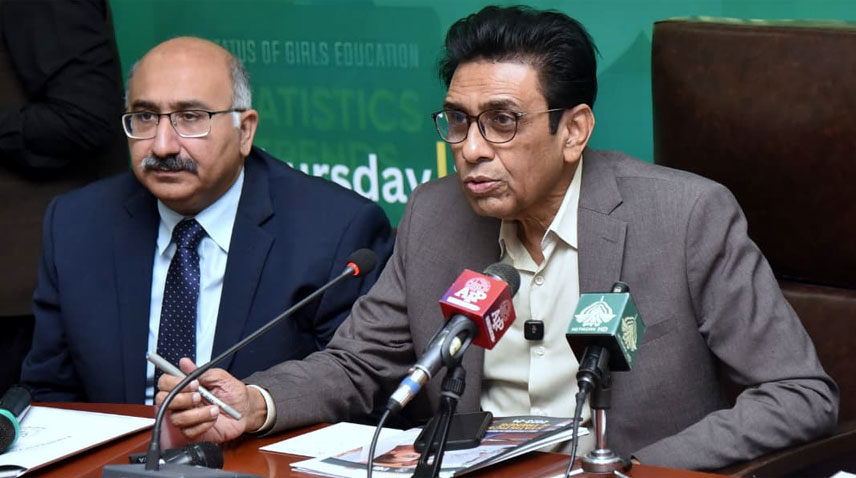
ISLAMABAD, Feb 26 (APP): Minister of Federal Education and Professional Training (FE&PT), Dr Khalid Maqbool Siddiqui launched report under the title of “Girls’ Education Statistics and Trends Report 2023-24,” highlighting that the primary school completion rate for girls has surged from 75% to 89%, reflecting a significant return on infrastructure investment.
The launching ceremony was held at PIE on Thursday, which was graced by Federal Minister for Education and Professional Training, (FE&PT) Khalid Maqbool Siddiqui as chief guest, other participants included Minister of State, FE&PT, Wajiha Qamar, Federal Parliamentary Secretary Farah Naz Akbar, Senator Fawzia, DG PIE Dr Muhammad Shahid Soroya, representatives of partners and educationists.
This report was prepared in collaboration with Pakistan Institute of Education (PIE), Malala Fund, Pakistan Alliance for Girls Education (PAGE) and the Ministry of Education.
The key findings of the report highlighted 96% of schools have concrete buildings, 92% have toilets and 82% have clean drinking water. The percentage of girls completing primary education has increased from 75% to 89%, and facilities and infrastructure for girls’ education are gradually improving every year and others
Speaking on the occasion, Khalid Maqbool Siddiqui said that the data presented in the report would serve as the foundation for policymaking on girls’ education.
He emphasized that accurate data is essential for solving educational challenges, noting that no country progresses alone but advances collectively with regional cooperation.
He stressed the need to move toward practical actions based on data, as successful global policies are built on evidence. He added that girls’ dropout rates can only be reduced by changing societal attitudes and broadening mindsets.
The minister highlighted that Pakistan has 140 million youth, and the country must decide whether to treat them as a burden or empower them as an asset by providing opportunities.
He stressed that the fight against ignorance must begin at home. When the state equips a girl with education or skills, it is her right to progress. He urged parents to allow their daughters to pursue professional careers alongside domestic responsibilities, warning that restricting skilled women to homes is a loss of valuable human capital.
Concluding his remarks, the minister said that serious measures to promote girls’ education are urgently needed and assured that the government would utilize all available resources to address the issue.
Minister of State Wajiha Qamar highlighted key findings of the report and said an action plan would be developed, using both achievements and challenges as guidance for future progress.
DG PIE Dr. Muhammad Shahid Soroya said Pakistani girls are proving their exceptional abilities in education. The National Achievement Test (NAT) results show that when girls are provided a supportive environment, they outperform boys in various subjects.
He added that the report aims to identify gaps through data to improve policymaking and remove barriers to girls’ education.
According to the report, Pakistani girls have demonstrated academic excellence. In the National Achievement Test (NAT) 2023, girls scored higher than boys in English, Urdu/Sindhi, and Mathematics. In Grade 8, girls also outperformed boys in Science and Mathematics.
However, population pressure has reduced the number of schools per 1,000 children. Only 23% of schools have ramps for students with disabilities, and even fewer provide specialized teaching materials or assistive devices.
The report further revealed that only 23% of teachers in girls’ schools are formally trained, while just 19% of schools have digital equipment. The share of the education budget has declined from 13% to 11%, with 94% of funds spent on salaries, leaving limited resources for development. Although women’s enrollment in higher education is approaching parity with men, their workforce participation remains only 24%, representing a major loss of human capital.
The report also highlighted that 26.2 million children in Pakistan remain out of school, including 13.4 million girls. Despite girls proving their academic potential, systemic weaknesses continue to hinder their educational progress.
Experts emphasized that the report clearly demonstrates the talent and capability of Pakistani girls, but achieving full progress will require increased education funding, modern teacher training, and improved digital facilities.