Hailing Central African Republic’s landmark elections, Pakistan warns progress remains fragile
Hailing Central African Republic’s landmark elections, Pakistan warns progress remains fragile
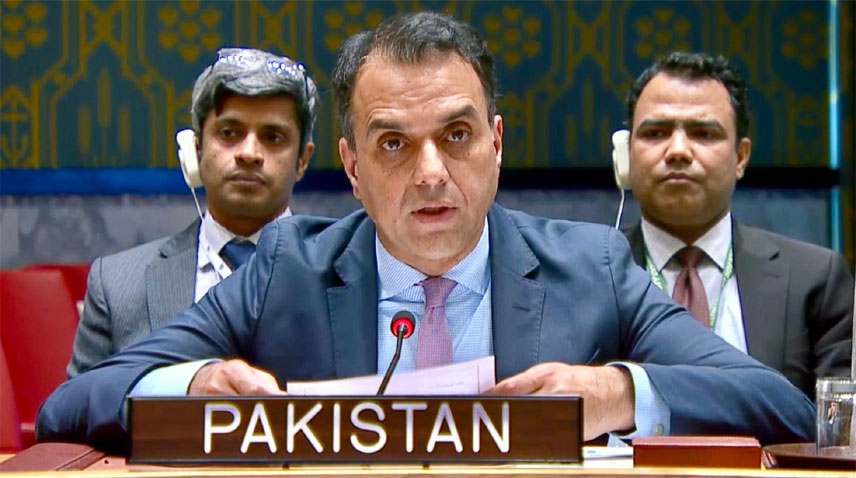
UNITED NATIONS, Feb 26 (APP): While welcoming the holding of combined presidential, legislative, regional and municipal elections in Central African Republic (CAR) last December, Pakistan told the UN Security Council on Thursday that gains made in this small landlocked country in recent years were fragile and required continued support to consolidate.
“Conducted with the logistical, technical and security support of the UN peacekeeping mission, MINUSCA, under its electoral support mandate, they reaffirm the Mission’s continued relevance as a guarantor of stability and an enabler of political processes,” Ambassador Usman Jadoon, deputy permanent of Pakistan to the UN, said.
Speaking in a debate on the situation in CAR, he welcomed the progress in implementing the 2019 Political Agreement, including the dissolution of armed groups and advances in D.D.R. (disarmament, demobilization and reintegration).
“However”, the Pakistani envoy added, “persistent volatility in the east and southeast, the presence of residual armed elements and spillover from Sudan underline the fragility of these gains. Strengthening national defence and internal security forces, extending State authority, and advancing justice and reconciliation remain essential for lasting stabilization.”
While MINUSCA is a “success story of this Council”, Ambassador Jadoon said Pakistan — which contributes more than 1,200 uniformed personnel to the Mission — was concerned that “indiscriminate financial cuts ultimately undermine both peacekeeping and the Council’s core mandate”.
He also pointed out that troop-contributing countries have not been reimbursed for personnel costs since 30 September 2025 or for equipment since 31 December 2024.
Against that backdrop, the Pakistani envoy observed: “This essentially means that the troop-contributing countries — in addition to providing human resources and sacrifices — also continue to shoulder the financial burden of peacekeeping missions while having little to no say in mandate formulations, changes or drawdowns.”
Pakistan supports a conditions-based transition aligned with CAR’s national priorities, Ambassador Jadoon said, while stressing that the objective is consolidation of the hard-won gains achieved over the past decade, not to risk their reversal.
“We reaffirm our unwavering support for CAR’s sovereignty and for MINUSCA, and will continue working with partners to advance lasting peace and stability in the country.”
Earlier, briefing the Security Council, UN’s Special Representative Valentine Rugwabiza said the 28 December 2025 polls marked “an important milestone in the consolidation of the peace process and State authority.”
The combined presidential, legislative, regional and municipal elections – including the first municipal polls since 1988 – represented “the most extensive electoral operations ever undertaken in the Central African Republic,” she said.
Voting was conducted “in a peaceful and secure manner across most of the country, despite isolated security incidents, ” Ms. Rugwabiza said.
Incumbent President Faustin-Archange Touadera secured an outright majority and won a third term in office.
MINUSCA provided technical, logistical, operational and security support, including transporting more than 232 tonnes of voter information and facilitating the deployment of nearly 500 election-related workers nationwide.
The mission also supported the rotation and reinforcement of 1,237 national defence and security forces and provided assistance packages to more than 800 soldiers in hotspot areas.
The elections also reflected progress on inclusion, with women representing more than 47 per cent of voters and 45 per cent of municipal candidates.
CAR has faced recurrent cycles of conflict since 2013, when predominantly Muslim Seleka rebels seized power, prompting the rise of largely Christian anti-Balaka militias.
The 2019 Political Agreement for Peace and Reconciliation between the Government and 14 armed groups – brokered with international support – remains the central framework for stabilization efforts.
Ms. Rugwabiza reported continued progress under that agreement, including the dissolution of two additional armed groups and the signing of a third agreement for the return of the Movement of Central African Patriots to the process, facilitated by Chad.
Since July 2025, more than 1,200 combatants have been disarmed and demobilized.
APP/ift