ISLAMABAD, Feb 23 (APP): Pakistan and Uzbekistan have set an ambitious bilateral trade target of $2 billion and signed 28 agreements aimed at deepening economic cooperation and accelerating regional integration, marking a significant milestone in relations between the two countries. The development came during the landmark state visit of Uzbek President Shavkat Mirziyoyev to Islamabad, where he held talks with Prime Minister Shehbaz Sharif. The two leaders signed a joint …
Pak, Uzbekistan have set bilateral trade target of $2 billion, signed 28 agreements
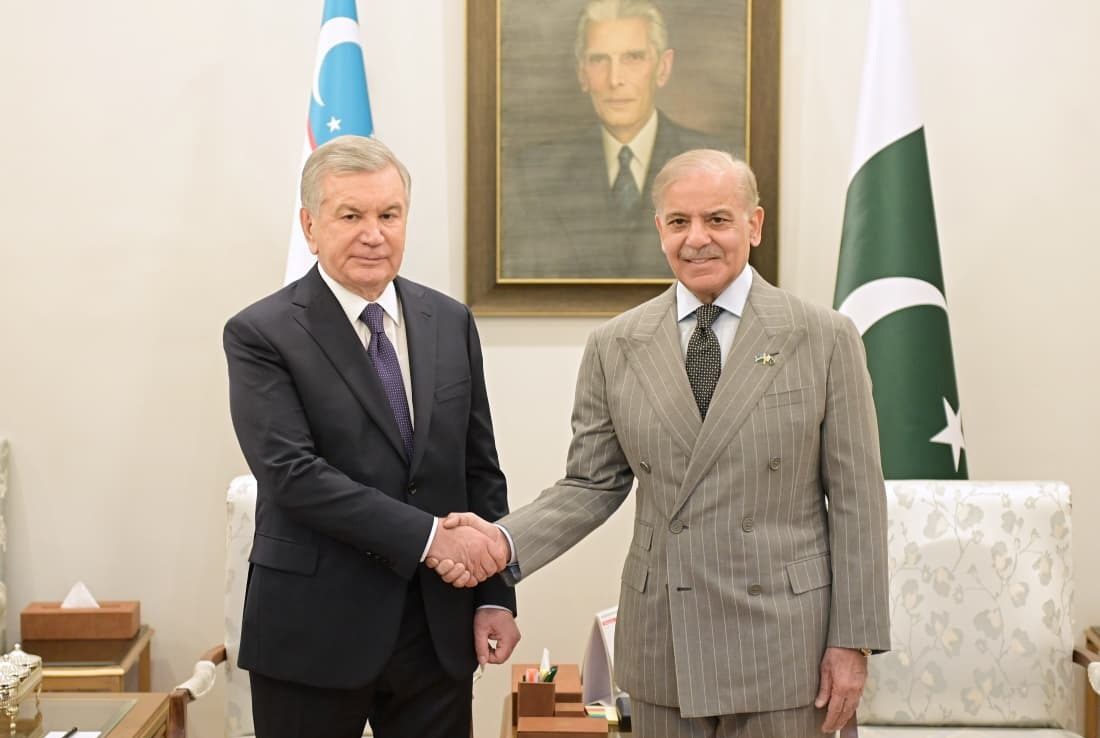
ISLAMABAD, Feb 23 (APP): Pakistan and Uzbekistan have set an ambitious bilateral trade target of $2 billion and signed 28 agreements aimed at deepening economic cooperation and accelerating regional integration, marking a significant milestone in relations between the two countries.
The development came during the landmark state visit of Uzbek President Shavkat Mirziyoyev to Islamabad, where he held talks with Prime Minister Shehbaz Sharif.
The two leaders signed a joint declaration reaffirming their commitment to strengthening the strategic partnership and expanding bilateral collaboration across multiple sectors.
A key outcome of the visit was the agreement to enhance annual trade to $2 billion over the next five years. The 28 signed agreements and memoranda of understanding (MoUs) cover a broad spectrum of areas, including foreign affairs, preferential trade, defence, climate change, agriculture, food security, information technology, science, education, culture, maritime cooperation, pharmaceuticals, textiles, mining, geosciences, small and medium enterprises (SMEs), sports, and counter-narcotics.
To facilitate trade, both sides concluded a protocol to expand the list of goods under the Preferential Trade Agreement, adding more than 40 product categories from each country. They also established a Pakistan-Uzbekistan Inter-Regional Forum to promote business-to-business engagement and private-sector collaboration.
Recognizing Uzbekistan’s landlocked status, the two countries signed an MoU on maritime cooperation, granting preferential port arrangements at Karachi, Gwadar, and Port Qasim to provide improved access to sea routes. Additional agreements were reached in industrial cooperation, pharmaceuticals, textiles, and SME development.
Energy and environmental cooperation also featured prominently in discussions. Both countries agreed to collaborate on ecology, climate change adaptation, and disaster risk reduction, underscoring their shared commitment to sustainable development.
Regional connectivity emerged as a central theme, particularly the proposed Trans-Afghan railway corridor. The project is expected to reduce cargo transit time between Uzbekistan and Pakistan from 35 days to as little as three to five days, lower logistics costs by up to 40 percent, and initially handle three million tons of cargo annually, with potential expansion to 15–20 million tons.
The two sides also highlighted multimodal connectivity initiatives, including the Uzbekistan–Kyrgyzstan–China–Pakistan corridor, and discussed expanding direct flight operations to Islamabad, Lahore, and Karachi to strengthen people-to-people and commercial ties.
Pakistani investment in Uzbekistan reached $70 million in 2025, up from $33 million in 2024, supporting approximately 230 joint ventures in sectors such as textiles, pharmaceuticals, and banking. A business forum co-chaired by the two leaders unveiled a $3.5 billion project portfolio, while the Uzbekistan-Pakistan Business Council was established to institutionalize private-sector cooperation.
Industrial collaboration is also expanding in digital technologies and artificial intelligence exchanges, alongside traditional sectors such as textiles and pharmaceuticals.
Business leaders welcomed the developments in talking to APP. President of the Federation of Pakistan Chambers of Commerce and Industry (FPCCI), Atif Ikram Sheikh, described Pakistan and Uzbekistan as reliable trading partners with centuries-old historical linkages.
“We need to revive the historic Silk Route and achieve the ambitious bilateral trade target of $2 billion through diversification and enhanced cooperation between business communities on both sides,” he said.
President of the Islamabad Chamber of Commerce and Industry, Sardar Tahir Khan, also expressed optimism, stating that both countries possess significant potential to meet the $2 billion trade target in the coming year. He emphasized that, given their strategic geographic locations, Pakistan and Uzbekistan can play a central role in fostering regional economic integration.
The signing of 28 accords, the ambitious trade road-map, and the high-level engagement during President Mirziyoyev’s visit collectively signal a new phase in Pakistan-Uzbekistan relations, anchored in connectivity, economic partnership, and shared regional development goals.