By Fakhar-e-Alam SWAT, Feb 15 (APP):As the first rays of sunlight slip over the snow-clade peaks of the Maraghazar hills, 50-year-old Ataullah Khan steps out of his stone made house in Minglawar Valley to explore the breathtaking beauty of River Swat. Wrapped in his traditional Swat chuga and wollen cap, he walks quietly toward the Swat River, his young son running ahead with a football and colorful boats transporting villagers …
Along timeless Swat River: A living museum of Ghandhara awaiting KP Govt attention
By Fakhar-e-Alam
SWAT, Feb 15 (APP):As the first rays of sunlight slip over the snow-clade peaks of the Maraghazar hills, 50-year-old Ataullah Khan steps out of his stone made house in Minglawar Valley to explore the breathtaking beauty of River Swat.
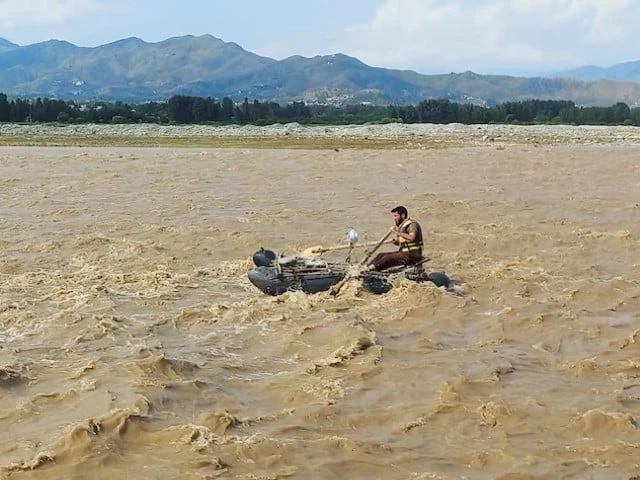
Wrapped in his traditional Swat chuga and wollen cap, he walks quietly toward the Swat River, his young son running ahead with a football and colorful boats transporting villagers and schools children in the picturesque Manglawar.
“Morning walks along the river have been part of my life since childhood,” he said, his breath visible in the cold pre-dawn air. “I used to come here with my father. Now I bring my son for fresh air.”
For Ataullah, the river is not just water flowing through the valley. It is memory, identity, and inheritance.
For historians and archaeologists, it is something even greater being a living corridor of Ghandhara civilization stretching back thousands of years.
Known in ancient Sanskrit texts as Suvastu, meaning “pleasant dwelling,” the Swat River had witnessed more than 5,000 years of continuous human activity. Its fertile banks nurtured early settlements, burial grounds, monasteries, and trading hubs.
Archaeologists described Swat as a “vertical museum,” where every layer of soil preserves the imprint of a different civilization such as from Stone Age hunters to Buddhist monks and later Islamic communities.
The valley’s most significant prehistoric chapter began around 1400 BCE with the emergence of the Gandhara Grave Culture.
According to Bakhtzada Khan, Director of Archaeology and Museums, the Gandhara Grave Culture emerged after the decline of the Indus Valley Civilization.
Communities settled along the river at sites such as Aligram and Loebanr.
Excavations revealed stone-lined graves and later cremation practices, where ashes were placed in clay urns crafted with facial-like openings, symbolically allowing the soul to recognize its resting place.
He said modern DNA analysis of remains from these graves suggested a blend of Indo-Aryan steppe migrants and local populations. Researchers believed these communities introduced iron technology and horse riding to the region with innovations that reshaped transport and warfare.
Long before the arrival of Alexander the Great, genetic markers indicate that some inhabitants of the valley already had Central Asian features.
Centuries later, he said the valley blossomed into a cradle of Buddhist learning. More than 1,400 stupas and monasteries once stood along the riverbanks in places like Butkara, Saidu Sharif, and Shamozi.
Excavations at Barikot and ancient Bazira showed that Swat was not only a religious center but also a vibrant commercial and strategic hub.
Here, artisans created the world-renowned Gandhara art, a remarkable fusion of Greek sculptural realism and local spiritual expression. This artistic tradition flourished after Alexander’s invasion in 327 BCE and during Indo-Greek rule.
Bakhtzada said the cultural layering continued through Persian Achaemenid administration, Mauryan influence, and subsequent Indo-Greek dynasties as each leaving inscriptions, coins, and architectural remains scattered across Swat, Dir, Mardan, Charsadda, and Peshawar.
“Human presence in the wider region dates back far beyond the Gandhara period.
Archaeological discoveries in the Soan Valley of Punjab reveal stone and bone tools from as early as two million years ago. Excavations at Sangaro Cave in Mardan uncovered Middle Paleolithic remains dating between 9,000 and 27,000 years before present.”
Neolithic evidence from sites such as Mehrgarh, Rehman Dheri, and Sheri Khan Tarkai indicates early mud and stone houses, pottery-making, and settled life nearly 8,000 years ago.
Each finding reinforces a powerful truth that this historic land has never been silent and remained centre of Ghandhara and primitive civilizations.
A sacred geography of faiths oer millennia, buddhism, hinduism, sikhism, christianity, and later Islam all found roots in Khyber Pakhtunkhwa. The Swat Valley became not just a geographical passage but a spiritual crossroads.
Recently, monks from Thailand and Sri Lanka visited Swat’s archaeological sites and museum, expressing appreciation for preservation efforts undertaken by the provincial government. Yet experts said much more remains to be done especially for safeguarding the ancient River Swat
Prof. Dr. Salimur Rehman, former Chairman of Environmental Sciences at the University of Peshawar, warned that the Swat River now faces a different threat such as environmental degradation.
Pollution, unchecked construction, and poor waste management are gradually choking the very river that sustained civilizations for millennia.
“The Swat River is the identity of Khyber Pakhtunkhwa,” he said. “Protecting it is not just an environmental responsibility but a cultural and historical obligation.”
As Ataullah finishes his morning walk, his son’s laughter echoes across the riverbank. The water flows on indifferent yet enduring.
But the question lingers that will the present generation preserve this ancient highway of civilization, or allow neglect to erode what thousands of years carefully built?
The Swat River has carried the stories of horsemen, monks, emperors, and farmers.
Now it carries a silent appeal for protection, preservation, and renewed attention from the KP government before this living museum fades into memory.