ISLAMABAD, Feb 12 (APP): Special Assistant to the Prime Minister (SAPM) on Digital Media Fahd Haroon on Thursday termed President Kassym-Jomart Tokayev of Kazakhstan’s visit to Pakistan as a historic milestone in bilateral engagement. Addressing the International Conference on Pakistan–Kazakhstan Relations: Post-Visit Reflections and Pathways for Strategic Cooperation, he said, “It was not merely a ceremonial exchange; it was a strategic reaffirmation of shared vision, mutual trust, and converging national …
Fahd Haroon terms Kazakhstan President’s visit to Pakistan historic milestone in bilateral engagement
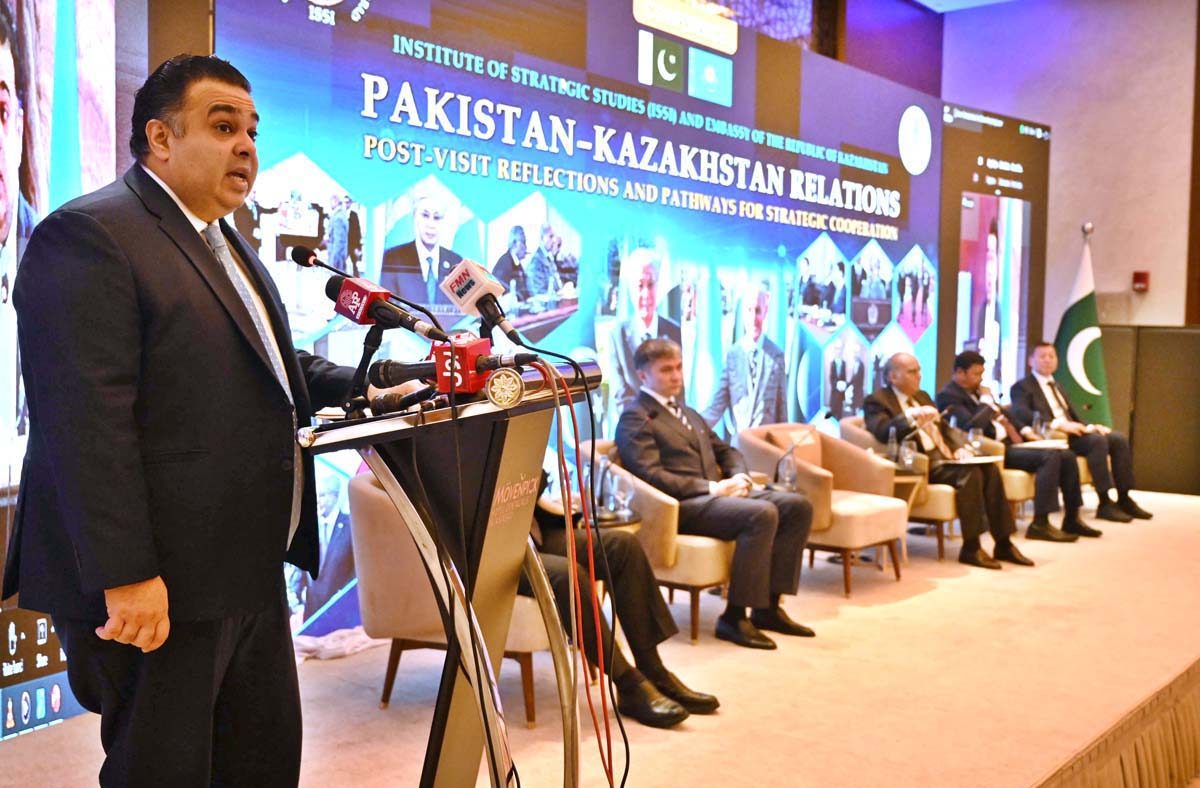
ISLAMABAD, Feb 12 (APP): Special Assistant to the Prime Minister (SAPM) on Digital Media Fahd Haroon on Thursday termed President Kassym-Jomart Tokayev of Kazakhstan’s visit to Pakistan as a historic milestone in bilateral engagement.
Addressing the International Conference on Pakistan–Kazakhstan Relations: Post-Visit Reflections and Pathways for Strategic Cooperation, he said, “It was not merely a ceremonial exchange; it was a strategic reaffirmation of shared vision, mutual trust, and converging national interests.
The signing of the Joint Declaration on Strategic Partnership marks the formal elevation of Pakistan–Kazakhstan relations and provides a durable political framework for long-term cooperation.”
The event was attended by ambassadors, members of the diplomatic community, esteemed scholars, experts, and practitioners.
He appreciated the Institute of Strategic Studies Islamabad for convening the conference at a particularly significant moment in the evolution of Pakistan’s relations with Central Asia, and Kazakhstan in particular.
Fahd Haroon said that the conference rightly seeks to move beyond symbolism and focus on implementation. “The true measure of diplomatic success lies not only in signed documents, but in their translation into concrete outcomes that benefit peoples, strengthen regional connectivity, and contribute to stability and prosperity across Eurasia,” he said.
He added that at the heart of this renewed partnership lies a shared understanding of geography as opportunity. Pakistan and Kazakhstan are natural partners in regional connectivity, with Kazakhstan serving as a key Central Asian hub and Pakistan as a gateway to the Arabian Sea.
The extensive agreements concluded in transport, logistics, and maritime cooperation reflect this strategic logic.
He highlighted cooperation between Kazakhstan’s railways and logistics institutions and Pakistan’s National Logistics Corporation, sister-port arrangements linking Aktau with Karachi and Gwadar, and enhanced collaboration between postal and maritime authorities, all aimed at operationalizing a seamless north–south connectivity corridor.
These initiatives, he said, can significantly reduce transit times and costs, enhance trade volumes, and integrate Central Asia more deeply with South Asian and global markets.
Equally significant, he said, are agreements in trade, investment, and economic cooperation. The Transit Trade Agreement and Customs Cooperation Agreement provide a framework for predictable, secure, and efficient trade flows. Sector-specific initiatives in agriculture, veterinary sciences, plant protection, cotton research, and standardization demonstrate a pragmatic focus on early gains.
“Of particular importance are emerging joint ventures and investment platforms, including partnerships in building materials, sugar production, floor coverings manufacturing, and the establishment of a joint investment platform between major national holding entities. These initiatives signal a shift from transactional trade to long-term, value-added industrial cooperation, aligned with Pakistan’s economic transformation agenda and Kazakhstan’s diversification objectives,” he said.
Energy and natural resources cooperation, he said, is another pillar of the strategic partnership. Agreements in mining, geosciences, petroleum, and renewable energy reflect mutual recognition of the role that energy security and resource development play in sustainable growth.
“As both countries pursue cleaner, resilient, and diversified energy pathways, collaboration in these sectors can generate shared solutions and technological exchange,” he added.
Fahd Haroon stressed that the future of Pakistan–Kazakhstan relations will ultimately be shaped by people, not just policies. In this regard, cooperation in education, science, and technology is particularly encouraging.
The establishment of specialised centres such as the Al-Farabi Center, Satbayev Center for Science and Technology, and Yassawi Center, along with multiple university-to-university agreements, will institutionalize academic exchanges, joint research, and innovation-driven collaboration.
Equally forward-looking is cooperation in information technology, digital development, artificial intelligence, fintech regulation, space research, and innovation ecosystems, including linkages between Astana Hub and Pakistan’s national technology institutions. These initiatives, he said, position both countries to benefit from the opportunities of the digital economy and the Fourth Industrial Revolution.
Agreements on security cooperation, countering crime, extradition, and peacekeeping reflect shared responsibilities in addressing transnational challenges and underline a convergence of views on regional stability, multilateralism, and respect for international law.
As responsible members of the international community and active participants in the Shanghai Cooperation Organisation, Pakistan and Kazakhstan have a vital role to play in promoting cooperative security, he said.
He also highlighted cooperation in culture, media, tourism, sports, healthcare, and the environment, which adds a human dimension to the partnership. From broadcasting and cultural exchanges to joint sports initiatives, climate cooperation, and healthcare collaboration, these agreements deepen societal linkages and foster mutual understanding. Sister-city relationships further anchor bilateral ties at the local and community level, ensuring inclusive and sustainable cooperation.
Fahd Haroon said the conference provides a critical platform for policymakers, scholars, and practitioners to identify priorities, address implementation challenges, and propose actionable follow-up mechanisms. “Strategic partnerships succeed when supported by sustained dialogue, institutional coordination, and informed public discourse,” he said.
“Pakistan views Kazakhstan not only as a bilateral partner but as a key pillar of its broader engagement with Central Asia. The momentum generated by the recent Presidential visit must be preserved and translated into steady progress. This requires commitment, coordination, and continuity on both sides,” he added.