By Fakhar e Alam PESHAWAR, Feb 10 (APP): India, which has repeatedly been accused of disregarding international treaties, UN resolutions, and guarantees, has once again come under criticism for violating the judgment of the Permanent Court of Arbitration (PCA) in The Hague and the World Bank’s guarantees by unilaterally holding the Indus Waters Treaty (IWT) in abeyance. International relations experts and legal observers reiterated that whether it concerns United Nations …
Violation of IWT by India tests International Court authority, World Bank guarantees
By Fakhar e Alam
PESHAWAR, Feb 10 (APP): India, which has repeatedly been accused of disregarding international treaties, UN resolutions, and guarantees, has once again come under criticism for violating the judgment of the Permanent Court of Arbitration (PCA) in The Hague and the World Bank’s guarantees by unilaterally holding the Indus Waters Treaty (IWT) in abeyance.
International relations experts and legal observers reiterated that whether it concerns United Nations Security Council (UNSC) resolutions on Jammu and Kashmir or binding rulings of international arbitration court, the fascist Modi government has demonstrated a pattern of non-compliance with international legal obligations and went against judgments of international courts and World Bank guarantees.
The illegal unilateral decision to place the IWT in abeyance is viewed as a clear violation of international law and treaty commitments that further exposed Indian Govt negative designs against Pakistan.
The Hinduvata regime has also acted in contravention of the World Bank’s role as guarantor of the treaty, under which neither party is permitted to suspend or take unilateral action against the historic IWT signed in 1960 by the top leadership of both countries.
In recent years, India has been accused of violating the 1960 water treaty by attempting to divert waters from the western rivers and using water as a war instrument, raising serious concerns for regional peace and stability.
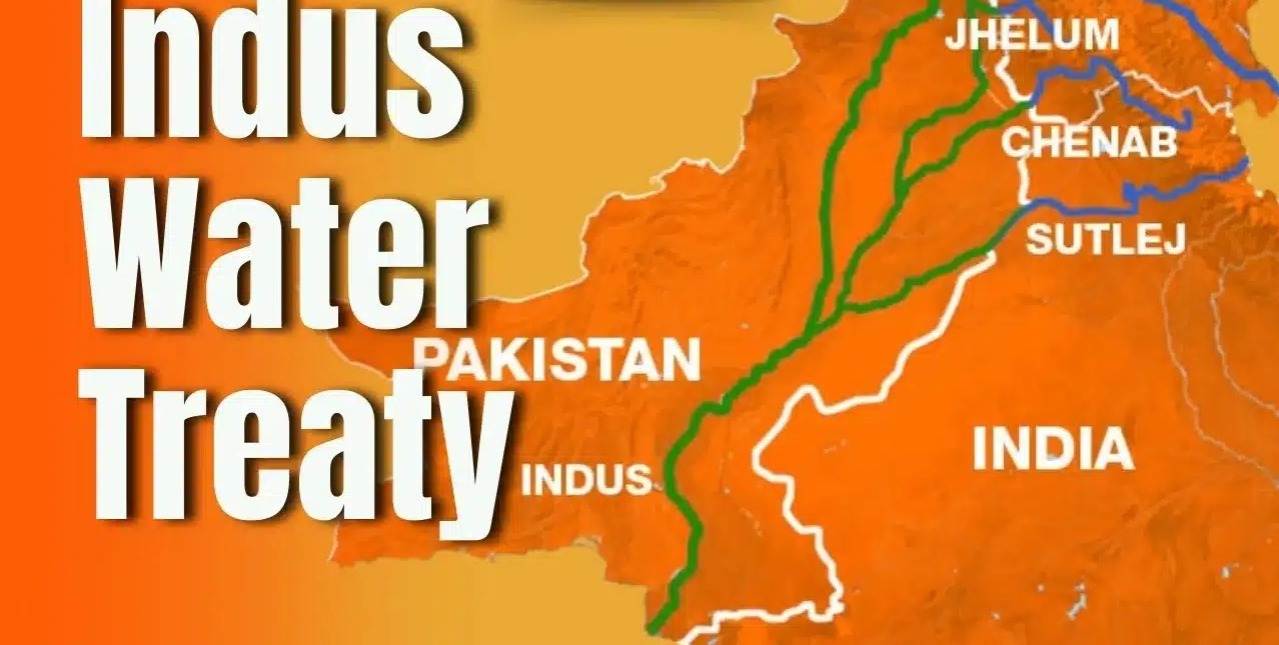
The Indus Waters Treaty, signed in September 1960 by President Ayub Khan of Pakistan and Prime Minister Jawaharlal Nehru of India, and brokered by the World Bank, established a comprehensive framework for water sharing between the two countries.
Under the historic treaty, the eastern rivers namely Sutlej, Beas, and Ravi were allocated to India, while the western rivers namely Indus, Jhelum, and Chenab were reserved for Pakistan. Notably, the treaty remained in force even during the wars of 1965 and 1971.
Advocate Asif Yousafzai, a Supreme Court lawyer and expert in international law, maintained that India’s disregard for international agreements and treaties have been fully exposed before the global community through its illegal announcement to hold the IWT in abeyance.
The India’s illegal actions, including the development of hydroelectric projects on the Chenab and Jhelum rivers, are widely regarded as serious violations of the treaty’s let flow provisions governing the western rivers.
Modi Govt illegal actions are tantamount of putting millions of people to hunger and starvation besides fanning terrorism and energy crisis in Pakistan.
He emphasized that India has no legal justification to suspend or hold the treaty in abeyance, particularly after the binding ruling of the Permanent Court of Arbitration, which reaffirmed that the IWT does not allow unilateral suspension by either party.
According to Asif Yousafzai, the PCA ruled that India must ensure the unrestricted flow of waters from the western rivers namely Indus, Jhelum, and Chenab for Pakistan’s use, and rejected India’s attempts to suspend the treaty unilaterally.
On August 8, 2025, the PCA has ruled that India must strictly adhere to IWT provisions concerning the design of hydroelectric projects, prohibiting design features that enable excessive water storage especially on western rivers flowing to Pakistan.
He added that the historic ruling had protected Pakistan’s rights to uninterrupted river flows and confirmed that the treaty remains fully in force despite India’s negative rhetoric.
The PCA also rejected India’s “best practices” justification regarding dam designs on the western rivers. He described the judgment as a significant legal success for Pakistan, reiterating that Islamabad’s position was firmly grounded in international law.
Professor Dr Abdul Rauf, Chairman of the Political Science Department at the University of Peshawar, said that the fascist Modi government’s move was a deep-rooted conspiracy designed to please domestic audiences.
He said that following military and diplomatic setbacks in May conflict, Modi Govt sought to generate internal political support by escalating negative rhetoric against Pakistan and announced the suspension of the IWT, an illegal move that was criticized even within India.
Dr Rauf said the illogical decision was also intended to undermine Pakistan economically by exploiting its agriculture and livestock position as a lower riparian state.
He cautioned that if such uncalled for actions by an upper riparian state were normalized or accepted, it could set a dangerous precedent, potentially allowing other upper riparian countries, including China, to take similar measures against India in the future.
Professor Dr Hussain Shaheed Soharwardi, Chairman of the International Relations Department at the University of Peshawar, strongly condemned India’s suspension of Indus water treaty, calling it a serious breach of IWT guaranteed by the World Bank 66 years ago that minimised chances of war on water.
He explained that Article 12(4) of the Indus Waters Treaty allows termination only through mutual written agreement between Pakistan and India. “The treaty contains no provision for unilateral suspension, withdrawal, or abeyance, and this treaty is of indefinite duration.”
“IWT is a state specific treaty, not a regime-specific one,” he said, adding that it remains binding on both states regardless of changes in government or security challenges.
“Any unilateral withdrawal or suspension would constitute a clear breach of the treaty and potentially serious security and economic consequences for the entire region with consequences beyond borders.”
Dr Hussain further said that even in the absence of the IWT, international water law does not permit an upper riparian state to interrupt water flows to a lower riparian, and that no precedence in world was witnessed that an upper riparian state has blocked water of lower riparian country.
He warned that any such illegal action by India could establish a regional precedent that might later be invoked by other states, including China, in relation to transboundary rivers.
Experts concluded that treaties represent binding obligations between states, and cannot be revoked due to political considerations or temporary deterioration in bilateral relations.
They said international agreements like IWT must be upheld in good faith to preserve regional stability and people prosperity and ensure the credibility of international law.
Great responsibilities rest on international community especially the world bank to prevent Modi Govt from taking unilateral action and ensure that IWT remain enforce imperative for allievation of poverty, combating food insecurity and promoting peace and prosperity of millions of people.