ISLAMABAD, Feb 10 (APP): Pakistani and Russian scholars on Tuesday held in-depth discussions on the evolving security landscape in Europe and Eurasia, emphasizing the growing interlinkages between regional and global security dynamics and their implications for Pakistan and South Asia. The dialogue, titled “European and Eurasian Security: Views from Islamabad and Moscow,” was hosted by the Centre for Strategic Perspectives (CSP) at the Institute of Strategic Studies Islamabad (ISSI) in …
ISSI hosts IMEMO scholars from Russia, discusses European, Eurasian security dynamics
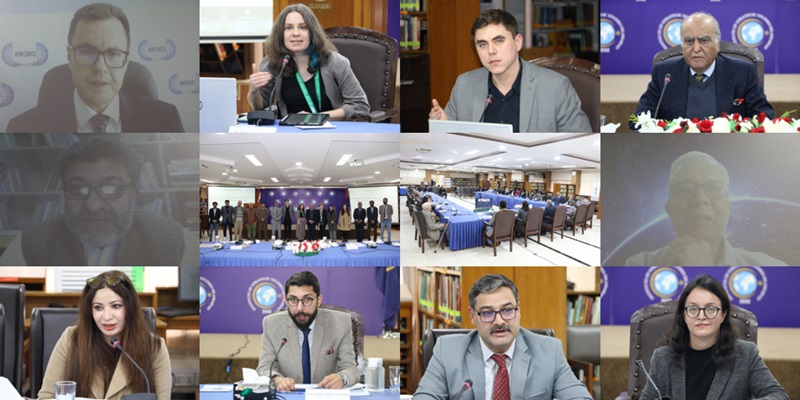
ISLAMABAD, Feb 10 (APP): Pakistani and Russian scholars on Tuesday held in-depth discussions on the evolving security landscape in Europe and Eurasia, emphasizing the growing interlinkages between regional and global security dynamics and their implications for Pakistan and South Asia.
The dialogue, titled “European and Eurasian Security: Views from Islamabad and Moscow,” was hosted by the Centre for Strategic Perspectives (CSP) at the Institute of Strategic Studies Islamabad (ISSI) in collaboration with the Institute of World Economy and International Relations (IMEMO), Russian Academy of Sciences, said a press release.
In his welcome remarks, Ambassador Khalid Mahmood, Chairman Board of Governors, ISSI, observed that the 2020s have witnessed profound shifts in global politics and security with significant implications for Pakistan, given its geographical location and strategic linkages with Eurasia. He emphasised the importance of informed and nuanced dialogue on these developments and reaffirmed ISSI’s commitment to sustained engagement with leading international research institutions, including IMEMO.
In his opening remarks, Dr. Fedor Voitlovsky, Director, IMEMO, expressed appreciation for the long-standing partnership between IMEMO and ISSI, describing it as a valuable investment in strengthening academic, political, and economic cooperation between Russia and Pakistan. He highlighted the scope for enhanced bilateral collaboration in areas such as infrastructure development, energy security, technology, and innovation.
Dr. Voitlovsky noted that Russia has historically viewed European and Eurasian security as interconnected rather than separate domains. He observed that, for much of the post–Cold War period, Russia sought an inclusive European security order and closer political and economic integration with Europe. However, he argued that differences in conceptual approaches particularly the Euro-Atlantic, NATO-centric understanding of security gradually undermined prospects for an inclusive framework.
He pointed to successive rounds of NATO expansion as a key factor contributing to mistrust, declining interdependence, and the erosion of arms control and cooperative security arrangements. He underlined that Russia is now advancing a broader Eurasian security vision within a polycentric world order, based on equality, mutual respect for national interests, and inclusive cooperation, while reiterating that further NATO expansion continues to be viewed by Moscow as a direct challenge to its national security.
Dr. Maria Khorolskaya, in her presentation, identified the 2014–2022 period as a decisive turning point in Russia–West relations. She traced the roots of the post-2022 security crisis to tensions between the principle of indivisible security and NATO’s eastward expansion, intensified competition in the post-Soviet space, and the weakening of arms control frameworks. She outlined Russia’s stated demands for security guarantees, including limits on NATO expansion and force deployments, and noted that European rearmament has been driven by uncertainty over U.S. commitments, continued reliance on American defence supplies, and structural constraints within the EU defence sector.
Dr. Gleb Makarevich highlighted the evolving Eurasian landscape, referring to initiatives such as the Eurasian Economic Union, its linkage with the Belt and Road Initiative, and the concept of the Greater Eurasian Partnership. He described this framework as flexible and development-oriented, encompassing economic integration, security cooperation, and responses to shared challenges. He noted that Pakistan has opportunities to engage constructively in Eurasian institutional processes and development initiatives of mutual interest.
Mr. Taimur Khan emphasized that Eurasian security is best understood as a complementary and adaptive framework rather than a replacement for European security. He noted that Pakistan approaches Eurasian security pragmatically, with a focus on regional stability, economic development, connectivity, and strategic autonomy, while remaining attentive to developments in European security that shape global norms and crisis management.
Pakistani scholars, including Prof. Dr. Adam Saud, Dr. Saira Nawaz Abbasi, Prof. Tughral Yamin, and Prof. Shabbir Khan, shared perspectives on the implications of European and Eurasian security dynamics for South Asia, regional connectivity, and emerging geopolitical alignments.
The discussion concluded with an interactive question-and-answer session, featuring a wide-ranging exchange on NATO–Russia relations, arms control, Eurasian institutional frameworks, and the impact of great-power competition on regional and global stability. The discussion was moderated by Dr. Neelum Nigar, Director, CSP, ISSI. It ended with the presentation of mementoes to the speakers by Ambassador Mahmood.