ISLAMABAD, Feb 08 (APP): Pakistan’s youth, empowered by the Pakistan Poverty Alleviation Fund (PPAF), are turning knowledge into action by presenting a national climate mandate to parliament. Pakistan’s youth are stepping off the sidelines and into the heart of climate decision-making. Young climate leaders have formally submitted a national youth climate mandate to parliamentarians, marking a pivotal moment for inclusive, accountable, and youth-driven governance. The announcement comes at the culmination …
Pakistan’s youth present national climate mandate to parliament in PPAF-led initiative
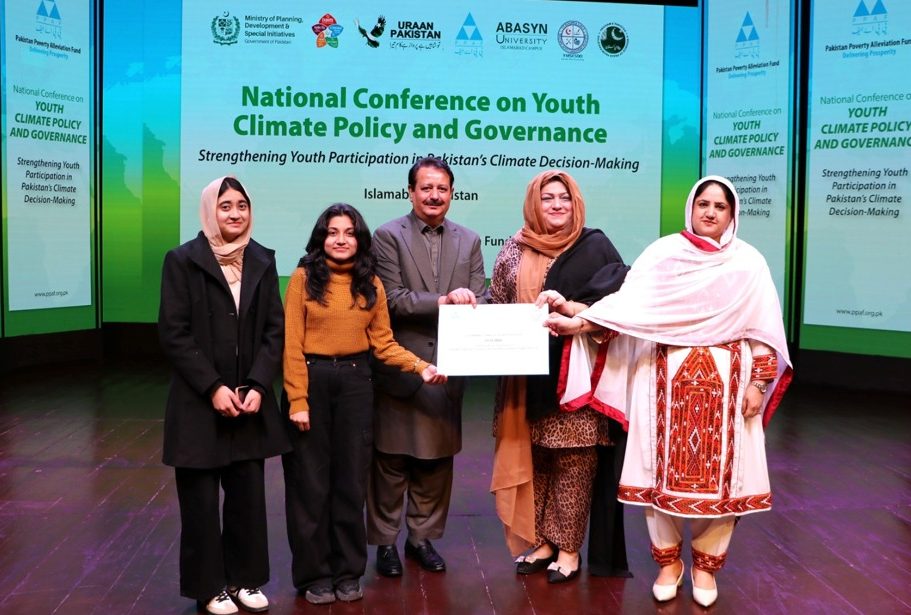
ISLAMABAD, Feb 08 (APP): Pakistan’s youth, empowered by the Pakistan Poverty Alleviation Fund (PPAF), are turning knowledge into action by presenting a national climate mandate to parliament.
Pakistan’s youth are stepping off the sidelines and into the heart of climate decision-making.
Young climate leaders have formally submitted a national youth climate mandate to parliamentarians, marking a pivotal moment for inclusive, accountable, and youth-driven governance.
The announcement comes at the culmination of a nationwide initiative funded by the PPAF, implemented by the Yar Muhammad Samejo Educational Society and Development Organization (YMSESDO), in collaboration with Abasyn University, and hosted at the Pakistan National Council of the Arts (PNCA).
Addressing the audience at the National Conference on Youth Climate Policy and Governance, Nadir Gul Barech, CEO of PPAF, said, “Climate change is not just an environmental issue; it affects economic justice, social stability, and peace,” stressing that youth must move from the margins to the center of climate governance.
He added that with 64 percent of Pakistan’s population under 30, youth leadership is critical for a country facing floods, droughts, heatwaves, and glacial melt. “PPAF is creating pathways for youth to move from climate diplomacy training to policy influence and local solutions,” he said.
Central to the initiative, Nadir explained, were PPAF’s Youth COP Simulations, held across all provincial capitals, Gilgit-Baltistan, and Islamabad. The simulations enabled youth—including girls and persons with disabilities—to step into negotiator roles, tackling challenges such as droughts, floods, coastal erosion, and glacial risks, gaining hands-on experience in dialogue, consensus-building, and negotiation. The programme deliberately linked global climate literacy with local action, with youth forming provincial cohorts to implement targeted interventions—from water governance in Balochistan and flood mitigation in Punjab to coastal resilience in Sindh and glacial risk reduction in Gilgit-Baltistan and Azad Jammu and Kashmir.
The highlight of the conference was the submission of the Consolidated Youth Statement on Climate Action, a youth-driven national climate agenda, to Dr. Shaista Jadoon, MNA, and Ms. Akhtar Bibi, MNA.
“The leadership and innovation demonstrated by young people are already influencing Pakistan’s climate trajectory,” said Dr. Jadoon. “The government recognizes youth as essential partners in strengthening climate resilience, and PPAF has played a crucial role in bridging grassroots action with national policy making.”
Ms. Akhtar Bibi also praised PPAF and YMSESDO for promoting initiatives that link climate resilience with protecting the country’s most vulnerable communities.
She emphasized that empowering youth to lead locally relevant climate interventions not only strengthens community preparedness but also ensures that policy decisions are informed by on-the-ground realities. “Supporting youth-led action is critical to building adaptive, inclusive, and sustainable solutions for the challenges our communities face,” she added.
A high-level panel discussion featured Brig (R) Prof. Dr. M. Salik Javaid (Abasyn University), Mr. Arshad Rashid (PPAF), Dr. Aamir Kaleem (CARE International), and Ms. Qurat-ul-Ain Cheema (Environmental Governance Expert), highlighting the need for institutional mechanisms to include youth in policy formulation, accountability, and disaster management frameworks. Panelists stressed that youth-led initiatives, supported through institutional pathways, can evolve into scalable models for national climate governance.
Concluding the conference, Mr. Barech thanked parliamentarians, youth participants, academics, civil society representatives, UN agencies, diplomats, and the media. He highlighted that the National Youth Policy, developed through consultations in nearly 11,000 villages, reflects an increasingly inclusive governance approach.
Pakistan’s PPAF-led Youth COP Simulation initiative demonstrates how youth leadership can move beyond consultation to tangible impact, positioning young Pakistanis as contributors to decisions shaping a climate-resilient future.