PESHAWAR, Jan 31 (APP):For years, unemployment shadowed 30-year-old Musawar Ahmad’s life, depending on family to meet his financial needs. Degree in hand and hope in his heart, he knocked on many doors only to be turned away due to lack of experience and fierce competition for Govt jobs. Today, however, the once-jobless youth is all smiles as the demand for his handmade cricket bats has surged ahead of the T20 …
Beating unemployment through sports goods manufacturing: A jobless youth’s dream comes true
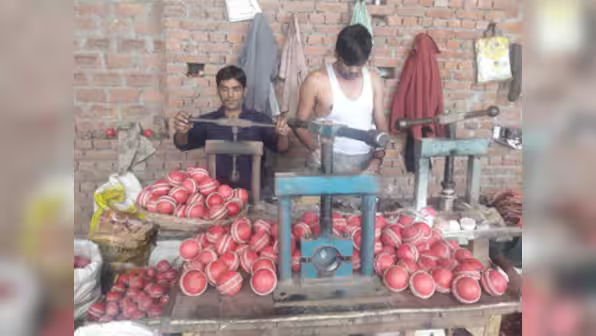
PESHAWAR, Jan 31 (APP):For years, unemployment shadowed 30-year-old Musawar Ahmad’s life, depending on family to meet his financial needs.
Degree in hand and hope in his heart, he knocked on many doors only to be turned away due to lack of experience and fierce competition for Govt jobs.
Today, however, the once-jobless youth is all smiles as the demand for his handmade cricket bats has surged ahead of the T20 World Cup in Peshawar Valley.
“I applied for several government jobs, but every application was rejected due to lack of professional experience and tough competition,” Musawar told APP while carefully polishing glowing handles in his modest two-room sports workshop in Peshawar.
“That’s when I decided to create my own opportunity by investing in sports goods.”
Busy like a hive of honeybees, Musawar and his small team are racing against time to meet growing orders. Government and private educational institutions have placed bulk demands for spring sports events, while individual buyers from across the country are also lining up.
“Our cricket bats are now being supplied to other provinces,” he said with quiet pride. “The demand for Khyber Pakhtunkhwa-made bats has increased because of their durability and strength.”
Musawar’s journey reflects a larger possibility for the province, the one where unemployment can be tackled through local manufacturing and smart use of natural resources.
He said bats made of english willow trees created green economic opportunity for cricket bats manufacturers of Khyber Pakthunkhwa.
From the plantation of English willow to the global export of cricket bats, experts believed a new green economy and employment revolution can be created in Khyber Pakhtunkhwa.
English willow, globally renowned for cricket bat manufacturing, thrives best in cool and humid climates with abundant water, fertile alluvial soil, and riverine environments.
In Pakistan, these conditions naturally exist in several districts of Khyber Pakhtunkhwa.
“English willow considers proximity to water a sign of life,” said Gulzar Rehman, former Conservator of Forests, while speaking to APP.
“That is why it performs exceptionally well along rivers, floodplains, and irrigated agricultural lands.”
Districts such as Swat, Upper Dir, Lower Dir, Lower Chitral, Mansehra, Battagram, and Shangla are considered highly suitable due to their cold to temperate climate, mild summers, adequate winter chill, and permanent water sources. Deep, moist, loamy and silty soils further provide strong root support for the tree.
In Upper and Lower Dir, the Panjkora River and its tributaries including Usheri Khwar and Barawal Khwar offer ideal conditions. Annual floods replenish groundwater levels, creating an environment where English willow flourishes naturally.
Similarly, the Swat River belt from Mingora to Malakand, along with the Upper Swat Canal and its subsidiary channels irrigating Mardan and Swabi districts, provides excellent opportunities for linear plantation. These plantations not only yield valuable timber but also help protect river and canal banks from erosion.
“English willow performs poorly in areas with extreme heat and water scarcity,” Gulzar explained. “Therefore, it must be planted along wide, perennial water bodies and not seasonal streams.”
Beyond Khyber Pakhtunkhwa, experimental plantations along canal banks in Punjab such as Changa Manga, Qadirabad, and Khangra have also shown promising results under planned irrigation systems.
Latifur Rehman, spokesman for the Forest Department, said large-scale plantation of English willow can quickly translate into local bat-making industries.
“Unlike slow-growing trees like deodar and pine, English willow matures faster and becomes industrially usable in a shorter time,” he said. “Bat-making can begin at the local level within a few years.”
He added that the industry would create employment at multiple stages such as wood harvesting, transportation, craftsmanship, finishing, and packaging—providing dignified livelihoods to skilled labor within their own communities.
If cricket bats manufactured from locally grown English willow gain access to global markets, they could earn valuable foreign exchange for the province. More importantly, they could position Khyber Pakhtunkhwa as a new hub of Pakistan’s sports goods industry.
For Musawar Ahmad, the impact is already real. “I may not have gotten a government job,” he said, gently placing a finished bat on the rack, “but I have work, respect, and hope and now I am creating jobs for others too.”