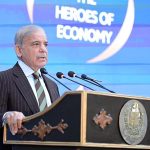
KARACHI, Jan 30 (APP): Sindh Chief Minister Syed Murad Ali Shah has termed unchecked population growth one of Pakistan’s most serious social and economic challenges, stressing the need for sustained, evidence-based family planning policies to secure the country’s future. He was addressing a programme, "Waqfa – Tawazun Ke Liye", organised by the Khalil-ur-Rahman Foundation (MKRF) and Population Council Pakistan to launch a social and behavioural change campaign on …
Unchecked population growth major economic, social challenge: Murad Shah

KARACHI, Jan 30 (APP): Sindh Chief Minister Syed Murad Ali Shah has termed unchecked population growth one of Pakistan’s most serious social and economic challenges, stressing the need for sustained, evidence-based family planning policies to secure the country’s future.
He was addressing a programme, “Waqfa – Tawazun Ke Liye”, organised by the Khalil-ur-Rahman Foundation (MKRF) and Population Council Pakistan to launch a social and behavioural change campaign on family planning, at the Hindu Gymkhana, NAPA Auditorium, on Friday. The programme was also addressed by MPA Nida Khuhro, Country Director Population Council Pakistan Dr Zeba Sathar, UK Deputy High Commissioner Lance Domm, and MKRF Managing Director Shahrukh Hasan.
The chief minister recalled that Pakistan underwent a historic turning point in 1971, when the country was divided. He said that at the time, Pakistan’s population was around 62 million, Bangladesh had about 70 million people, and India’s population was slightly below 550 million.
Highlighting the demographic shift over the last 54 years, CM Murad Ali Shah said that today India’s population has reached 1.48 billion, Bangladesh stands at 177 million, while Pakistan’s population has surged to 259 million.
Shah explained that population growth patterns reveal stark contrasts. “India’s population grew by 2.7 times, Bangladesh’s by about two and a half times, while Pakistan’s population grew by 4.2 times,” he noted.
The CM further said that while India and Bangladesh maintained a population growth ratio close to 1.8 per cent, India still managed to keep its growth rate 1.7 per cent lower than Pakistan’s, underscoring the effectiveness of long-term population management policies.
The chief minister observed that had Pakistan followed a population growth trajectory similar to Bangladesh since 1971, the country’s population today would have been around 155 million – nearly 100 million less than its current size. “We must ask ourselves what went wrong and why we failed to acknowledge our mistakes in time,” he remarked.
Calling population growth a deep-rooted social issue with far-reaching economic consequences, the chief minister recalled that in the 1970s, public awareness campaigns such as “Small family, prosperous family” were regularly aired on television. “At that time, there was only PTV, and we grew up hearing these messages,” he said.
However, he lamented that during the martial law period, population control lost priority and family planning campaigns gradually disappeared from public discourse. “Other countries took timely measures, knowing population growth would eventually become an economic burden, but unfortunately, we did not,” he added.
Murad Shah said that during General Zia-ul-Haq’s era, family planning was sidelined, though discussions resumed after the restoration of democratic governments and NGOs began playing their role. “Despite these efforts, the impact was still far less than what was required,” he observed.
Highlighting successful initiatives, the chief minister credited Shaheed Mohtarma Benazir Bhutto’s Lady Health Workers Programme for creating meaningful awareness by taking family planning messages door to door. “This programme has benefitted communities immensely, yet even today, when compared with other countries, we remain far behind,” he admitted.
CM Murad Ali Shah rejected the notion that family planning is a religious issue. “This has been unnecessarily turned into a religious debate, whereas in reality it is not,” he said.
The CM cited international comparisons, stating that over the last decade, Saudi Arabia’s population growth remained at 1.22 per cent, Iran’s at 0.5 per cent, Iraq’s at 0.54 per cent, and Turkey’s at just 0.12 per cent. He also noted that the United States, with a population of around 310–315 million, has managed its demographic growth despite vast economic demands.
Referring to Pakistan’s geography, the chief minister pointed out that the country’s land area is approximately 800,000 square kilometres, yet it has failed to develop a sustainable population management programme.
The ceremony also marked the launch of Pakistan’s largest and most comprehensive Social and Behaviour Change Communication (SBCC) campaign on family planning, initiated jointly by the Khalil-ur-Rahman Foundation (MKRF) and Population Council Pakistan. The chief minister expressed hope that such initiatives would help steer the country toward informed decision-making and long-term socio-economic stability.